

![Sinclair QL [Sinclair]](https://www.jungsi.de/blog/wp-content/uploads/2012/11/QL-kl.jpg)
The Sinclair QL (Quantum Leap) was unveiled on January 12, 1984, and was intended to be Sir Clive Sinclair's next major triumph following the ZX Spectrum. On paper, the concept read impressively: a 32-bit home computer featuring a true multitasking operating system, professional office software, and networking capabilities for under £400 (specifically £399—a fraction of what Apple was charging for the Macintosh, which was released that same month). With this device, Sinclair aimed to make a direct push into the business market, where IBM and Apple had previously held sway.
Die Realität sah leider anders aus. Der QL ging fast ein Jahr vor seinem geplanten Termin auf die Bühne, vor allem um Apple und dem im Jahr darauf erwarteten Atari ST zuvorzukommen. Zum Zeitpunkt der Pressevorstellung existierte nicht ein einziger voll funktionierender Prototyp – Sinclair nahm trotzdem sofort Bestellungen entgegen und versprach Lieferung innerhalb von 28 Tagen. Die ersten Geräte trudelten dann schleppend ab April 1984 bei den Kunden ein, weshalb die britische Computerpresse das Kürzel QL bald nicht mehr als „Quantum Leap“ sondern spöttisch als „Quite Late“ übersetzte. Selbst die britische Werbeaufsicht ASA interessierte sich für die Vorgänge.
The Kludge – When the ROM Doesn't Fit in the Case
Damit überhaupt etwas ausgeliefert werden konnte, griff Sinclair zu einer Notlösung, die bis heute legendär ist: Bei den ersten Geräten mit dem Issue-4-Mainboard war das Betriebssystem schlicht noch nicht fertig genug, um in die geplanten 32 KB ROM zu passen. Der überschüssige Code wurde kurzerhand auf ein zusätzliches 16-KB-ROM-Modul ausgelagert, das hinten aus dem Gehäuse herausragte. Dieses Provisorium bekam von der Fachpresse spöttisch den Namen „Kludge“ oder „Dongle“ verpasst. Erst spätere Boardrevisionen (Issue 5, 6 und 7) kamen mit vollständigen 48 KB ROM im Gehäuse, und die Käufer der allerersten Geräte konnten ihre Maschinen kostenfrei umtauschen lassen.
Inner Values
Im Inneren steckt ein Motorola 68008 mit 7,5 MHz – im Kern derselbe 32-Bit-Prozessor wie der 68000 im Atari ST und Amiga, allerdings mit einem auf 8 Bit reduzierten externen Datenbus. Genau das ist der „verkrüppelte Prozessor“, den ich in der ursprünglichen Version dieses Artikels schon kritisiert hatte: Der 68008 kostete weniger und brauchte simplere Speicherbausteine, war aber durch den schmalen Bus deutlich langsamer als seine großen Geschwister. Zusätzlich klaute die ULA ZX8301 dem Prozessor regelmäßig Taktzyklen für den Bildaufbau (cycle stealing), was die effektive Leistung weiter drückte.
An der Seite kümmern sich zwei kundenspezifische ULAs um die Drecksarbeit: Die bereits erwähnte ZX8301 ist für die Grafikausgabe zuständig, die ZX8302 („Peripheral Chip“) regelt Microdrives, serielle Schnittstellen, Netzwerk und Echtzeituhr. Für Tastatur und – sehr rudimentäre – Klangerzeugung ist ein Intel 8049 als Co-Prozessor zuständig.
The graphics subsystem features two modes: 512 × 256 pixels with 4 colors for word processing, or 256 × 256 pixels with 8 colors for somewhat more colorful applications. There are no sprites or hardware scrolling—the QL was clearly not intended as a gaming machine.
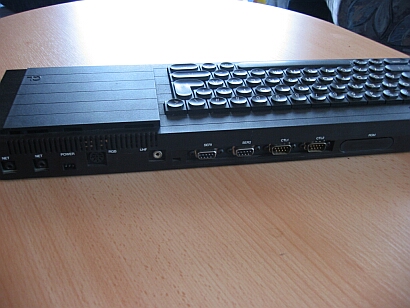
QDOS and SuperBASIC
However, the truly fascinating aspect of the QL lay in its software. With QDOS, Tony Tebby had written a preemptive multitasking operating system that was far ahead of its time. Running multiple programs simultaneously, switching between windows, and printing in the background while continuing to work in the foreground—in 1984, this was absolutely extraordinary for a home computer. Added to this was SuperBASIC by Jan Jones—a structured BASIC featuring named procedures, functions, and local variables, and free from the rigid requirement of line numbers. For anyone emerging from the "GOTO hell" of Spectrum BASIC, this felt like true liberation.
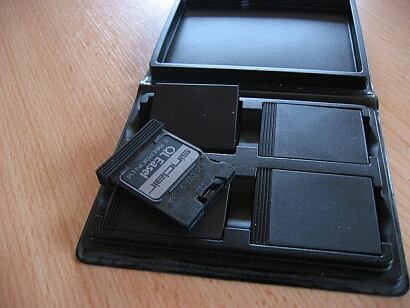
Also included was the famous Psion Suite on two Microdrive cartridges—four full-featured applications that later, in a slightly modified form, also made their way to the PC under the name *Psion Xchange*:
- Quill – Word Processing with True WYSIWYG Display
- Abacus – Spreadsheet
- Archives – Database with its own query language
- Easel – Business Graphics
It was precisely this package that captivated me back then. I gained my first experience with word processing and spreadsheets using it—long before such programs became the standard on the Atari ST or PC.
Microdrives – The Eternal Achilles' Heel
The two built-in Microdrives were intended as an affordable alternative to floppy disk drives. They consist of tiny continuous-loop tapes housed in plastic cartridges, capable of storing around 100 KB per cartridge—and, notably, they load significantly faster than a standard cassette. They were already familiar as a peripheral device for the ZX Spectrum; with the QL, however, they were now built directly into the system.
Theoretically, it was a nice idea. In practice, however, the Microdrives were the QL's Achilles' heel: sensitive to dust, increasingly unreliable with age, and—with their awkward 100 KB of storage capacity—hardly competitive against 720 KB floppy disks. Anyone wishing to work seriously with the QL could scarcely do without an external floppy interface.
The Personal Story
Warum ich damals meinen ZX Spectrum gegen einen QL eingetauscht habe, weiß ich heute leider nicht mehr genau. Vermutlich war es die Faszination für die mitgelieferte Bürosoftware und der Reiz, etwas „Richtiges“ mit dem Rechner anstellen zu können. Gekauft habe ich meinen QL bei einem kleinen Systemhaus in der Nähe meines Wohnorts.
Obtaining software for the QL in Germany was significantly more difficult than it was for the Spectrum. At the time, I subscribed to an English QL magazine just to get access to listings and news about the platform. I had to program much of it myself—which, in retrospect, was probably the main reason I learned more on that computer than I did on the Spectrum before it.
Nevertheless, my time with the QL was relatively brief: In the summer of 1987, upon graduating from school, I received my Atari 1040 STFM—and with that, the QL chapter came to a close for me, at least for the time being. In retrospect, the QL served as the link between the 8-bit world of the Spectrum and the 16/32-bit world of the ST.
A little trivia gem on the side
In 1987, a certain Linus Torvalds used his savings—supplemented by a loan from his father—to buy his very first computer: a Sinclair QL. On it, he first wrote his own editor and assembler, then a Pac-Man clone named *Cool Man*, and finally a driver for a floppy disk interface, as he found the included one to be too slow. In the process, he discovered several bugs in QDOS. A few years later, working on a 386 PC, he wrote the first lines of code for a project he would later name *Linux*. Without the QL, Linux would likely not exist in its current form.
Extensions – When the Community Takes Over
After Sinclair discontinued the QL in April 1986—having sold only around 150,000 units (Amstrad had acquired Sinclair and saw no remaining market)—a very active community took the helm. Foremost among them was the British company Miracle Systems, which kept the QL alive for more than a decade:
- The Trump Card provided 768 KB of additional memory (totaling 896 KB—exceeding the official 640 KB limit), a floppy interface, and Toolkit II on a single card connected to the expansion port.
- The Gold Card replaced the 68008 with a 16 MHz 68000, and added 2 MB of RAM, a floppy interface with support for DD, HD, and even ED disks, as well as a battery-buffered real-time clock—all without requiring any internal modification to the QL.
- The Super Gold Card capped it all off in 1993 with a 24 MHz 68020 processor, 4 MB of RAM, and a Centronics interface. With this, a QL suddenly became a thoroughly serious computer.
In addition, there were alternative operating system ROMs (Minerva, later SMSQ/E), hard drive interfaces, and even complete QL replicas housed in PC cases.
Sinclair QL Technical Specifications
| processor | Motorola 68008, 7,5 MHz (32 Bit intern, 8 Bit Datenbus) |
| Coprocessors | ZX8301, ZX8302 (ULAs), Intel 8049 (Tastatur/Sound) |
| RAM | 128 KB RAM, 32 KB VRAM, 48 KB ROM |
| Expandable | offiziell auf 640 KB, mit Trump Card auf 896 KB |
| Resolutions | 512 × 256 (4 Farben) / 256 × 256 (8 Farben) |
| Text Modes | 80 × 25 oder 40 × 25 Zeichen |
| Storage Units | 2 × interne Microdrives, ca. 100 KB pro Cartridge |
| Interfaces | 2 × RS-232, 2 × QLAN-Netzwerk, 2 × Joystick, Expansion Port, ROM-Cartridge, externe Microdrive-Erweiterung |
| Operating System | QDOS (Tony Tebby) mit SuperBASIC |
| Included Software | Psion Quill, Abacus, Archive, Easel |
| Year of publication | 12. Januar 1984 |
| Discontinued | April 1986 |
| Number of units sold | ca. 150.000 |
| Introductory price | £399 |
My copy today
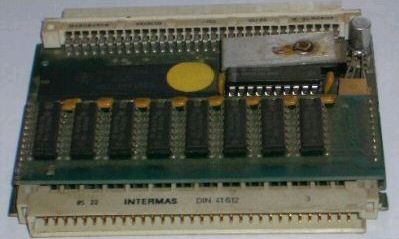
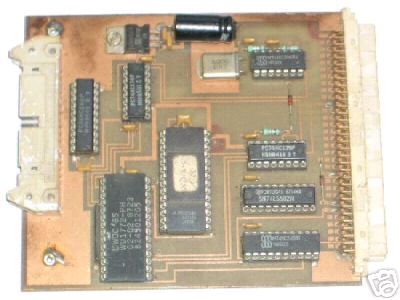
Gut erhaltene und vor allem „unverbastelte“ QLs sind inzwischen auf Ebay echte Mangelware geworden. Ich hatte vor einigen Jahren das Glück, ein solches Exemplar zu ersteigern. Dabei lag eine funktionierende 512 KB Memory Expansion für den Expansion Port mit durchgeschliffenem Bus.
During my first extensive test, I noticed that several individual keys were no longer responding. The cause was quickly identified: the keyboard membrane inside the QL—as was the case with so many Sinclair devices of that era—had become brittle over the years. Fortunately, new membranes are still available as reproduction parts, and replacing one is a manageable task if you have a little patience (see my separate repair article).
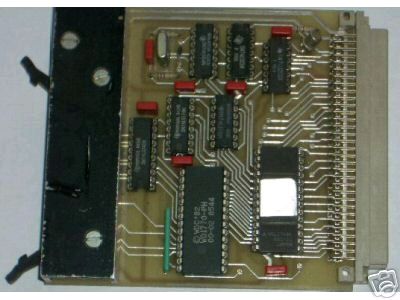
I have also now successfully got the two disk interfaces in the collection up and running—an *XDISK Wolf Computer V1.00* from 1987 and a *QDOS Disc Controller V1.16* from 1984. This was made possible by Ben from Belgium, who still builds compatible 3.5-inch dual-drive units for the QL, as well as Rich Mellor, whose assistance helped clarify exactly which drive was required. I have documented the details—including the most important QDOS disk commands and a neat trick for transferring PC software onto a QL diskette using QEmuLator—in a dedicated article on using disk drives with the QL.
Modern Extensions from the Community
What makes the QL particularly fascinating to me today is the small yet remarkably productive community that continues to develop new hardware for the machine. Over the past few years, I have added several of these expansions to my collection, presenting each one individually and in detail:
- QL-SD – an SD card interface by Peter Graf that finally liberates the QL from the straitjacket of Microdrive cartridges. With it, half of the world's entire QL software archive fits onto a single card.
- QubIDE – an AT/IDE hard drive interface, originally developed by Zeljko Nastasic in 1996 and distributed by Qubbesoft. It retrofits the QL into a proper workstation complete with a hard drive.
- Tetroid Disk Interface CF – a modern reproduction of a disk interface that additionally features a Compact Flash slot, thereby combining floppy and mass storage access in a single device.
- mICE —the Icon Controlled Environment by Eidersoft—was an early attempt in the mid-80s at an icon-based interface for the QL, stylistically closely resembling Digital Research's GEM. Today, a small adapter board even makes it possible to connect a USB mouse.
- QL-VGA – an FPGA-based adapter that converts the QL video signal into modern VGA. This finally allows the QL to be used with a modern monitor without any tinkering.
- QL Power Converter – a small but extremely useful adapter board that connects a modern standard power supply to the QL's completely non-standard, rectangular power port. Anyone still using an original power supply knows exactly why this item is a sound investment.
- QIMSI / QIMSI Gold – the scene's newest project, emerging out of nowhere in the autumn of 2023 and, once again, developed by Peter Graf. A modern interface that bundles several classic expansion functions onto a single compact circuit board.
Current Points of Contact
Nowadays, original accessories can be found almost exclusively through SellMyRetro in the UK. Those wishing to avoid the hassle of UK shipping and customs can find what they are looking for at the German Sintech-Shop, which also carries QL hardware in its inventory. However, the central international hub for all things QL is the discussion forum The QL Forum—it is where developers, collectors, and users exchange ideas, where new hardware projects are first announced, and where you can always find someone with tips for tricky repairs. For those who wish to experience a QL without the risks associated with aging original hardware, the Q68 offers a sophisticated, modern FPGA-based alternative—one that I have also added to my own collection.
![QL Modem [Sinclair QL]](https://www.jungsi.de/blog/wp-content/uploads/2015/02/QL-Modem-komplett.jpg)
![QubIDE [Sinclair QL]](https://www.jungsi.de/blog/wp-content/uploads/qubide.jpg)
Moin Jungsi,
nachdem ich in der Rhön auf den Geschmack gekommen bin, will ich mir eine RAM Erweiterung bauen. Du hast in deinem QL Artikel eine 512 K RAM Erweiterung erwähnt—– ist diese aus „diskreten“ Bausteilen gebaut, oder sind da GAL Chips o.ä. vorhanden?
Ich würde diese RAM Erweiterung gern nachbauen, hast du einen Schaltplan davon? Ich würde diesen auch erstellen wenn ich die Platine leihweise bekommen könnte?
Viele Grüße von Dieter