

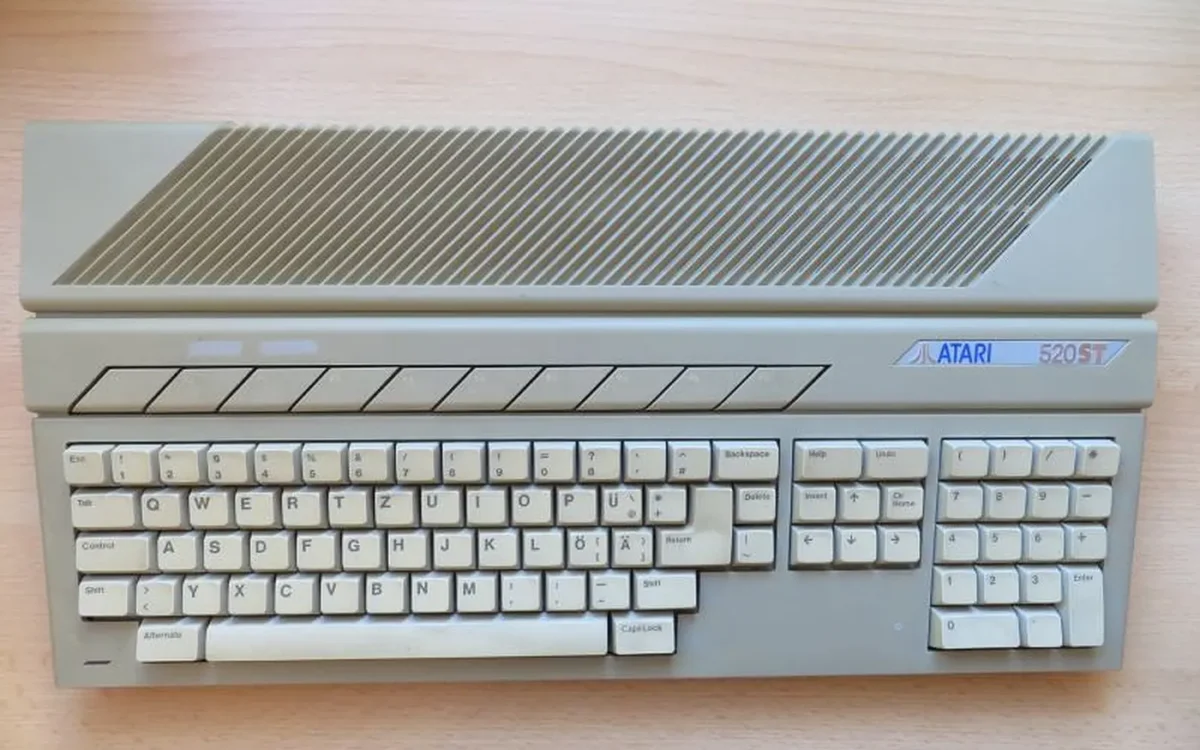
Atari 520 STM – an ST with a history of DIY tinkering
Alongside my 260 ST, the collection also includes a second small Atari, which has a story all of its own: an Atari 520 STM. The M in the name stands for Modulator – specifically, a built-in RF modulator that allowed the computer to be connected to a standard television via the aerial socket. It was a great solution for anyone who didn’t have a monitor. Otherwise, the STM is technically almost identical to the 520 ST – no internal floppy drive, an external power supply, and the same basic specifications.
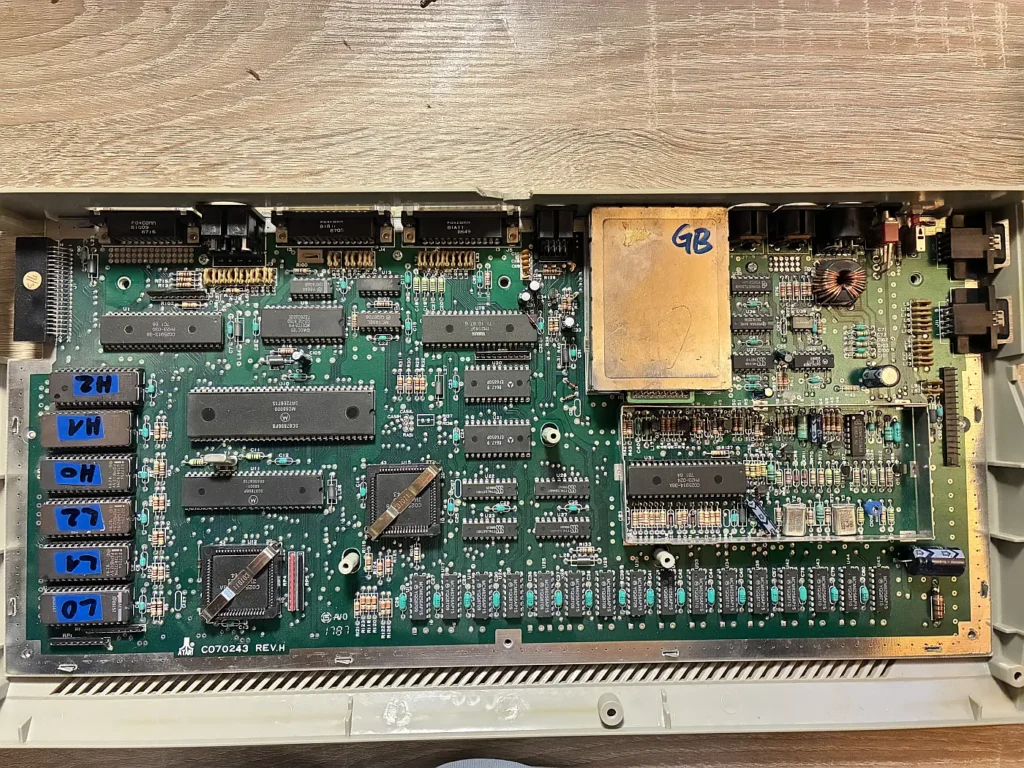
View of the circuit board
Upon opening it, a C070243 Rev. H comes into view – the latest revision of the small ST motherboard. The date code A/O 1787 is printed on the board, indicating calendar week 17 in 1987. As usual, the Motorola MC68000 running at 8 MHz sits in the centre, flanked by the Atari custom chips: Shifter, MMU and GLUE. Sound is once again provided by the Yamaha YM2149. In the top right-hand corner of the board, beneath a metal shield, sits the aforementioned RF modulator – the handwritten label ‘GB’ suggests that the unit was originally produced for the British market.
Main memory: 16 × MCM6256
Along the lower edge of the circuit board are 16 MCM6256AP15 memory chips from Motorola. These are classic 256-Kbit DRAMs (256 K × 1 bit) with an access time of 150 ns – exactly the standard configuration for the 520 STM. The date code YQQ8709, produced in calendar week 09/1987, ties in nicely with the board’s date of manufacture.
The 16 chips are a result of the architecture: the 68000 has a 16-bit data bus, so each chip provides a single bit of every 16-bit word. 16 chips × 256 K × 1 bit = 256 K × 16 bits = 512 KB of main memory, which is the standard configuration. No piggyback modifications, no SIMM adaptors, no tinkering with the RAM – all original, straight from the factory.
The exciting bit: homemade TOS EPROMs
Things get interesting on the left-hand side of the circuit board, where the TOS ROMs are located. Instead of the original Atari mask ROMs (part numbers C026xxx), there are six 27256-type EPROMs fitted into the sockets. They are labelled with blue adhesive tape and a felt-tip pen as H0, H1, H2 and L0, L1, L2 – the designators for the high and low bytes of the 16-bit data bus, each appearing three times to represent the three word positions of a complete TOS version.
The blue sticker serves a dual purpose: on the one hand, it provides labelling; on the other, it offers UV protection for the transparent quartz glass window on top of the EPROMs. Without this cover, the chips would be erased following prolonged exposure to UV light – a typical feature of genuine EPROMs that is not found in OTP versions or mask ROMs.
The chip manufacturers are a mixed bag: one is clearly identifiable as Intel D27256, another as National Semiconductor NB9152, whilst the rest also bear the designation D27256. The date codes on the EPROMs point to the year 1984. Someone has obviously helped themselves to components from their personal stash.
So what exactly is stored on the EPROMs? Most likely TOS 1.02 (“Mega-TOS”) or TOS 1.04 (“Rainbow TOS”) – both versions that originally fit onto 27256 chips in a 6-EPROM configuration. To find out exactly which ones, you would either need to check via Sysinfo or insert the EPROMs into a programmer.
Who would do something like that?
The answer is obvious: someone who wanted to update TOS to a newer version without buying the official Atari ROMs. Anyone who had access to an EPROM programmer in the late 80s or early 90s – and this was quite common in the hobbyist scene – could obtain the ROM images from various sources and burn them onto blank EPROMs. This saved a fair bit of money compared to the expensive original Atari ROMs.
The neat finish – consistent labelling, UV protection, neatly fitted into the bases – suggests that this was not the work of a novice. Perhaps a dedicated ST fan, perhaps someone from the Atari User Club scene of the late 1980s.
Conclusion
My 520 STM is basically a perfectly ordinary standard ST – with a small but neat extra feature. The original Atari ROMs went missing at some point and were replaced by a DIY solution using 27256 EPROMs. This allowed the previous owner to upgrade to a newer version of TOS without following the official Atari upgrade path.
From today’s perspective, it’s a lovely example of the craft tradition in action: what we now do with a few clicks in a browser emulator – switching between TOS versions – used to be a hands-on hardware task involving a soldering iron, an EPROM programmer and a bit of patience.


Leave a Reply