

![Atari Jaguar [Atari]](https://www.jungsi.de/blog/wp-content/uploads/Aari-Jaguar-mit-Controller.jpg)
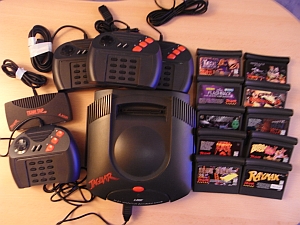
Finally, this gap at the end of my Atari collection has been closed as well. I was lucky enough to win a nice bundle on eBay at a reasonable price.
The bundle includes:
- Jaguar (NTSC-Version)
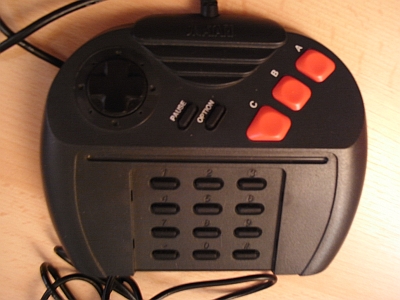
- 4 Jaguar Power Pad
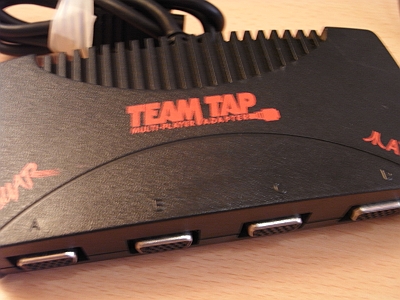
- Jaguar TeamTap
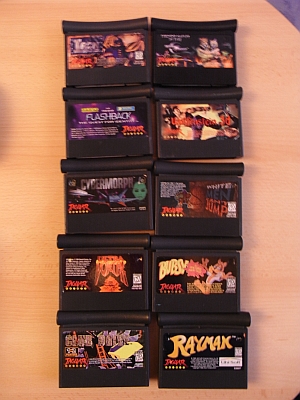
- 9 Spiele:
- Rayman
- Bubsy
- Club Drive
- Ultra Vortek
- White man can’t jump
- Cybermorph
- Flashback
- Wolfenstein 3d
- Trevor McFur in the Crescent Galaxy
- Iron Soldier
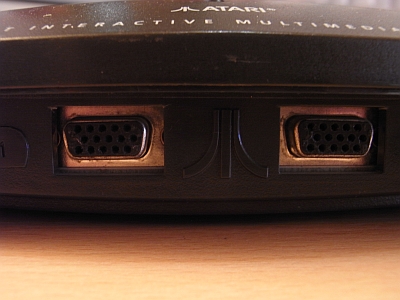
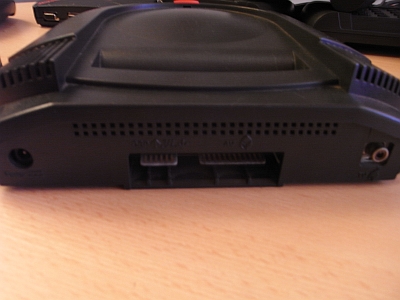
To complement this, I also picked up a suitable SCART cable from England. Cost: around 15 pounds – it produces a significantly better picture!
 |  |
Technische Details und Hintergrund
Ende 1992 wurde von Atari die neue Spielekonsole vorgestellt: das Jaguar 64-Bit Interactive Multimedia System. Zu diesem Zeitpunkt konkurrierte man direkt mit dem SEGA Mega Drive und dem Super Nintendo Entertainment System. Der Jaguar kam zu einem hervorragenden Preis – 250$ inkl. einem Spiel auf den Markt und war damit klar billiger als die Konkurrenz.
Die Geschichte begann aber noch ein paar Jahre früher – es wurde am Nachfolger des Atari 7800 gearbeitet – ein 32 Bit System – das dann den Übergang zum 64 Bit Jaguar bringen sollte. Die Arbeiten am Jaguar gingen aber schneller voran als beim 32 Bit System. Deshalb wurden die Arbeiten an dem „einfacheren“ System eingestellt.
Die Hauptbestandteile des Jaguar sind drei Prozessoren:
- TOM – responsible for graphics – consists of three processors: GPU, Object Processor, Blitter
- Jerry – responsible for sound – I/O functions and a DSP
- Motorola 68000 – it's responsible for controlling the other chips 🙂
Leider war das alles nicht sonderlich optimal aufgebaut und zum Teil äußerst schwer zu programmieren – daher gingen einige der Entwickler dazu über, die Spiele hauptsächlich rund um den 68000er zu programmieren, der eigentlich gar nicht dafür gedacht war. (siehe die mangelnde Qualität der Spiele „Club Drive“ und „Supercross 3D“)
Leider waren zum Release keine Spiele vorhanden, außer dem mit dem Gerät ausgelieferten „Cybermorph“. Die Auszeichnung als bestes neues System 1993 durch die Zeitschrift „Game Informer“ half auch nicht viel. Bedauerlicherweise erschienen die Spiele, die auf der Rückseite der Verpackung abgebildet waren, zum Teil erst ein Jahr später – wenn überhaupt.
Der Marketing -Super-GAU:
Werbespruch von Atari: „Wenn ihnen der Jaguar nicht den größten Spielspaß bereitet, bringen Sie es zurück und sie erhalten ihr Geld zurück.“ Wegen der fehlenden Spiele und der mangelnden Qualität der verfügbaren Spiele kann man sich vorstellen das tausende Jaguar zurückgegeben wurden.
Gebaut wurde der Jaguar übrigens in den USA von IBM. Die genauen Zahlen sind nicht bekannt – es dürften ca. 250.000 Stück gewesen sein.
Einige der besten Games für den Jaguar:
- Tempest 2000
- Iron Soldier
- Alien vs. Predator
- Rayman
Officially, over 100 games have been released. But there are still a few developers who continue to produce new games for the Jaguar (both on cartridge and on CD). Some Jaguars are still available in their original packaging - the prices are correspondingly high. The combination I got was actually okay in terms of price – although not super cheap :)
A suitable RGB cable for the Jaguar is very important, since the picture quality via the antenna output isn't really good 🙂
The successor was planned for 1996 – but never appeared, as Atari ran out of money and the merger with hard drive manufacturer JTS was imminent. The Jaguar 2 was intended as competition for the PlayStation 1 and Nintendo 64.
 |  |
Jaguar CD
Der CD-Aufsatz für den Jaguar erschien 1993 für knapp 150$. Das Laufwerk ist ein Double-Speed Laufwerk, die CD’s haben eine Kapazität von 790 MB und basieren auf dem Format der Audio CD. Philipps hat das Laufwerk in Amerika gebaut. Die erste Auflage davon waren ca. 20.000 Stück. Dies dürften auch alle produzierten Laufwerke sein. Aufgrund der Besonderheiten der Einheit gibt es leider keine Möglichkeit diese Laufwerke heute nachzubauen. Daher sind sie – wenn überhaupt – nur für mehrere hundert Euro erhältlich.
 |  |
PAL/NTSC und 50/60 Hz
Die Cartridges des Jaguar hatten keine regionale Unterscheidung – konnten also auf jeder Konsole eingesetzt werden. Kleine Unterschiede zwischen PAL und NTSC-Geräten gab es trotzdem:
– der Schalter neben dem Antennenausgang ist ein Zeichen für ein NTSC-Gerät (Umschaltet zwischen Kanal 3 und vier)
– bei der US-Version leuchtet die Power LED rot und bei der anderen Version grün
– wird der Bildschirm mit Balken angezeigt, ist es die PAL-Version – bei Vollbild die NTSC Version
Alle die eine PAL-Konsole besitzen würde ich die einfach durchzuführende Umrüstung auf 60Hz durchzuführen. Dabei muss nur eine Leitung durchtrennt werden (Videos dazu gibt es auf Youtube).
Link zum 50/60 Hz-Umbau
Bei meiner Konsole wurde das bereits durchgeführt, zusammen mit einem nach außen geführten Schalter
Bei den Spielen stellt „Dragon´s Lair“ die Ausnahme dar und benötigte einen NTSC/60 Hz Jaguar. Dazu läuft Space Ace zwar auf einem 50Hz Gerät, soll aber dann Timingprobleme haben
Zu dem Thema 50/60 Hz habe ich folgende interessante Beschreibung gefunden:
Hier die Übersetzung:
Certain games are so improved at 60 Hz that the higher speed makes them feel like a completely different experience. Games like Doom and Wolfenstein are examples of this. Doom in particular moves so much more smoothly than the 50 Hz version that it's actually quite impressive. Super Burnout also feels a bit faster… if that's even possible. There doesn't seem to be a specific rule here – some games benefit massively from the switch to 60 Hz, while others don't. AvP is one example… unfortunately, the only difference on screen is the enlarged display area. That probably has more to do with the actual game engine than with the console's frequency.
By the way: Atari's original developer software for the Jaguar ran on the Falcon/TT
Accessories
- ProController – available from 1995. Thinner and smaller—and thus easier to handle—than the standard pad. It also features a few additional buttons.
- PowerPad – just like the StandardPad, but in gray/blue instead of black/red (matching the design of the Atari Falcon).
- Note: There are some games for the Atari Falcon that support the Jaguar controller.
- JagLink – connect multiple Jaguars and play against each other (e.g., DOOM)
- TeamTap – die Controller-Schnittstellen werden vervierfacht – zwei TeamTap können angeschlossen werden – somit kann man bis zu acht Controller anschließen (z.B. bei White Man Can’t Jump und „NBA Jam Tournament Edition“)
- Jaguar Modem – never released – was intended for connecting to the Internet. (Supported by Ultra Vortek).
- ICD CatBox – manufactured by ICD, not Atari. It expanded the Jaguar with inputs and outputs for composite video, S-Video, RGB, stereo and mono audio, two headphone jacks, RS232 and RJ11 communication ports, and a DSP port.
Community
– Atari Age (englisch)
– Nexgame (deusch)
![Another World [Atari Jaguar]](https://www.jungsi.de/blog/wp-content/uploads/another-world-komplett.jpg)
![Treasure Island Dizzy [Atari Jaguar]](https://www.jungsi.de/blog/wp-content/uploads/Treasure-Island-Dizzy-Vorderseite.jpg)
![JHL15 [Atari Jaguar]](https://www.jungsi.de/blog/wp-content/uploads/jhl15-cartridge.jpg)
Nett, damit hatte ich nie Berührung, ein paar Videos wären schön 🙂
Ansonsten wünsche ich Dir ein gesundes und erfolgreiches 2014!
Bitte mache weiter so, Deine Seite gefällt mir sehr gut!