

![Commodore 1084 [Commodore]](https://www.jungsi.de/blog/wp-content/uploads/1084-Vorderansicht-1.jpg)
Purely by chance, I managed to acquire a Commodore 1084 monitor at a bargain price. Since the device enjoys a truly excellent reputation, I was, naturally, delighted. The monitor was released in 1987 and was available in various different versions.
The 1084’s design is based on the Philips CM8833 monitor—the P-variants were manufactured by Philips, while the D-variants were produced by Daewoo. Depending on the specific variant, picture tubes from various manufacturers were installed, including Orion, Toshiba, Hitachi, and Samsung. Here is a brief overview of what I have discovered regarding the individual models. Should any attentive readers have comments or corrections, I would be delighted to hear them. When the monitor was first released, it likely cost approximately 800 DM.
1084 (Old Version)
– featuring only a single speaker – also available without a SCART connector. 1084-P (newer version) – one speaker – round RGB port.
-> Features a digital RGB input (RGBI/TTL) for the C128's 80-column mode—a feature that is partially absent in the later 1084-S variants. -> CVBS and Y/C (Luma/Chroma) are provided via RCA jacks, while digital RGB is provided via a round DIN connector.
1084S – with two speakers (S = Stereo)
There are at least six distinct variants of the 1084-S: the 1084S-P, 1084S-P1, 1084S-P2, 1084S-D1, 1084S-D2, and 1084ST. These differ in that some no longer feature digital RGB connectivity. Furthermore, the connectors for analog RGB are implemented in two different styles: either as a round DIN socket or as a SUB-D socket. Additionally—depending on the specific variant—controls such as switches (including the power switch) may be located on the front or on the rear of the unit. The picture tubes themselves are sourced from different manufacturers depending on the variant (P = Philips-based; D = Daewoo). The P1 and D1 models still support RGBI (digital TTL RGB), whereas the P2 and D2 models do not.
A practical tip for identification: on Philips variants, the power LED is located directly within the on/off switch, whereas on Daewoo variants, it is situated above the switch.
The 1085S, by contrast, is a more budget-friendly variant of the 1084—featuring two speakers, but with a coarser dot pitch (0.52 mm compared to the 0.42 mm of the 1084/1084S) and lacking an anti-reflective coating. While it is indeed compatible with various computers, it delivers a noticeably less sharp image—so you are better off avoiding it if you have the choice.
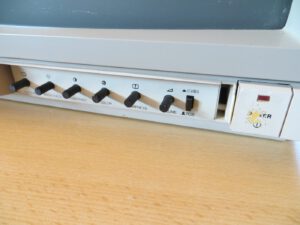
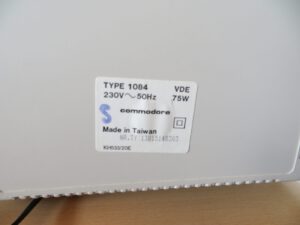
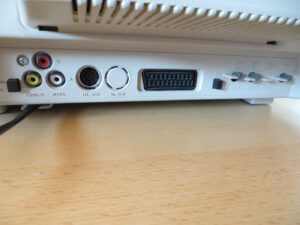
The monitor I received is a 1084 housed in the older-style casing, featuring SCART, Composite (RCA—via a red jack), TTL-RGB (DIN connector), CVBS, and mono audio (RCA).
As it turned out (confirmed in part by the cables included with the unit), it is ideally suited for use with systems such as the Commodore 128. One of the cables features a D-sub connector (for the C128) at one end and an 8-pin DIN connector at the other; this connection is designed for the C128's 80-column mode. The second cable also features a DIN connector at one end (connecting to the C128's monitor port) and three RCA plugs at the other—one for color (Chroma), one for brightness (Luma), and one for audio—connecting to the 1084's CVBS input, making it suitable for the C128's 40-column mode.
Naturally, the Amiga can also be connected via SCART. This is not quite ideal, however, as this particular 1084 model outputs only mono audio—in this case, the 1084S, with its stereo speakers, would be the better choice. The Atari ST, too, delivers a very good picture via SCART in both of its color resolutions.
Known Vulnerabilities
Anyone purchasing or restoring a 1084 should keep an eye out for a few common trouble spots: the hinged cover for the front-panel controls is broken off on many units. Solder joints at the connector jacks can fracture over time, leading to color loss—resoldering provides a fix. The power switch may also suffer from intermittent failure. For units equipped with "Taicon" brand capacitors, replacement is recommended, as these types are prone to a higher-than-average failure rate.
Hallo, hätte eine Fragen zu zwei Commodore Amiga Monitoren. Worin besteht der Unterschied zwischen Commodore 1084S-P und Commodore 1084s-P1??? Beide Stereo, welcher ist besser? Der P1 ist neuer odere?
LG Constantin
Hallo,
ja, der P1 ist neuer und minimal besser. Er ist etwas komfortabler ausgestattet – Kopfhöreranschluss und je nach Variante einen Scart-Eingang.
Das Gehäuse ist etwas kompakter, sonst gibt es aber kaum einen Unterschied.
LG Jungsi