

![BSS01 [VEB Frankfurt/Oder]](https://www.jungsi.de/blog/wp-content/uploads/BSS01.jpg)
The BSS01, also known as Bildschirmspiel 01, is a new addition to my collection of Pong consoles. This device is anything but "normal", as one might assume, and is also known as TV-Spiel or RFT TV-Spiel (RFT stands for Rundfunk- und Fernmeldetechnik, or broadcasting and telecommunications technology).
The history of this device is quite adventurous, although some parts of it cannot be 100% confirmed. Despite the simple technology used, the device is absolutely unique.
In the 1970s, game consoles became an important leisure activity in the USA and Europe. In the East, however, these devices were practically non-existent, mainly due to the lag in microelectronics. In order to introduce the population to digital technology, the GDR's Ministry of Electrical Engineering and Electronics decided in 1977 to produce a "screen game device".
Between 1980 and 1984, VEB Halbleiterwerk Frankfurt an der Oder, part of the Mikroelektronik Erfurt combine, produced the BSS01 in the former GDR. This company and its workforce specialised in the manufacture of integrated circuits for industry in the GDR and the Council for Mutual Economic Assistance (CMEA).
The decision to produce the GDR’s only games console was probably taken in 1976/1977 and was made by the government of the time, represented by State Secretary Karl Nendel. At the start of the project, the use of TTL chips – which were also manufacturable – was considered, but the idea was quickly abandoned due to the high number of 40–50 chips required per console. Similarly, replicating the existing chips (AY-3-8500-7) from General Instruments (USA) was ruled out. Ultimately, it was decided to import the necessary chips from the West.
The procurement of the chips has its own legendary history. One such legend claims that chips were brought from the USA to West Germany and hidden in concrete blocks, which were then imported into the GDR to conceal them from border guards and Western intelligence services.
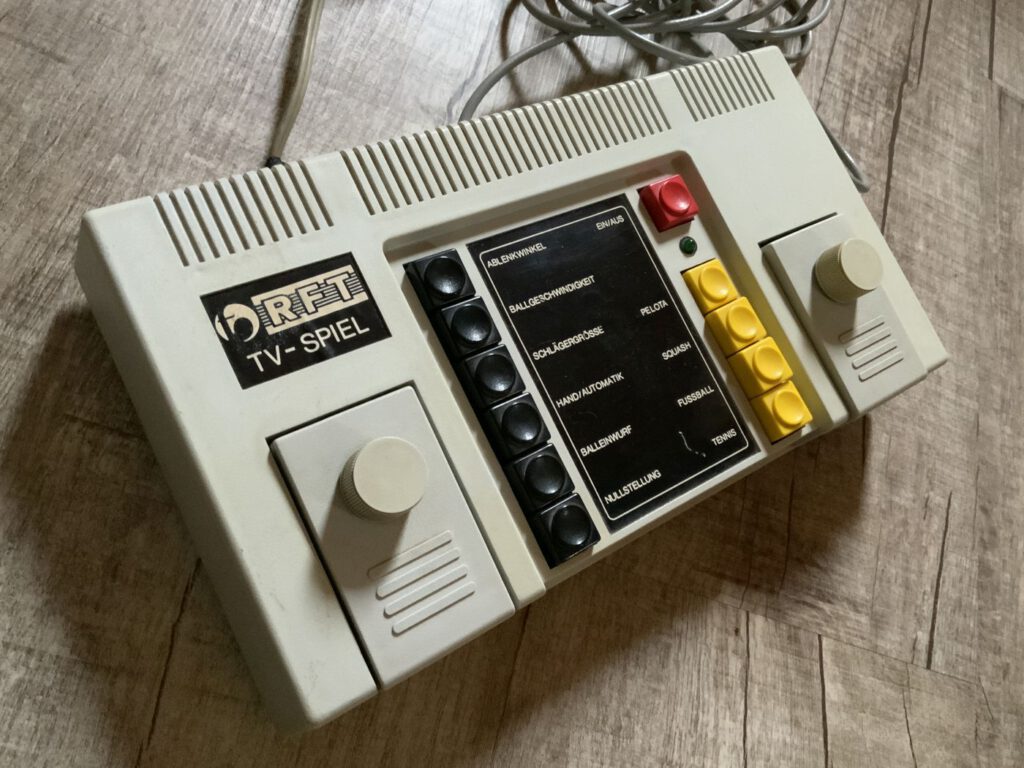
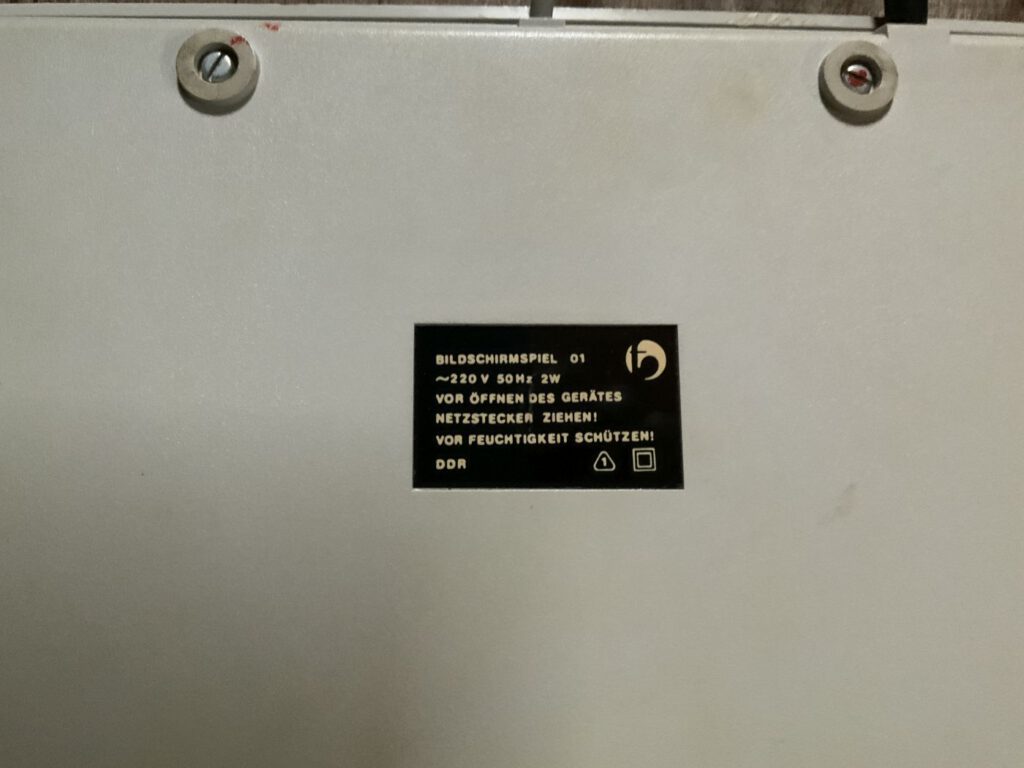
When the device was finally produced between 1980 and 1984, with an estimated production run of around 1,000 units, it was too expensive for private households – 550 East German marks was equivalent to half a month’s salary. As a result, it was more commonly found in youth clubs and public institutions. According to estimates, around 500 units of the various variants still exist today. These variants arose due to the shortage of materials at the time, and whatever was available was used – here are a few examples of the possible combinations:
- black, with coloured buttons and black controller
- black, with coloured buttons and white controller
- weiß, mit farbigen Knöpfen und schwarzem Controller
- white, with coloured buttons and white controller
There are estimates of the number of consoles still in existence, and it appears that the almost completely white consoles (with white casing and white controllers) are the rarest. Each console was given a "serial number" (also known as an insert number), which was located under the right-hand controller. Unfortunately, my white console has "lost" this number. There are reports that devices with identical numbers have turned up, which may be due to these numbers being "lost" during production and the subsequent number being skipped. For example, if there are two number 523s, there is no number 524. There is also a rumour that 3,000 chips were imported instead of 1,000, but what happened to these chips remains a mystery. Production of the BSS01 was discontinued in favour of manufacturing more radio alarm clocks, although rumours suggest that a successor, the BSS02, was in the works.
The BSS01 was quite simple to operate: two control pads equipped with rotary knobs allowed players to move the "rackets" vertically on the screen to hit the ball. The ball could be put into play automatically or manually. The game ended after 15 points had been scored.
The following games were available and could be selected using the buttons on the right-hand side
– Tennis: classic Pong
– Football: each player has two rackets – one on each wall
– Squash: both players play against the same wall
– Pelota: squash for one player
If no button is pressed, football with handicap starts: The left player has two rackets, the right player has three. The other two games on the chip are not used, as they are designed for use with a light gun. In 1982, instructions were published on how to modify the console to use the two games, as well as instructions for building a light gun. It was also possible to modify the console so that you could play against it on your own.
Apart from the circuit board imported from the West, there was not much technology to be found inside – the power supply, HF modulator and loudspeaker were the rest.
The interesting thing about this console is mainly its origin and the stories surrounding it, otherwise it would have been forgotten like many of the other Pong consoles, of which there were numerous different variants.
Das Halbleiterwerk Frankfurt/Oder war nicht in erster Linie Produzent von Radioweckern sondern von integrierten Schaltkreisen für die DDR – Industrie und den RGW (Rat für Gegenseitige Wirtschaftshilfe). Radiowecker, Bildschirmspiele oder ähnliches wurden im Rahmen der von der Partei geforderten Konsumgüterproduktion hergestellt, die die meisten Industriebetriebe zu leisten hatten.
siehe auch: https://de.wikipedia.org/wiki/Bildschirmspiel_01
VG Ingo.
Hallo Ingo,
vielen Dank für den Hinweis. Auch wenn man lange recherchiert, können sich Fehler einschleichen, auch wenn dieser vermeidbar gewesen wäre. Ich habe die Korrktur in den Text „eingebaut“.
Hattest Du damals auch ein BSS01 oder gar den Arcade-Automaten?
Viele Grüße
Jungsi
Hallo Jungsi, nein als Student wäre mir das BSS01 zu teuer gewesen. Ich hatte das Glück, daß meine Schwester mir von einem Ungarnurlaub einen AY3-8500 und die passende Applikationsschaltung (als Thermokopie) mitgebracht hat. Im Internat beim Studium habe dann darum eine eigene Pong-Konsole aufgebaut. Die Paddles waren Srifendosen mit eingebauten Potentiometern. Entsprechend einer Veröffentlichung habe ich das Gerät auf 4 Spieler erweitert, indem sowohl die Paddles-Eingänge als auch die Spielerausgänge von Zeile zu Zeile alternierend gemultiplext wurden. Auch eine (ausgeweidete) Wasserpistole mit Fototransistor und Mikrotaster zum Auslösen habe ich dazugebaut, so daß auch das „Schießen“ auf das Kästchen auf dem Bildschirm funktionierte (sehr kontrastreich eingestellter Röhrenfernseher). Dann haben wir in der Studentenbude bends beim Bierchen gedaddelt.
Diese Konsole habe ich noch und sie funktioniert heute noch.
Viele Grüße Ingo.
Hallo Sammlerkollegen,
die BSS01 ist etwas ganz besonderes, vor allem wegen ihrer Geschichte. Ich beschäftige mich schon seit fast vier Jahren mit ihr. Und man entdeckt immer wieder neue Geschichten um diese Legändere Konsole
Thomas
P.S : Ich besitze insgesamt 31 ! ! ! ! Stück
Hallo Thomas,
freut mich sehr, dass Du Dich hier zu Wort meldest. Ich habe Deine YouTube-Videos zur BSS01 ausführlich studiert und fand sie sehr informativ.
Viele Grüße
Jungsi
Als jemand, der an Technologie und Geschichte interessiert ist, finde ich es spannend, mehr über das BSS01 [VEB Halbleiterwerk Frankfurt an der Oder] zu erfahren. Dieses Werk spielte eine wichtige Rolle in der DDR-Zeit bei der Produktion von Halbleiterbauelementen und trug zur Entwicklung der Elektronikindustrie in der Region bei.
Ich fand das Thema sehr spannend bei der Recherche. Ich würde mich freuen, wenn sich ein Mitarbeiter finden würde, der damals bei der Produktion mit dabei war.