

![Atari 260ST [Atari]](https://www.jungsi.de/blog/wp-content/uploads/2014/05/Atari-260ST-frontal.jpg)
Atari 260ST – a surprising stroke of luck
Some finds just fall right into your lap. Years ago, I stumbled upon an Atari 260 ST at a small flea market—two keys were broken off, but otherwise it was complete: power supply, keyboard dust cover, everything included. Price: 5 euros. Naturally, I had to snap it up.
An initial inspection revealed that the unit was in its original condition. I was able to decipher the production date—11/1985—on the underside. The 260ST’s case is somewhat slimmer than that of the later 1040ST, as the 260 model does not yet contain an internal floppy disk drive. When connected to an external drive, the computer booted up without a hitch. Sysinfo reported TOS 1.00 and a full 1 MB of RAM.
The business with the name
The model designations of the early ST series still cause confusion today. A brief overview:
- 130 ST: The first announced variant, featuring 128 KB of RAM. It was dropped from the product lineup in April 1985 without a replacement—there was simply nothing useful to be done with so little memory and TOS loaded into RAM.
- 260 ST: originally planned as a budget version with 256 KB of RAM. However, due to rapidly falling memory prices, the unit ended up with 512 KB—yet the name remained.
- 520 ST: technically virtually identical to the 260 ST. The crucial difference lay not in the memory, but in the operating system: the 520 model had TOS hard-coded into ROM chips, whereas the 260 did not.
So, anyone who received a 260 ST generally had to load TOS from a floppy disk—thereby losing around 192 KB of RAM. The ROM chips could be retrofitted for about 98 DM, as the sockets were already present on the circuit board.

View of the circuit board
A look inside is revealing. The motherboard bears the Atari model designation C070243 Rev. C—the standard layout for the 260 ST, 520 ST, and 520 ST+. Dominating the center is the Motorola MC68000 running at 8 MHz, flanked by Atari’s signature custom chips: Shifter, MMU, and GLUE. Sound is provided by the reliable Yamaha YM2149, a chip also found in the MSX and many other home computers of that era.
Links am Rand sitzen die sechs TOS-Bausteine mit den Atari-Teilenummern C026302 bis C026307 – die kompletten 192 KB von TOS 1.00 in ROM-Form. Bei genauerem Hinsehen fällt am rechten Platinenrand auch eine Speichererweiterung auf 1 MB auf, vermutlich nach der bewährten „Huckepack“-Methode: zusätzliche Bausteine auf die regulären RAM-Chips aufgelötet, einzelne Pins frei nach oben verdrahtet.
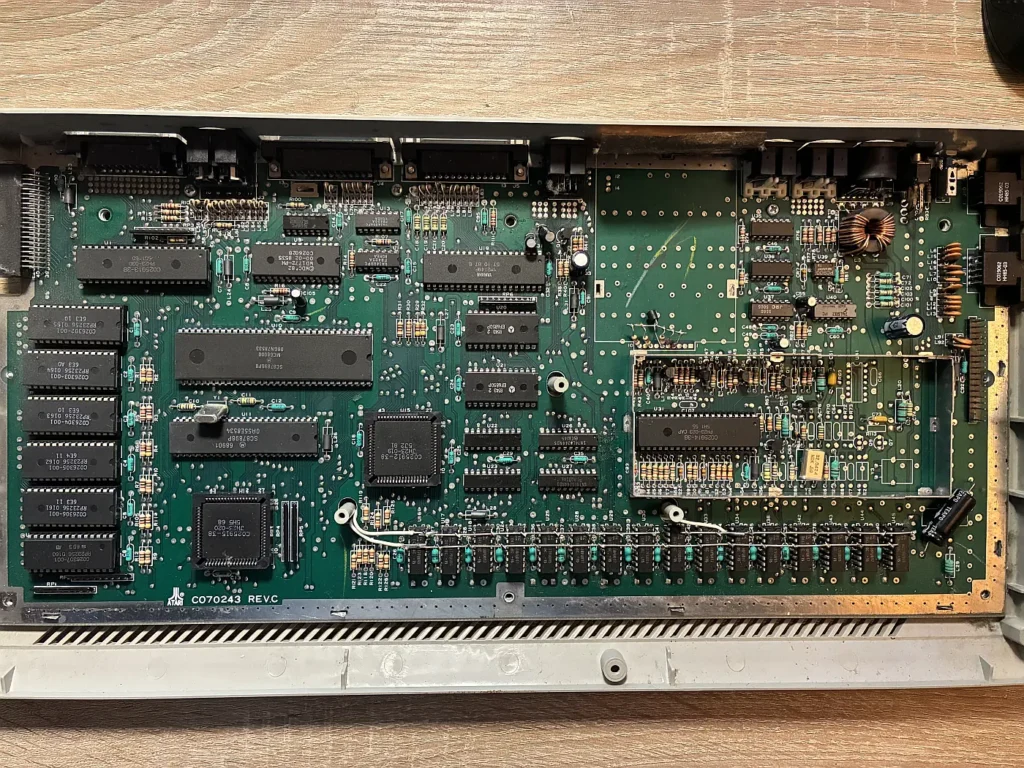
The Probable Story
That is likely the very story behind this machine: a **260 ST originally shipped with just 512 KB of RAM and the two boot ROMs**—which later underwent the classic Atari upgrade process at a dealer. Atari offered TOS ROMs for retrofitting at a cost of around 98 DM, and the memory upgrade to 1 MB via the "piggyback" method was also officially sanctioned; dealers performed this in the exact same way Atari did at the factory for the 520 ST+. Consequently, a fully upgraded 260 ST was technically indistinguishable from a 520 ST+. It was a worthwhile proposition for the buyer back then—and for me today, it represents a wonderful piece of upgrade history.
Original scope of delivery
The 260 ST was normally supplied with the external SF354 3.5-inch floppy disk drive—offering a capacity of 360 KB per disk. It was not until the 1040 ST and Mega ST models that the drive was integrated into the main casing.
Übrigens kein Zufall, dass die erste ST-Generation mit externem Netzteil und externer Floppy daherkam: In den USA waren Einzelgeräte einfacher zuzulassen als integrierte Maschinen. Laut Atari sparte das ganze sechs Monate – genau der Vorsprung, der den „Jackintosh“ ein halbes Jahr vor dem Commodore Amiga auf den Markt brachte.
Conclusion
Five euros, a piece of computer history, and a personal little anecdote about the model strategy of the Tramiel era. What more could you ask for? Now it’s time to test programs and games and see what the little ST can do.
![MonSTer [Atari ST]](https://www.jungsi.de/blog/wp-content/uploads/atari-st-monster.jpg)
![GigaFile [Atari ST]](https://www.jungsi.de/blog/wp-content/uploads/2013/01/GigaFile-am-1040STE1.jpg)
![Laserball 2014 [Atari ST]](https://www.jungsi.de/blog/wp-content/uploads/2014/10/Laserball-2014-Ladescreen.jpg)
Hallo,
Ich stolperte auf der suche nach SCSI/ACSI information auf deine webseite. Mein erster Atari ST war auch ein 260ST, wurde damals geliefert mit ein einseitiges diskettenlaufwerk (also 360kB). Die speicherausstattung war 512 kByte wie beim 520ST
Grusz,
Gert