

![Sanwa 9012 [Sanwa]](https://www.jungsi.de/blog/wp-content/uploads/Sanwa-9012-Verpackung-Vorderseite.jpg)
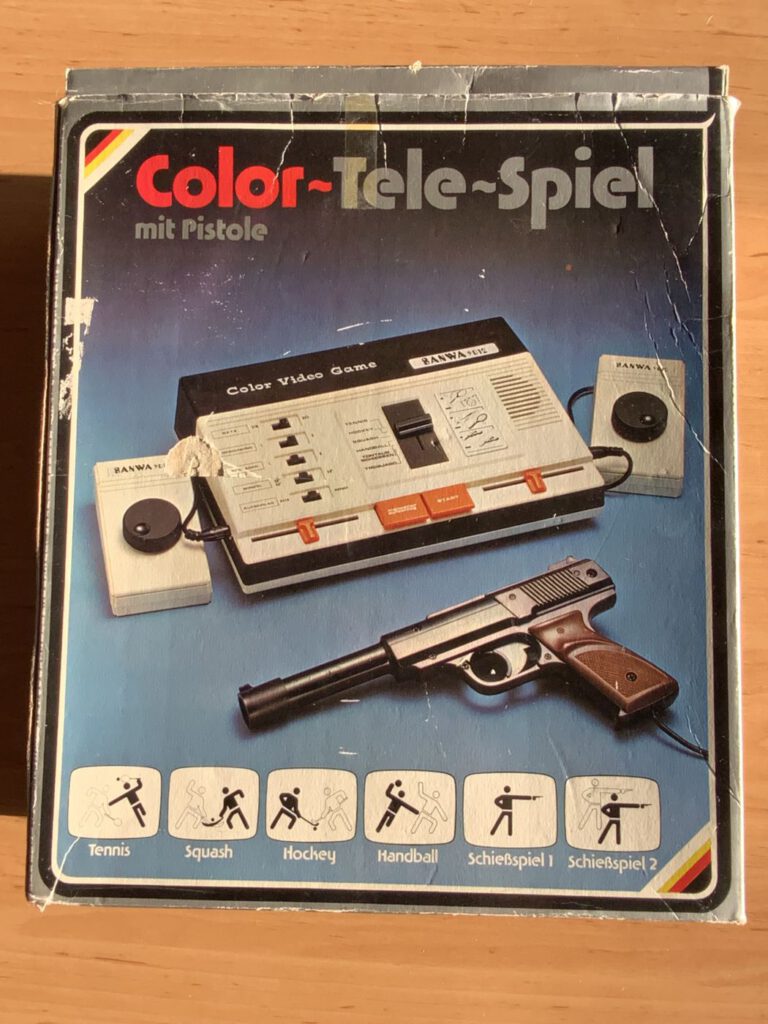
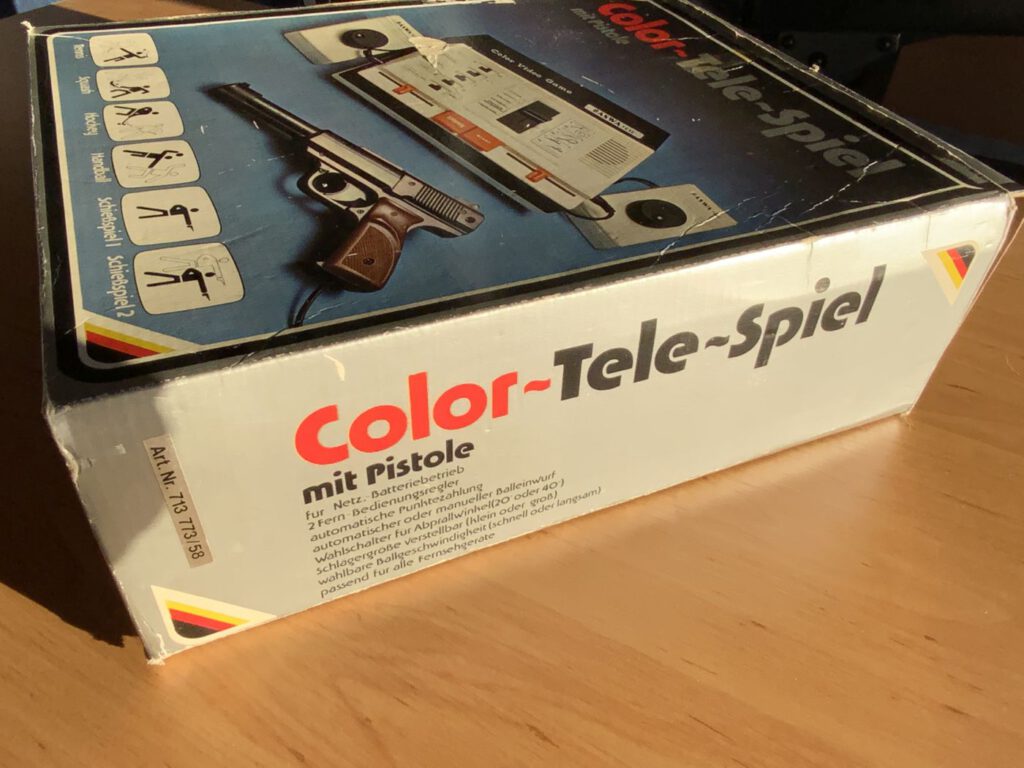
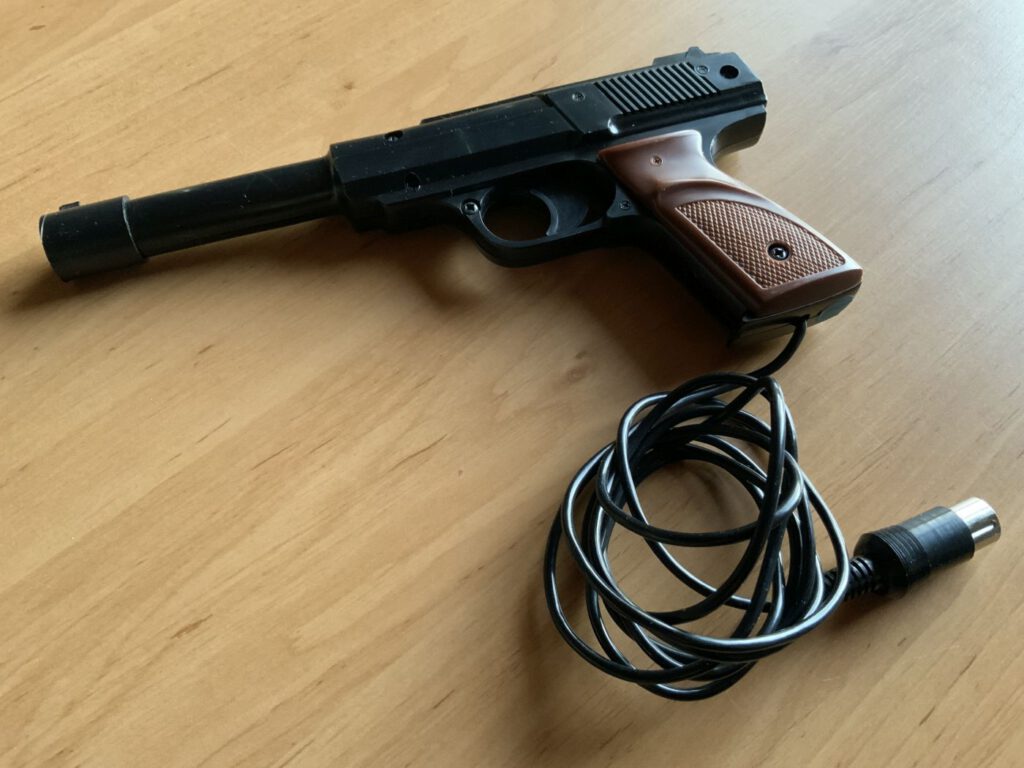
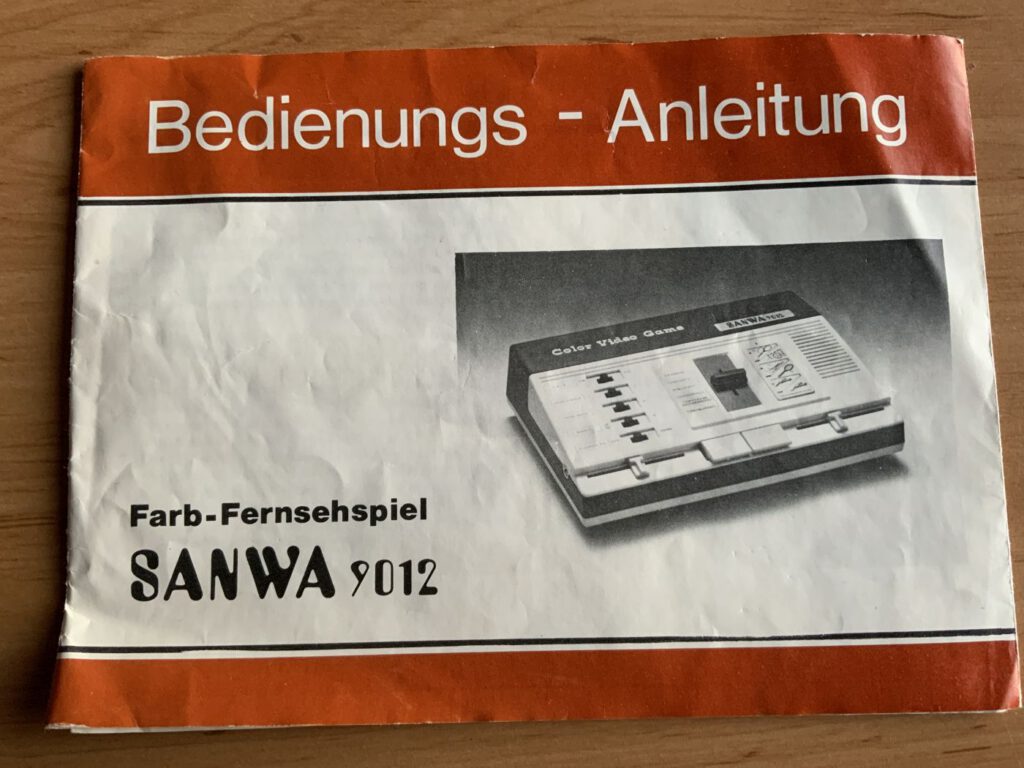
I bought the “Colour Tele Game with Gun”, or rather the Sanwa 9012, on eBay, which allowed me to expand my small collection of Pong consoles a little. The unit arrived in excellent condition, including the packaging (without the polystyrene) and instructions, and was well packed. The manufacturer Sanwa is not mentioned on the German packaging, but only on the unit itself. Six games are listed on the front of the packaging, and various settings are shown on the side of the box.
The device
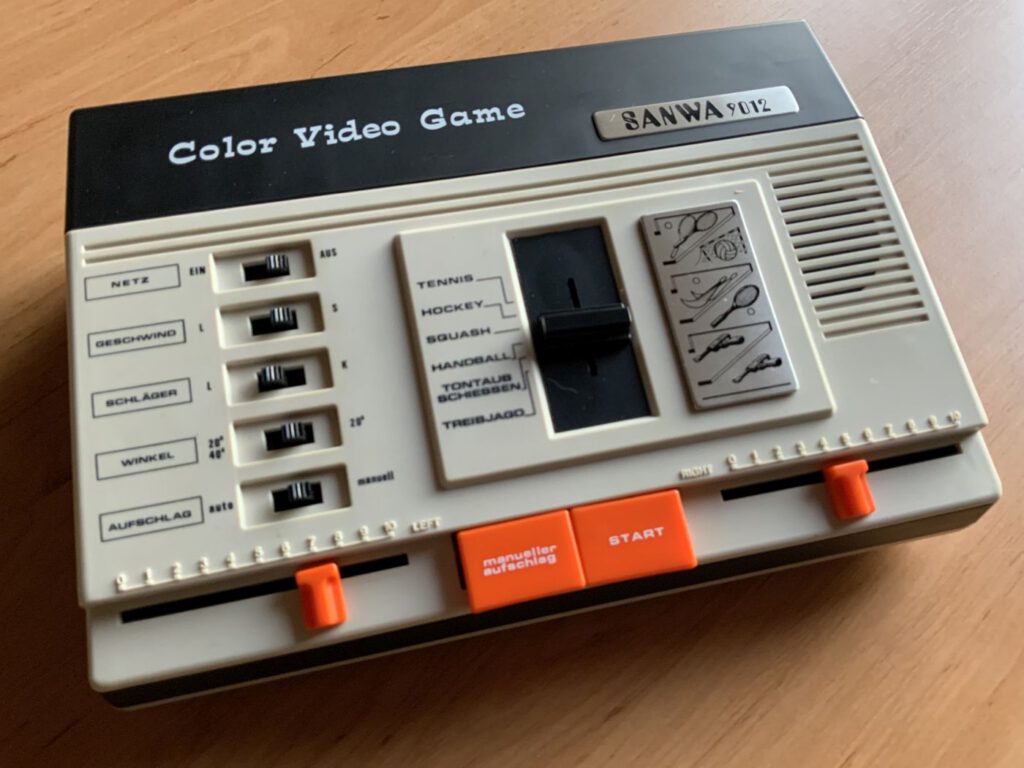
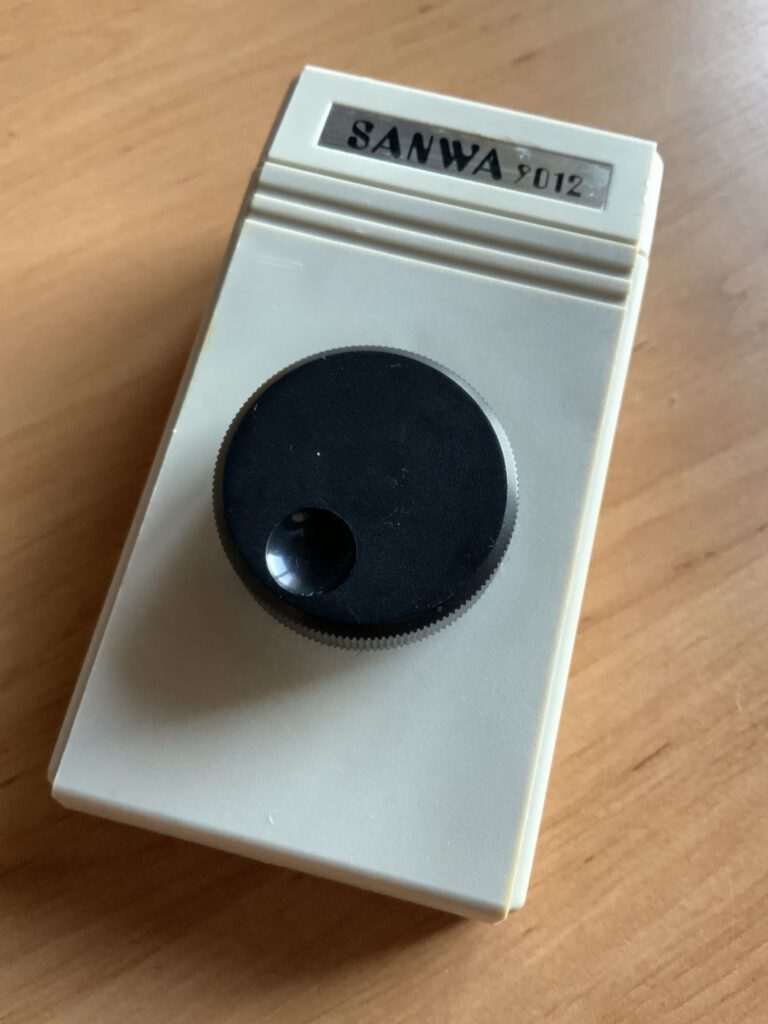
The small controllers with rotary knobs are connected to the left and right sides of the console, with the cables themselves able to be tucked away on the underside of the controllers. The same solution has been applied to the antenna cable used to connect to the console – a practical feature, although in practice it is likely to be consistently ignored by most children. The console can be powered either by a mains adapter (9 volts/100 mA) or by six batteries.
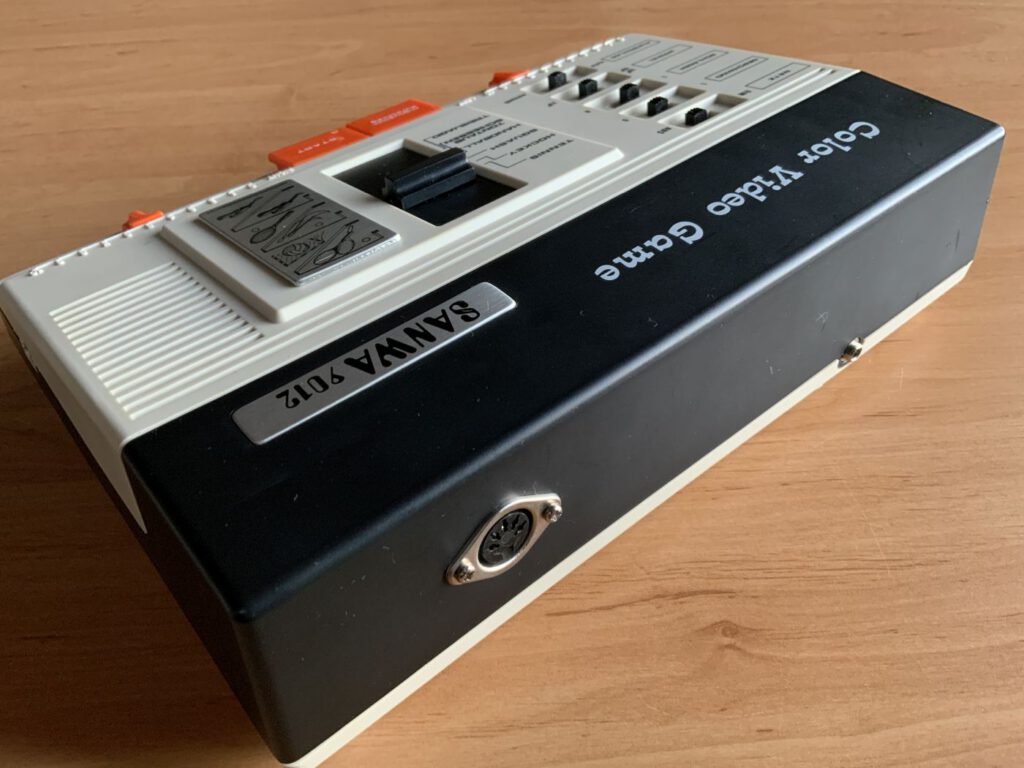
The controls for the various game settings are located on the top panel: net height, game speed, angle, racket length and serve. The power supply socket and a 5-pin DIN connector for the light gun are located on the back.
The games
The device offers six games: tennis, squash, handball, hockey, as well as clay pigeon shooting and a hunt for the light gun. The four ball games are designed for two players, whilst the shooting games are, naturally, for one player only. The latter require an old CRT television – they do not work on a modern TFT or LCD screen. This is due to the way the light gun works: it detects the brief flash of light produced by the electron beam as it passes over the target area. Flat-screen displays work differently and do not produce this effect.
If you want to use the device with a modern television, you basically have two options: either an RF-to-HDMI converter with a freely adjustable VHF range, or an AV module integrated directly onto the chip – the latter requires some soldering experience, but delivers a clean composite signal.
Technique and classification
The Sanwa 9012 is powered by an AY-3-8500 from General Instruments – nicknamed “Ball & Paddle”, and sometimes referred to as “Pong in a Chip”. Produced from 1976 onwards, this chip contains all the necessary components for running up to six ball-and-paddle games: controller polling, game mechanics, and sound and image generation. Additional external circuitry is required for the two shooting games, as the AY-3-8500 alone does not support light gun control.
The Sanwa 9012 is a first-generation console: all the game logic is hard-wired into the device; there is no processor in the strict sense, no removable storage medium, and no RAM or ROM. Incidentally, this also applies to its successor, the Sanwa 9015, which, although it has a cartridge slot, technically also belongs to the first generation – because there, too, the entire logic is contained within the cartridge itself, in the form of an AY-3-8xxx chip from General Instruments. The second generation of consoles only began with true microprocessors, i.e. with devices such as the Fairchild Channel F (1976) or the Atari 2600 (1977).
Variants and clones
The Sanwa 9012 appears under various names. Sanwa was a German distributor – the unit was manufactured in Hong Kong. Identical versions are available under the names Poppy 9012, Mustang, R10 and A10, some in different casing colours. A visually striking black variant comes from the manufacturer R10.
Zeitgeist
The Sanwa 9012 was released in 1977 – the very year in which the ‘Telespiele’ era reached its peak in Germany. Over 200 different consoles were built around the AY-3-8500 chip alone, which powered virtually every device of this kind at the time. The SWF television programme “Telespiele”, featuring a then largely unknown Thomas Gottschalk, which was broadcast from 1977 onwards, also contributed to the popularity of Pong consoles in Germany: viewers controlled a Pong game via telephone calls and could win prizes in the process. There is no longer any reliable record of what a device like the Sanwa 9012 cost in shops at the time – however, comparable consoles in this price range cost between around 80 and 120 DM, depending on the retailer.
![Prinztronic Videosport 800-Colour [Prinztronic]](https://www.jungsi.de/blog/wp-content/uploads/Prinztronic-Videosport-800-Colour-Oberseite-480x300.webp)
![Körting Tele-Multi-Play 825/042 [Körting / Pong-Konsole]](https://www.jungsi.de/blog/wp-content/uploads/Körting-Tele-Multi-Play-825_042-_-2.jpg)
![Saba Videoplay/ITT Telematch Processor [Saba/ITT]](https://www.jungsi.de/blog/wp-content/uploads/Saba-Videoplay-und-ITT-Tele-Match-mit-Spielen.jpg)
Hi,
habe im Prinzip das gleiche „Telespiel“, aber ohne Pistole. Da es nur einen HF Ausgang gibt, also nur ein Antennensignal, wären Ideen, wie man das Gerät an einem moderneren Fernseher mit HDMI Ausgang betreiben kann, oder wenigstens ein FBAS / RCA / Cinch Signal (wahrscheinlich einfacher abzugreifen) nutzen könnte, hilfreich. Solche Konverter wie https://www.amazon.de/VBESTLIFE-Analog-TV-Receiver-HDMI-Eingang-Multimedia-Unterricht-Netzwerktechnik-EU/dp/B07NPGKHRM sind von den Spezifikationen her passend zum beschriebenen Zweck, aber qualitativ nicht unbedingt eine gute Wahl…
Gruß Peter