

![TI-99/4A [Texas Instruments]](https://www.jungsi.de/blog/wp-content/uploads/2014/10/TI-99-4A.jpg)
One of the home computers that I used to come across time and again in magazines – and which therefore stuck in my memory – but which I never actually owned, was the TI-99/4A. Back then, when I was typing out listings from magazines such as CK (Computer Kontakt) for the Sinclair ZX Spectrum, the TI often featured in them too, with long listings. However, nobody in my circle of friends owned this computer.
The TI-99/4A was launched in 1981 as the successor to the TI-99/4 and was developed and manufactured by Texas Instruments, the leading semiconductor manufacturer of the time, based in Dallas. In Germany, the launch price was around 1,400 DM. By way of comparison: a Sinclair ZX81 cost just under 400 DM in the same year, whilst the Commodore VC-20 was priced at 899 DM – so the TI was positioned well above the entry-level machines in terms of price. At the higher end of the market, however, it was still cheaper than ‘professional’ computers such as the Apple II, which cost around 3,000 DM (without a floppy disk drive) in this country. Although the TI-99/4A was not the very first 16-bit home computer – that honour goes to its predecessor, the TI-99/4, which was released in 1979 but saw little widespread use – it was certainly the first 16-bit computer to achieve significant popularity amongst home users. It became particularly popular in North America and Western Europe, but with 2.8 million units sold, it did not match the sales figures of Commodore, Apple, Sinclair or Amstrad. The high production costs led to substantial losses for Texas Instruments in 1983, following which production was discontinued in October of that year. Remaining stock was sold for just 50 dollars shortly before Christmas.
The TI-99/4A was not the first computer in this series: TI had already launched the TI-99/4 back in 1979, which also featured the TMS9900 processor. For a price of US$1,150, you received the computer and monitor as a compulsory bundle – TI had failed to secure FCC approval for its own RF modulator in time and was therefore obliged to include a modified 13-inch Zenith colour television as the monitor; you were not permitted to connect your own television set at all. It was not until January 1980, following an FCC exemption, that the TI-99/4 could be purchased without this monitor. With just around 20,000 units sold, it nevertheless remained a clear flop. Instead of a proper keyboard, it also featured only a button-like calculator layout with no key travel at all. For graphics, it used the TMS9918 (without the ‘A’), which, unlike the TMS9918A/9929A fitted in later models, lacked the additional Graphics II mode – though the TI-99/4 was already capable of 16 colours and sprites. With the TI-99/4A, launched in 1981, TI focused primarily on improving usability and reducing costs: a full-fledged keyboard with genuine key travel, a standard RF modulator for connection to any standard television, a simplified internal design that made production cheaper, and – with the PAL-compatible TMS9929A variant – the possibility, for the first time, of operating the computer in Europe as well. However, the built-in ‘Equation Calculator’ from the TI-99/4 was not carried over; TI removed it from the successor model without providing a replacement.
Technical Specifications
Processor: TMS9900 (16-bit, 3 MHz)
Memory: 256 bytes of static RAM (CPU-internal scratchpad RAM) + 16 KB DRAM used exclusively as video memory
Graphics: TMS9929A (PAL)
Sound: TMS9919
Storage media: Plug-in modules, audio cassettes, 5¼-inch floppy discs
Operating system: TI Basic, TI DOS
One reason for the failure of the TI-99/4A was a somewhat unfortunate hardware design, which is directly linked to the memory. The 16 KB of RAM in the computer is not freely usable working memory, but is reserved exclusively for the graphics chip. The actual CPU has only 256 bytes of its own, albeit fast, static RAM – this is where, amongst other things, the processor’s working registers are located, as the TMS9900 does not have any real internal registers of its own, but operates via a workspace pointer in the RAM.
If you want to access the 16 KB in the graphics chip, you can only do so indirectly: you must first pass a destination address to the video chip and can then read or write byte by byte – a real bottleneck, as every single access to variables or programme code takes this slow detour. In TI Basic’s Graphics-I mode, at least 12 KB of this was available to you. However, machine programmes could still not be executed – the 256 bytes of CPU RAM were nowhere near enough for that, which is why you needed the PEB (Peripheral Expansion Box) with 32 KB of memory expansion, as well as a floppy disk drive with a separate controller.
The marketing strategy also reflected this somewhat unfortunate start: the packaging deliberately did not feature the technical model designation TI-99/4A, but simply read ‘Texas Instruments Home Computer’ in large letters. After all, the term ‘home computer’ was still new in 1981 and had to be explained to many buyers in adverts – at that time, a home computer was still a completely abstract concept for most people.
- TI BASIC is very slow – on the one hand, it was not developed in machine language but in GPL, which meant that every command had to be translated into TMS9900 machine code at runtime. Furthermore, programmes and variables are stored in the 16 KB video memory, which the CPU can only access serially, byte by byte, via the graphics chip – taken together, these two factors noticeably slow the system down
- The power supplies were faulty – unfortunately, the TI didn’t have the necessary protection either, so it seems that one or two computers broke down
- The keyboard was a bit ‘problematic’ – not enough keys and a strange layout
- The joystick socket was not Atari-compatible and therefore did not meet the standard
- The TMS9900 main processor was challenging to programme, but not as widely used as, for example, the Z80 or the MOS 6502. Consequently, there was little incentive to write programmes in machine language
Graphics and Sound
The TMS9918A (or, in the PAL version, the TMS9929A) is responsible for graphics output – the same video chip that was later also used in the ColecoVision, the MSX standard and Sega’s SG-1000. It provides a fixed resolution of 256×192 pixels from a palette of 16 colours (15 visible colours plus transparent). In Graphics mode, the screen and character set are organised into 8×8-pixel tiles, with each tile able to display only two colours at a time – a principle similar to the ‘colour splash’ effect on the ZX Spectrum, but applied per 8×8 tile rather than per 8×8 attribute cell.
For moving objects, you have 32 hardware sprites at your disposal, although no more than four of these may appear on the same screen line at any one time – a fifth sprite on the same line causes the others to flicker. Each sprite is monochrome, either 8×8 or 16×16 pixels in size, and can be enlarged to double the edge length (16×16 or 32×32) using the ‘Magnify’ bit. By way of comparison: the C64 managed with just 8 sprites, which, however, could be multicoloured and allowed a higher resolution per sprite; the ZX Spectrum had no hardware sprites at all – every movement had to be simulated entirely in software.
A real weakness of the TMS9918A is the lack of hardware scrolling. Unlike, for example, the Atari 400/800, whose ANTIC chip directly supported smooth scrolling in both directions, or the C64, which at least had scroll registers for fine adjustments of a few pixels, every screen movement on the TI had to be achieved by redrawing the tiles in software. This took up additional processing time – on a system, of all places, whose CPU already had to access the video RAM via the slow, serial route (see above). Side-scrolling games therefore appear noticeably more jerky on the TI-99/4A than, for example, on the Atari.
The sound capabilities are similarly mixed: the TMS9919 offers three square-wave channels for tones, as well as a noise generator, with a frequency range of approximately 110 Hz to 115 kHz. It is essentially identical to the chip later known as the SN76489, which was used in the BBC Micro, the ColecoVision and Sega’s Master System, amongst others. What it lacks is an envelope controller (ADSR), such as that offered by the AY-3-8912 (found in the MSX, amongst others, or later in the ZX Spectrum 128) or even the legendary SID chip in the C64 – the latter also provides filters and ring modulation and is still regarded today as one of the most expressive home computer sound chips ever. The TI sound, by contrast, comes across as rather plain and functional, similar to the VIC-20’s own sound generation.
Housing
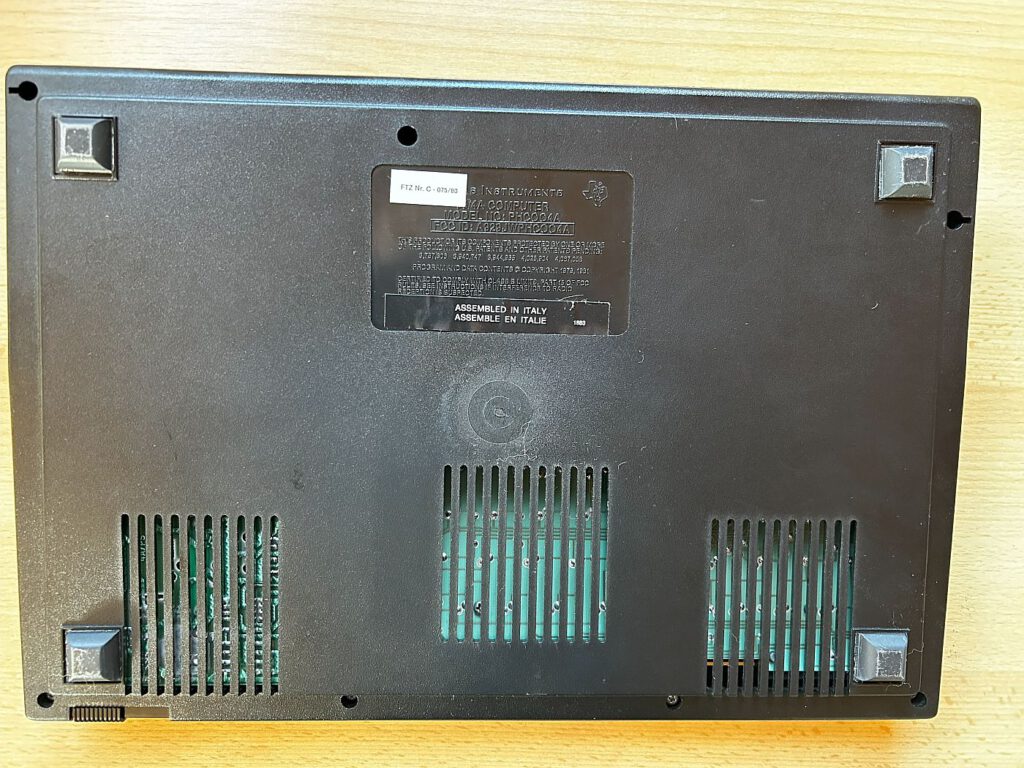
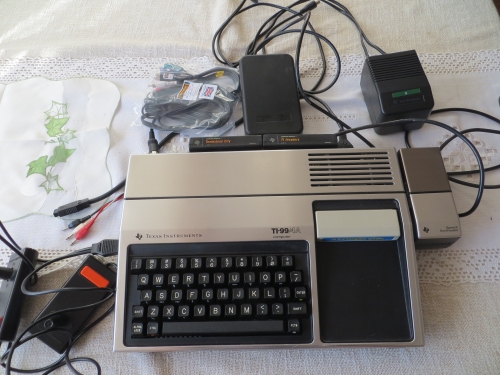
The housing is rectangular, made of plastic and features a brushed aluminium finish on the top. The slot for plug-in modules is on the right-hand side, whilst the power button is located at the bottom right of the front panel. There is no reset button. The keyboard has 48 keys and does not feature a German layout – the keys always follow the US QWERTY layout. The function key (to the right of the space bar) allows you to access certain characters on the letter keys, including the arrow keys, which are not provided as separate keys (e.g. ‘Up arrow’ = FCTN+E). As the multiple functions were not immediately obvious, TI affixed a printed keyboard guide above the keyboard showing an overview of all function key combinations – and for devices intended for German-speaking markets, this was even provided with German translations (e.g. ‘WORD-TAB’, ‘SCREEN COLOUR’, ‘AUTOMATIC (WORD WRAP)’).
On the left is the joystick socket, which is not compatible with the Atari standard (adapters are available nowadays). On the right is the expansion port for various peripheral devices. At the back is a Sub-D socket for connecting a cassette recorder, next to which is the power supply socket. Further to the right, depending on the version, there is either a five-pin DIN socket (NTSC) or a six-pin DIN socket (PAL/SECAM) for connecting a monitor.
Plug-in modules
The plug-in modules were mostly manufactured directly by TI and involved quite high production costs. They usually contain a 6 KB GROM chip, but have space for up to five chips (30 KB). Unfortunately, third-party suppliers had to purchase expensive licences from TI in order to be able to offer their own plug-in modules.
As early as the summer of 1981, the response to the limited capabilities of TI Basic came in the form of TI Extended Basic, which was launched as a module. It was largely compatible with its predecessor, but offered 35 additional commands, instructions, functions, subroutines and logical operations. This made it possible to programme sprites and use subroutines written in machine code. Program execution became noticeably faster, as large sections were written directly in machine code rather than in GPL. With 32 KB of ROM, TI Extended Basic was very comprehensive, but it also occupied an additional 2 KB of RAM, leaving only 14 KB of RAM for VRAM and programme memory. In 1982, the module cost US$95.95 and was not available in German-speaking countries until 1984.
There were also changes to the hardware itself over the course of its production run: the original silver-and-black casing from 1981 was followed in 1982 by a beige version, which was almost indistinguishable from its predecessor on the outside. Internally, TI then introduced a revised, cost-optimised motherboard in August 1983 – referred to by TI itself as ‘QI’ (Quality Improved). This revision held an unpleasant surprise for third-party manufacturers: a lock that prevented plug-in modules without a valid TI licence ID from booting up, in order to put a definitive stop to third-party suppliers without an expensive licence agreement. The copyright notice on the colourful start-up screen reveals whether a console is affected – ‘1981’ means no lock, whilst ‘1983’ means the lock is active.
Expansion modules
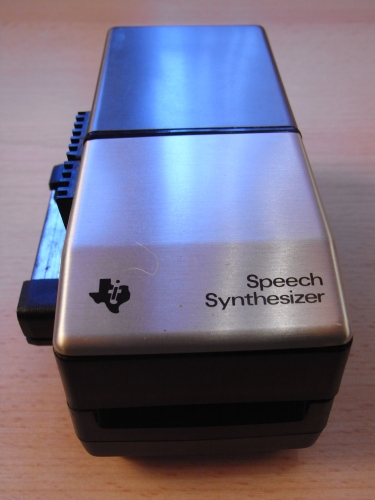
A number of important expansion modules could be connected to the expansion port. On the right-hand side of the TI-99/4A, these ‘sidecars’ could be slotted directly into one another, without the need for any cables – one expansion module simply slotted into the next. These included, in particular:
- PHP1500 Solid State Speech Synthesiser (expansion module for synthetic speech output)
- PHP1800 Disk Drive Controller Sidecar (floppy disk drive control unit)
- PHP1850 Disk Memory Drive (5¼-inch floppy disk drive)
- PHP2200 32 kilobyte memory expansion sidecar (32-KB RAM memory expansion)
In practice, this chain quickly reached its limits: the more sidecars were connected, the more unstable the system became, and the amount of space required on the desk increased accordingly. As these extensions took up a great deal of space, TI launched the Peripheral Expansion System PHP1200 in January 1982 – a more compact plug-in card solution. The rectangular metal casing had space for eight slots (one of which is required for the connection to the TI) and up to two 5 1/4-inch floppy disk drives. It had a fan and its own power supply. The following cards were available from TI:
- PHP1220 RS-232 interface (printer interface)
- PHP1240 disk controller (floppy disk drive controller)
- PHP1250 disk memory drive (5¼-inch floppy disk drive, double height)
- PHP1260 32 kilobyte memory expansion (32 KB RAM memory expansion)
- PHP1270 P-Code Version 4.0 (UCSD Pascal interpreter)
- PHP1280 Pascal Development System
Software
Most programmes were released as plug-in modules and were largely produced and distributed by TI itself. Popular titles included Blasto, Car Wars, Hunt the Wumpus, Munchman, TI Invaders and Tombstone City. Third-party titles included Dig-Dug, Donkey Kong, Jungle Hunt, Moon Patrol, Pac-Man and Pole Position from Atarisoft; Q-Bert from Parker Brothers; Buck Rogers and Star Trek from SEGA; Space Bandits from Milton Bradley; and Microsurgeon and Super Demon Attack from Imagic. Some games were also available on floppy disk, although these required a 5.25-inch floppy disk drive and the 32 KB RAM expansion.
![nanoPEB [TI-99/4A]](https://www.jungsi.de/blog/wp-content/uploads/2014/11/nanoPEB.jpg)
![Supercart Cartridge [TI-99/4A]](https://www.jungsi.de/blog/wp-content/uploads/2014/11/Cart-64K.jpg)
![32K Sidecar [TI-99/4A]](https://www.jungsi.de/blog/wp-content/uploads/32k-sidecar-oberseite.jpg)
Leave a Reply