

![Interton VC4000 [Interton]](https://www.jungsi.de/blog/wp-content/uploads/interton-vc4000.jpg)
The only game console developed entirely in Germany to date has fallen outside the mainstream and, unfortunately, has largely been forgotten. A prototype was first unveiled to the public on August 29, 1977, at the International Radio Exhibition in Berlin; however, the market launch—originally scheduled for February 1978—was delayed until the autumn of that same year. At launch, the console cost around 398 DM, though the price was reduced to 298 DM just a year later. It offered good value for money and featured two analog controllers equipped with two fire buttons and 12 additional function keys. While it was cheaper than its competitor, the Atari VCS2600, it was also less powerful; it remained on the market for several years until its graphics and sound capabilities became outdated.
Interton began the licensed production of Pong clones as early as the mid-1970s and then decided, as a Cologne-based hearing aid manufacturer, to develop its own microprocessor-controlled game console.
The console is based on components from the Signetics 2650 series – Signetics became part of Philips in 1975. The extent to which Interton itself was actually involved in the development is a matter of debate. (See: Radofin with the 1292 Advanced Programmable Video System, which was already available for purchase in 1976) .
It is the first in a series of identical or almost identical consoles, which were produced under various names by, amongst others, Grundig, Hanimex, Palladium, Schmid, Radofin and Emerson in Hong Kong and sold mainly in Europe.
Technical specifications
CPU: Signetics 2650A at 0.887 MHz
RAM: 37 bytes, of which 32 bytes were usable – the rest was reserved for sprites and graphics.
Video: Signetics 2636 Programmable Video Interface (PVI).
Resolution: 128 × 200 pixels (monochrome).
Sprites: four different monochrome sprites in four different sizes
Colours: the colours of the background image and the sprites could be selected individually from a choice of eight colours. In addition, there was the four-digit dot display.
Audio: a single audio channel (also included in the video processor), which was not, however, modulatable, and a separate module for three sound effects (bang, boom, static).
Input: two detachable controllers with an analogue, self-centring joystick and 14 buttons.
Output: In addition to the graphics, a large score display in BCD format was shown.
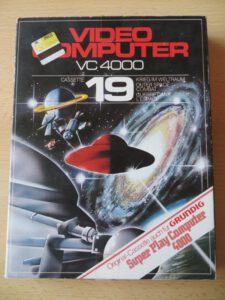
The games for the VC4000, all of which were developed by Interton itself, were consistently labelled with numbers from 1 to 40 alongside their titles. However, numbers 34, 35 and 39 were never released, meaning that 37 titles were ultimately published. The games often came with stencils for the joysticks, labelled with the functions. The analogue joysticks were self-centring, which was a standout feature at the time.
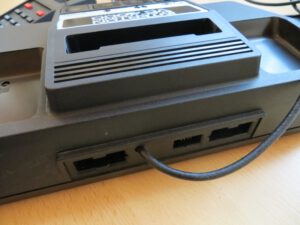
The console was sold in numerous versions across Europe – not only in Germany, but also in the UK, France, Spain, Austria, the Netherlands and Australia, amongst others. Units were produced by a wide variety of companies, such as Grundig, Radofin, Hanimex and Fountain, and were often software-compatible. However, the modules did not fit into units made by other manufacturers – adapters are now available for some of them.
The console has four buttons on the front, including the on/off button and a reset button. This button has a special function: whenever a game is inserted, you must press Reset so that the programme code is loaded into the main memory.
The best games for the Interton VC 4000 are likely to be Space Invaders, Monster Man, Football, War in Space, Cockpit and Metropolis/Hangman. The boxes in which the modules were supplied were very large, as was customary at the time – the instructions were printed on the inside. However, the packaging was quite neatly designed and, above all, really beautifully colourful. The modules had a storage capacity of 2 to 4 kilobytes.
The brand Interton still exists today 🙂 Hearing aids are manufactured under this name.
Some of the Interton’s features later reappeared on other consoles:
– Game numbering: Videopac
– Analogue, self-centring joysticks: Vectrex
– Joysticks with function buttons: Colecovision, Intellivision, Jaguar
– Joystick templates: Jaguar
Nochmal für alle, die zum ersten Mal ein Interton VC4000 verwenden, eine kurze Anleitung:
1. Konsole an den Strom anstecken und Fernseher einschalten
2. Modul einstecken
3. Ein-/Aus-Schalter auf Position „Ein“ (nach rechts schieben)
4. die Taste neben dem Ein-/Aus-Schalter drücken
5. Kanal am Fernseher suchen, wenn noch nicht geschehen
6. Start drücken
7. andere Spielvarianten auf der gleichen Kassette werden mit der Pfeiltaste ausgewählt (Pfeil nach rechts)
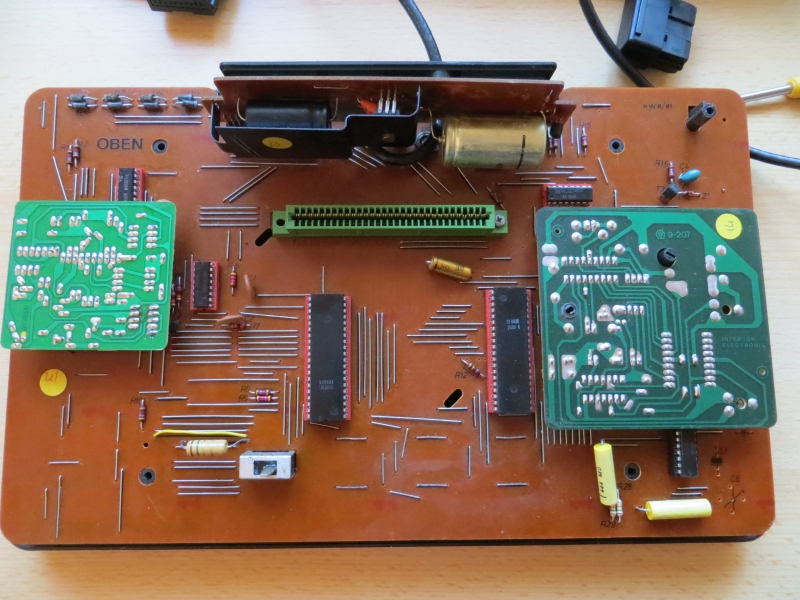
For anyone (including myself) who finds the antenna signal a headache, there’s an AV mod that’s very easy to carry out. To do this, you need to carefully open the console (four screws). You then need to loosen the two screws on the module bay.
Next, the RF modulator is carefully detached from the circuit board, and three cables are soldered to the underside: one for video, one for earth and one for audio. These are then connected to RCA sockets, which are fitted to the rear of the housing:
– Connect the video signal to the inner pin of the video RCA socket
– Connect the audio signal to the inner pin of one audio RCA socket and, from there, run a second cable to the inner pin of the second audio RCA socket
– Connect the earth to the outer pin of one RCA socket and, from there, connect it in series to the other RCA sockets
Pretty much anyone who’s into this hobby should be able to manage it. I can’t recommend it highly enough. The result is truly amazing – a superb picture!
Anyone who no longer wants to rely on original cartridges now has alternatives: there is an adapter available for the Rolo Dragon/CoCo Multicart that allows it to be used on the VC4000, and the Classic Computing community has produced its own DIY MultiROM cartridges. This allows you to play your entire games collection without constantly having to swap cartridges – you can read more about this in my article on the Dragon/CoCo Multi-Cart.
Incidentally, production of the VC4000 ceased in May 1983 when Interton was forced to file for bankruptcy – after around five years on the market.
Links
![Dragon/CoCo multi-cart [Interton/Videopac]](https://www.jungsi.de/blog/wp-content/uploads/DragonCoCo-Multi-cart.jpg)
Leave a Reply