


Following on from the classic Game Boy comes the leap to the Game Boy Advance. The GBA is the first Game Boy to feature a completely new hardware architecture. Despite these fundamental changes, the device, which was released in 2001 (Japan: 21 March, USA: 11 June, Europe: 22 June), is compatible with all Game Boy and Game Boy Colour games.
Technically, the GBA is roughly equivalent to an upgraded Super Nintendo. It has a larger screen and a different shape (landscape rather than portrait). Nintendo later responded to criticisms such as the buttons being unsuitable for larger hands and the lack of a backlit screen with the significantly improved Game Boy Advance SP. The entire GBA family – including the SP and the Micro, released in 2005 – sold around 81.5 million units.
Origins
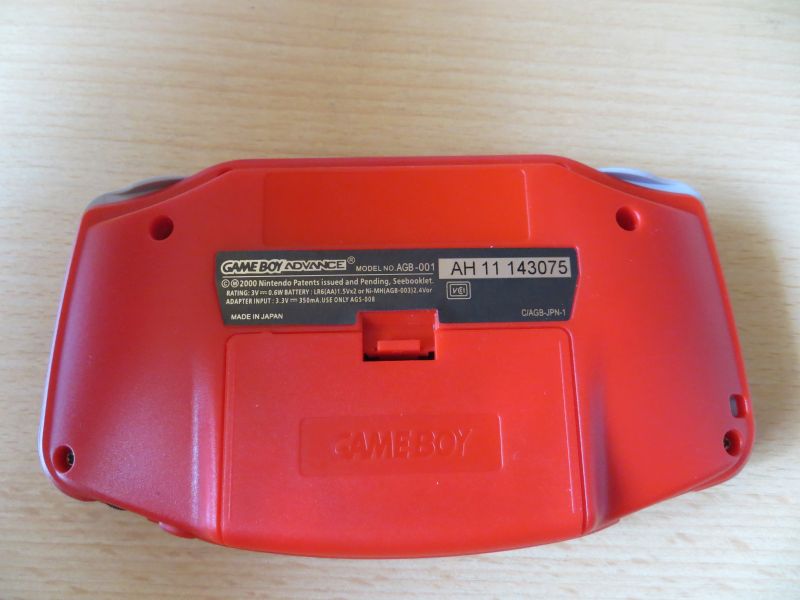
Internally at Nintendo, the device was known by the project name ‘Advanced Game Boy’ (AGB). That is why it also bears the model number AGB-001. The idea behind it is older than one might think: as early as the early 1990s, Nintendo was working on a prototype with a colour display and a 32-bit ARM processor, which went by the name ‘Project Atlantis’. The project was initially put on hold in 1997. The GBA brought the idea to market a few years later.
My opinion
The design of the device is quite alright, and it feels comfortable in (my) hands. The screen, however, is a disaster: without the backlight, you can hardly see anything …
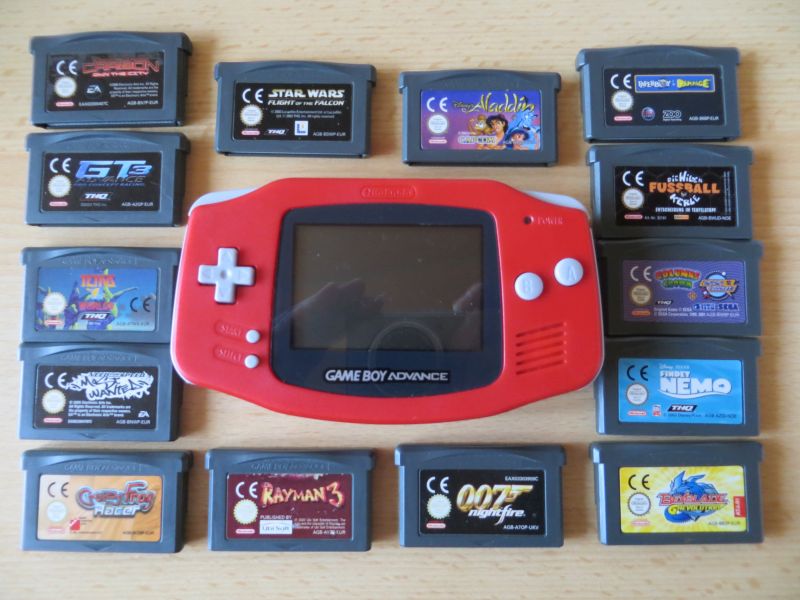
My GBA is a red model that I bought in 2017. The screen cover on this device has been replaced, and it works perfectly. It came with 14 games on cartridges – a colourful mix of racing games, licensed titles and a few classics.
An overview of the 14 matches
- Need for Speed: Carbon – Own the City
- Need for Speed: Most Wanted
- GT Advance 3: Pro Concept Racing
- Crazy Frog Racer
- Star Wars: Flight of the Falcon
- Disney’s Aladdin
- Rayman 3: Hoodlum Havoc
- 007: NightFire
- Tetris Worlds
- Columns Crown
- Findet Nemo
- Die Wilden Fußballkerle: Entscheidung im Teufelstopf
- Beyblade G-Revolution
- Paperboy & Rampage
Technical data
| feature | Value |
|---|---|
| Screen | 4.08 cm × 6.12 cm (2.9 inches); 240 × 160 pixels; reflective TFT screen with up to 32,768 colours |
| CPU | 16.78 MHz 32-bit RISC CPU (ARM7TDMI, ARM architecture) |
| Second CPU | 8-bit CPU (Sharp LR35902, a Z80/8080 derivative) running at 4.19 or 8.39 MHz, solely for backwards compatibility with the Game Boy and Game Boy Color |
| RAM | 32 KB IWRAM (1 cycle/32 bits), 96 KB VRAM (1–2 cycles), 256 KB EWRAM (6 cycles/32 bits) |
| Sound | Speaker (mono) / Headphones (stereo) |
| Multiplayer | Up to four players (using GBAs or GBA-SPs) or two players (using a Game Boy or Game Boy Color) |
| Power Supply | 2 × 1,5 Volt AA |
| Battery life | approx. 15 hours |
| Dimensions | 8.2 cm high × 14.45 cm wide × 2.45 cm deep |
| Weight | 140 g |
| Cartridge dimension | 3.4 cm high × 6.0 cm wide × 1.3 cm deep; maximum 256 Mbit (32 MByte) |
| Compatibility | Plays all classic Game Boy and Game Boy Colour games |
Graphics and sound
The graphics clearly show the similarity to the Super Nintendo. The GBA can display up to four background layers and manage up to 128 hardware sprites. This also allows for effects reminiscent of the SNES’s Mode 7. For sound, two DirectSound channels for samples work in conjunction with the old Game Boy sound channels, which have been retained for compatibility. This also explains the typical GBA sound: it is significantly more powerful than on the Game Boy Color, but it still sounds rather tinny through the small mono speaker.
Processor and memory interface
Although the GBA was marketed as a 32-bit system, Nintendo opted for a mix of 16-bit and 32-bit buses for cost reasons. The majority of the memory is connected only to a 16-bit bus. Many games therefore utilise the ARM processor’s space-saving Thumb instruction set, which uses 16 bits per instruction instead of 32 and is thus better suited to this configuration. This is an intriguing detail for tech enthusiasts, as these compromises are not noticeable in everyday use of the device.
Game modules
Games continued to be supplied on cartridges. These are significantly smaller than those of its predecessor, but offer far more storage space – up to 32 MByte. The GBA also sees a substantial increase in RAM: the Game Boy Color had 32 KB, whilst the GBA boasts 288 KB of RAM alone (excluding video RAM), which is around nine times as much.
There have also been changes to how game saves are stored: many games now save to Flash or EEPROM memory and no longer require a backup battery. Others continue to use battery-backed SRAM.
Start and Competition
The launch titles included, amongst others, Super Mario Advance and F-Zero: Maximum Velocity. As with the SNES, there were also many ports of classics from the 8- and 16-bit eras that followed. Competition came from the Neo Geo Pocket Color and WonderSwan, and later from the Nokia N-Gage as well. Nintendo clearly prevailed against these devices. The best-selling GBA game is Pokémon Ruby/Sapphire, with around 16 million copies sold.
In 2004, the Nintendo DS was released as its successor. It continues to play GBA cartridges via a second slot, thus bringing the handheld range to a stylish conclusion.
Accessories
Connection cables and wireless adaptors
Some games could now be played by several players using just one cartridge. To do this, each player needed their own GBA. A link cable was required for two players, two link cables for three, and three link cables for four. In 2004, the Wireless Adapter was released, which was included with Pokémon FireRed and LeafGreen, amongst others.
GameCube link cable and Game Boy Player
A similar cable could be used to connect the Nintendo GameCube to the GBA. The cable features a connector for the GBA and a GameCube controller socket. With certain GameCube games, this allowed additional information to be displayed on the GBA, or the GBA could be used as a controller. Furthermore, some games are designed to work together directly, such as Sonic Adventure 2 Battle and Sonic Advance.
Anyone who preferred to play GBA games on their TV would opt for the Game Boy Player: an attachment for the GameCube that accommodates GBA cartridges.
e-Reader
The e-reader was an add-on device that was inserted into the cartridge slot. It read cards with printed dot codes, which could be used to download mini-games or bonus content for certain titles.
Lighting
Because the screen was not backlit, there was a separate market for clip-on lamps from third-party manufacturers. They are a good example of just how seriously the problem was taken.
Everdrive GBA
With the Everdrive GBA, (almost) all games can be launched from an SD card.
The GBA today
The GBA remains popular in the retro gaming scene. Many fans are now fitting it with a backlit IPS display. This solves the original’s main problem. If you own a GBA, it’s worth taking a look at these modifications, as the difference is huge.
The backup batteries in the cartridges are also an issue: after around 20 years, they are often flat. This is particularly well known in the case of Pokémon Ruby, Sapphire and Emerald, where the battery powers the game’s real-time clock. Anyone with such cartridges should keep an eye on the battery or replace it.


Top Games
- WarioWare: Twisted!
- Castlevania: Aria of Sorrow
- The Legend of Zelda: A Link to the Past & Four Swords
- Advance Wars
- Tony Hawk’s Pro Skater 2
- Mario Golf: Advance Tour
- Super Mario Advance 3: Yoshi’s Island
- Final Fantasy VI Advance
- Metroid: Zero Mission
- Pokémon Rubin/Saphir
- Super Mario Advance 4: Super Mario Bros. 3
- Mario & Luigi: Superstar Saga
- Ultimate Card Games
- Final Fantasy Tactics Advance
- Mario Tennis: Power Tour

Leave a Reply