

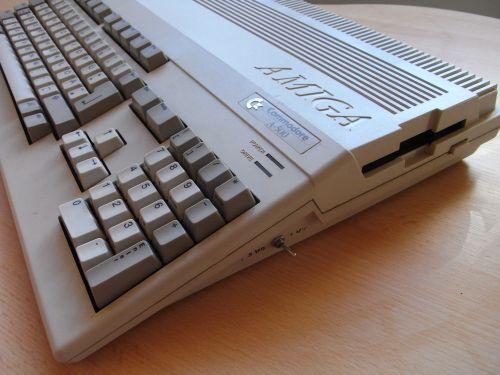
![Commodore Amiga 500 [Commodore]](https://www.jungsi.de/blog/wp-content/uploads/Amiga-500-oben.jpg)
Der Amiga 500 von Commodore war praktisch der „Nachfolger“ des Commodore C64. Ende der 80er war das der Rechner, den viele haben wollten – doch ich scherte mich nicht darum, was die Mehrheit wollte. Ich bekam einen Atari 1040 STFM zum Schulabschluss 1987 geschenkt. In meinem Freundeskreis gab es nur einen, der den Amiga besessen hat – auch machte ich keine Bekanntschaft mit den Meinungsverschiedenheiten der einzelnen Fans, welcher Rechner wohl der bessere sein könnte. Hier aber trotzdem die Geschichte des Amiga 500.
The story
What many people don’t know is that the Amiga didn’t actually originate from Commodore. The Californian company Amiga Corporation – founded, amongst others, by Jay Miner, the father of the custom chips in the Atari 8-bit – originally developed what would later become the Amiga 1000 as a games console. Financial difficulties then forced the company to sell, and Commodore snapped it up in 1984. An interesting side note: Atari also wanted to snap it up, but was too late. Jack Tramiel, who was now running Atari, is likely to have been annoyed about it for a long time afterwards.
The Amiga 1000 was released in 1985; the A500 followed in 1987 and was the first Amiga in which the computer was integrated into the keyboard. The Amiga series as a whole continued until Commodore’s bankruptcy in 1994 – with desktop models such as the A1000 (1985), A2000 (1987), A3000 (1990) and A4000 (1992), as well as the keyboard models A500 (1987), A500+ (1991), A600 (1992) and A1200 (1992).
The A500 was unveiled at CeBIT in 1987 alongside the Amiga 2000. It was aimed at home users on a tighter budget. A design resembling that of the Commodore 128 was chosen for the case. With over six million units sold worldwide, the A500 became by far the best-selling model in the entire Amiga family.
The technology
Like Atari’s competitors, the A500 had a Motorola 68000 as its main processor, clocked at 7.09 MHz (PAL). What really set the Amiga apart, however, was its custom chipset: whilst the Atari ST relied on its 68000 to handle almost everything on its own, the Amiga had three specialised co-processors that worked in parallel with the CPU:
- Agnus – DMA and memory controller; also houses the Blitter (for fast block operations) and the Copper (for raster-line-precise effects).
- Denise – Graphics output with up to 4,096 colours simultaneously in the legendary HAM (Hold-And-Modify) mode.
- Paula – 4-channel stereo sound, floppy controller, serial interface.
Added to this was Workbench with true pre-emptive multitasking – in 1987, simply put, no other home computer had this. All of this combined made the A500 a machine that captivated the demoscene, game developers and graphic designers alike. It was no coincidence that the famous Boing Ball demo was the quintessential iconic tech demo of its time.
A 3.5-inch floppy disk drive was built in (880 KB capacity, significantly more than the 720 KB offered by rival PCs), and 512 KB of chip RAM was originally available. In 1987 and 1988, the A500 was supplied with Kickstart 1.2; from October 1988 onwards, it was supplied with version 1.3.
Motherboard revisions and chipsets
During the just under five years of production (1987–1991), there were six major revisions of the motherboard: Rev. 3 (1987), Rev. 4, Rev. 5, Rev. 6/6A (1988), Rev. 7/7A and Rev. 8/8A (1991). Revisions 4 and 7 are regarded as transitional boards produced in small quantities.
Die ersten Boards (bis Rev. 6) hatten 512 KB RAM in 16 ICs à 32 KB verbaut – das Maximum, das der originale Chipsatz (OCS) adressieren konnte. Späte A500-Revisionen bekamen schon den ECS-Agnus (8372A, „Fatter Agnus“), der 1 MB Chip-RAM ansprechen konnte, behielten aber meist noch den OCS-Denise. Echtes „vollständiges“ ECS mit neuen Grafikmodi (Productivity, SuperHires) kam erst mit dem Amiga 3000 (1990) bzw. dem A500+ (1991).
The last Rev. 8/8A boards had actually been developed for the A500+ and were also used in parallel for the last A500 models running Kickstart 1.3.
Mass storage and extensions
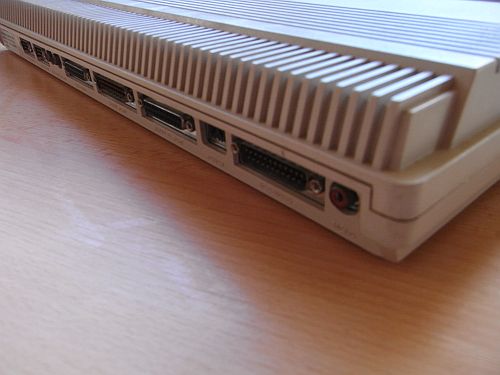
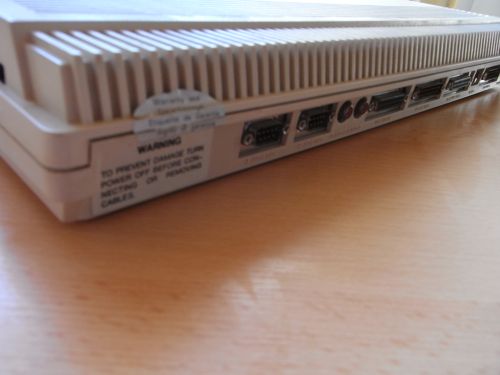
This is where it gets interesting – and, for eyes spoilt by the ST like mine, a little sobering. Hard drives were never as common on the A500 as they were on the Atari ST. Even during its heyday, the ST had the famous Megafile drives connected to the ACSI port (which is similar to SCSI but not identical – genuine SCSI didn’t appear on Atari machines until the TT) – with the Amiga, you had to wait for the external A590 drive, which plugged into the expansion slot on the side. Until then: everything was on floppy disk. Larger games came on 4 to 6 floppy disks; in the later AGA era, sometimes as many as ten.
Ein integriertes Netzteil hat der A500 nicht – wie beim ST liegt es extern (immerhin mit eigenem Schalter). Auch der HF-Modulator zum Anschluss an einen Fernseher war in Deutschland nicht im Lieferumfang. In Großbritannien gab’s den serienmäßig im Bundle „A500 with TV modulator“.
There are two ways to upgrade the A500:
- Trapdoor-Slot unten: 512 KB Erweiterung auf 1 MB Gesamt-RAM. Bei OCS-Boards landet die Erweiterung als „Slow-RAM“ im Speicher, bei späten Boards mit ECS-Agnus kann sie auch als zusätzlicher Chip-RAM genutzt werden.
- Side expansion slot: up to 8 MB of Fast-RAM, hard drives, accelerators.
Ein kleines Problem schleppt der A500 dabei mit sich: Die „Freundin“ (Amiga heißt auf Spanisch ja genau das) ist von der Leistung etwas zu schwach auf der Brust, um viele Erweiterungen gleichzeitig sinnvoll mit Strom zu versorgen.
The successor: Amiga 500 Plus
From 1991 onwards, the A500+ was available with twice the memory (1 MB of on-board chip RAM, expandable to 2 MB), a full ECS chipset and Kickstart 2.04, complete with Workbench 2.0. Visually almost identical to its predecessor, it represented a significant technical step forward.
Das hatte aber einen Haken: Viele ältere Spiele (etwa Treasure Island Dizzy, Lotus Esprit Turbo Challenge oder SWIV) liefen unter Kickstart 2.04 schlicht nicht mehr. Einige Käufer brachten ihre A500+ entnervt zurück zum Händler und verlangten einen „richtigen“ A500 mit Kickstart 1.3. So entstand schnell ein Markt für Kickstart-Umschalter, mit denen sich zwischen 1.3 und 2.0 wechseln ließ.
The games
As a self-confessed ST fan, I have to keep my mouth shut for once and take my hat off to this: the Amiga games library is legendary. Lemmings, Monkey Island, Turrican II, Settlers, Pinball Dreams, Cannon Fodder, Defender of the Crown, Shadow of the Beast – titles that have shaped entire generations. Many of them were also available for the ST, but on the Amiga they ran with hardware scrolling, more colours and four sound channels. The ST simply couldn’t keep up, despite its more attractive case. (Right, I had to admit that.)
Today: Extensions and alternatives
Even though the A500 has long since gone out of production, the community is still going strong. The latest upgrades that bring the device up to date:
- ACA500plus by Individual Computers – an accelerator with an SD card in place of a hard drive, the successor to the original ACA500.
- PiStorm – a Raspberry Pi used as a 68k CPU replacement, which has now become very popular within the community.
- Vampire – FPGA-based accelerators with their own extended chipset (SAGA), including an HDMI output.
- Gotek floppy emulators – no more faffing about with floppy discs; everything via USB stick.
- In addition, there are dozens of other boards from the community: TerribleFire accelerators, kipper2k memory expansions, Kickstart switches and more.
If you don’t want to run the original Amiga, you can opt for the THEA500 Mini (2022) from Retro Games – an official mini replica with pre-installed games and decent emulation. A nice compromise for the living room sofa.
My copy
Let’s take a look at the actual device sitting on my shelf here.
The silver type plate on the underside reveals: Model A500, serial number 192385, Made in China, electrically shielded in accordance with DBP Directive 1046/84 – meaning it is officially approved for the German market and is not a grey import. Next to it is another sticker bearing the designation A500 FG (Federal Germany, German market variant with QWERTZ keyboard) and a 22-digit barcode.
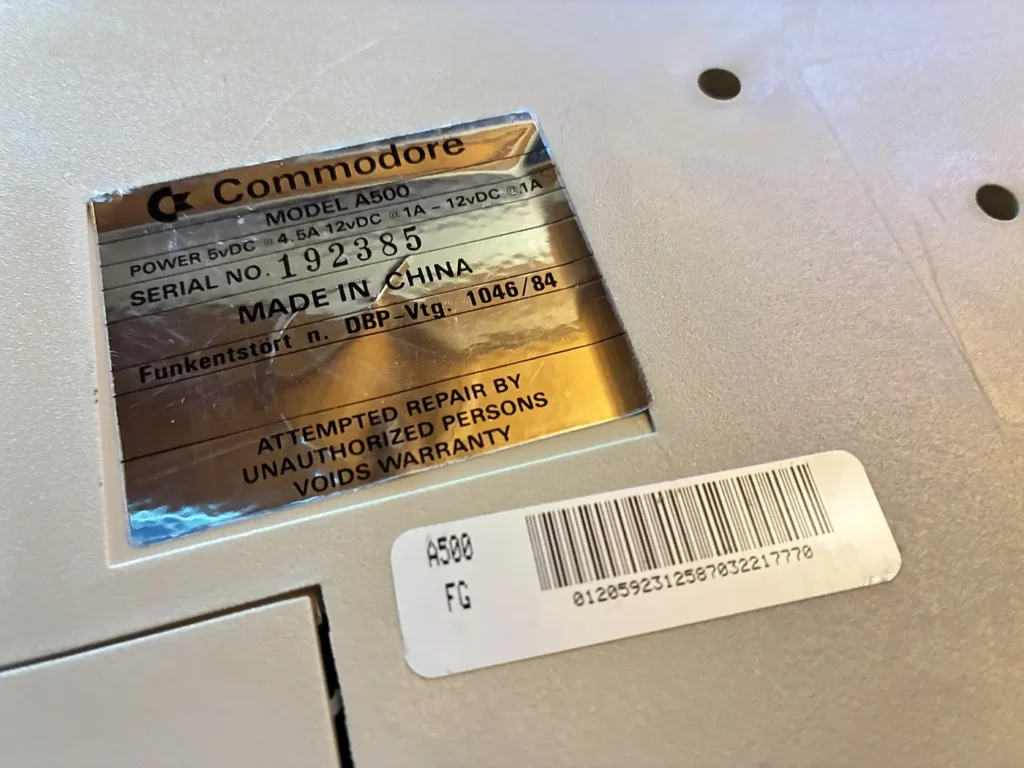
This barcode can be decoded using the same method as the one on the A1200:
AAA · BB · CC · DDDDDD · EE · FF · GGGGG
My code is 0120592312587032217770:
- 012 – Production site in China
- 05 – Production week 5
- 92 – Year of manufacture: 1992
- 312587 – Product number
- 17770 – internal device serial number
So my A500 rolled off the production line in the fifth calendar week of 1992 – late January / early February, shortly before A500 production was finally discontinued in favour of the A500+. A real latecomer, then, and one of the rather rare models manufactured in China. Most European A500s came from Braunschweig or Hong Kong, after all.
Auf der Platine bestätigt sich die These vom „Spät-A500“: Das Mainboard trägt den Aufdruck 312512 und vor allem „512K/1M RAM“ – das ist eindeutig ein Rev-8-Board, also baugleich mit dem A500+. Nur eben mit Kickstart 1.3 und 512 KB Chip-RAM ausgeliefert statt mit 2.04 und 1 MB. Im Sockel sitzt ein Fat Agnus in der ECS-Variante, das Diskettenlaufwerk ist ein Epson SMD-300 mit Datumssticker 12/91.
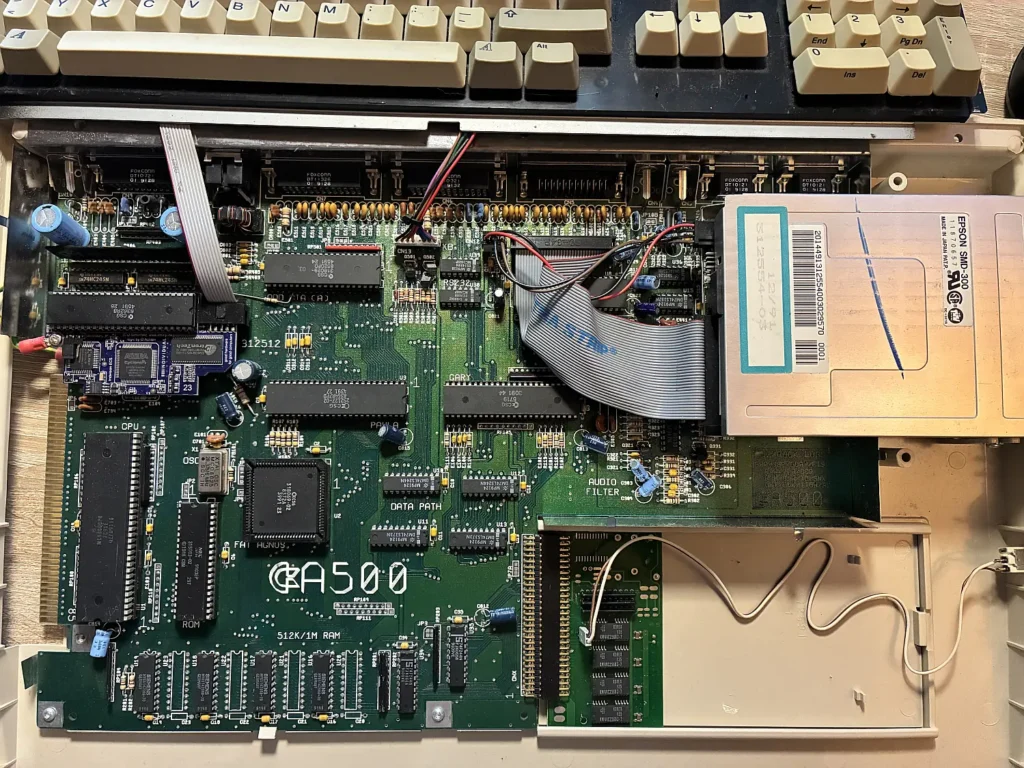
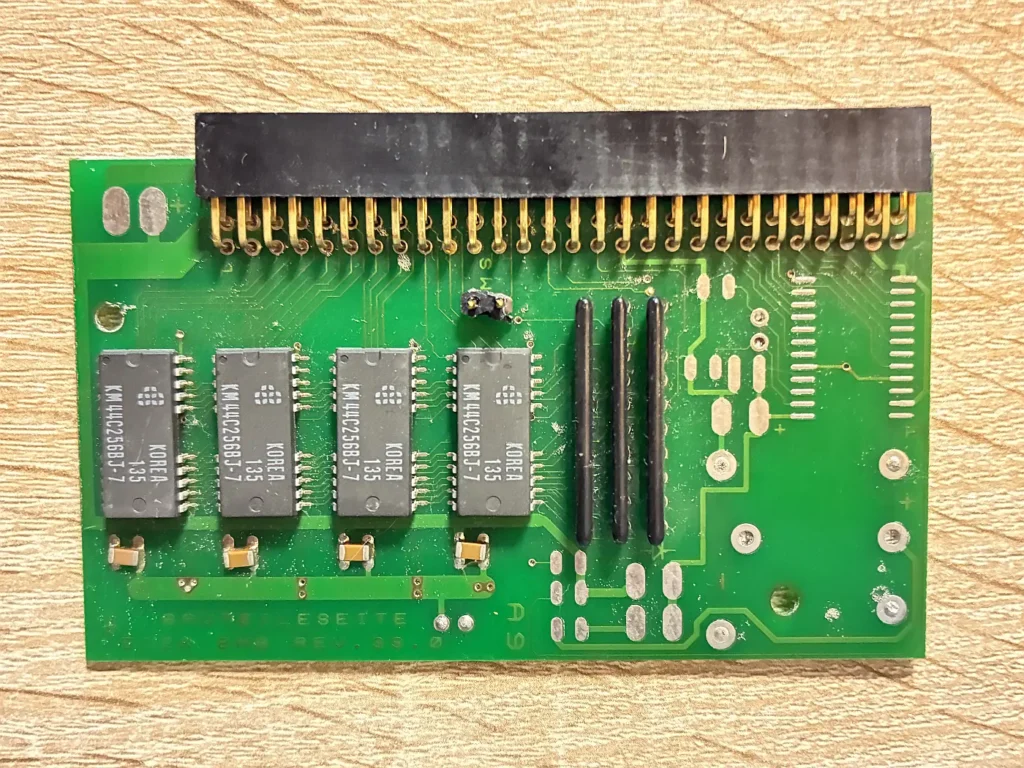
Im Trapdoor-Slot steckt eine 512-KB-Speichererweiterung – keine originale Commodore A501 (die hätte eine Echtzeituhr samt Batterie), sondern eine deutsche No-Name-Karte. Erkennbar am deutschen Silkscreen-Aufdruck „BAUTEILESEITE“ auf der Vorderseite und „LÖTSEITE“ auf der Rückseite. Vier Samsung KM44C256BJ-7 SMD-Chips (Korea, Woche 35/1991) liefern die 512 KB; auf der Platine ist Platz für weitere vier Chips, die das Ganze auf 2 MB hochrüsten würden. An der Karte hing ursprünglich ein externer Kippschalter, mit dem sich die Zusatz-RAM bei Inkompatibilitäten mit alten Spielen deaktivieren ließ. Der Schalter ist mittlerweile abgebrochen – ein Reparaturprojekt für später.
I’ve upgraded the machine with two expansion cards: an Indivision ECS from Individual Computers in a Denise socket for a clean VGA output on modern monitors, and the ACA-500 from the same manufacturer in the side expansion slot. The ACA-500 features a 14 MHz 68EC000, 2 MB of Fast RAM and two CompactFlash slots as a replacement for hard drives – finally putting an end to the clatter of floppy discs. Read more about this in my ACA-500 article.
To sum up: a late-model German A500 manufactured in China, based on an A500+ motherboard, featuring a German Trapdoor expansion and a modern VGA solution. Technically, it’s almost an A500+ in disguise, but with that charming Kickstart 1.3 patina, which is great for compatibility with older games.
I used to be so jealous of my friends for having this cool bit of kit. Now that I’ve got it on my shelf, I see it in a different light – as a remarkable piece of technology that was far ahead of its time in many respects. But let’s be honest: the ST just looks better. 😉
![ASM – Das Computerspiel [Commodore Amiga]](https://www.jungsi.de/blog/wp-content/uploads/ASM-Das-Computerspiel-Vorderseite-1.jpg)
![Hibernated 1 [Sinclair ZX Spectrum/Commodore 64 u.a.]](https://www.jungsi.de/blog/wp-content/uploads/Hibernated-I-Ladescreen.jpg)
![A500-IDE [Commodore Amiga]](https://www.jungsi.de/blog/wp-content/uploads/A500-IDE-mit-CF-Adapter.jpg)
Leave a Reply