

![Anbernic RG351MP [Anbernic]](https://www.jungsi.de/blog/wp-content/uploads/Anbernic-RG-351MP-Displayseite.jpg)
Today I’m presenting another device from my collection that isn’t quite so new – the Anbernic RG351MP handheld. It was my first foray into this category of devices, which emulate many classic systems. In 2021, the 351 series was state-of-the-art, and Anbernic had (and still has) a reputation for solid quality. At the heart of all 351 models is the Rockchip RK3326 with 1 GB RAM. The RG351MP combines this with a 4:3 display and a CNC-machined aluminium casing – a tactile advantage over many plastic handhelds.
Manufacturer: Anbernic at a glance
Anbernic is a brand established in 2017 in Shenzhen (parent company: Shenzhen YangLiMing Electronic Technology Co.). It specialises in retro handhelds for classic systems – renowned for their high-quality build and strong community support.
Display & Form Factor – why the MP is special
Within the 351 series, the MP (“Metal Pro”) is the widescreen model with a resolution of 640×480/4:3. This is natively compatible with many 8/16-bit consoles and the PS1 – resulting in fewer scaling artefacts than with 3:2 displays. Compared to the RG351P/M (480×320), the MP therefore offers visibly greater sharpness; compared to the RG351V, it remains horizontal.
Technical specifications (RG351MP)
- CPU/GPU: Rockchip RK3326 (4× 1.5 GHz), Mali-G31 MP2
- RAM: 1 GB DDR3L
- Display: 3.5″ IPS, 640×480 (4:3), full OCA lamination
- Housing: Aluminium (CNC)
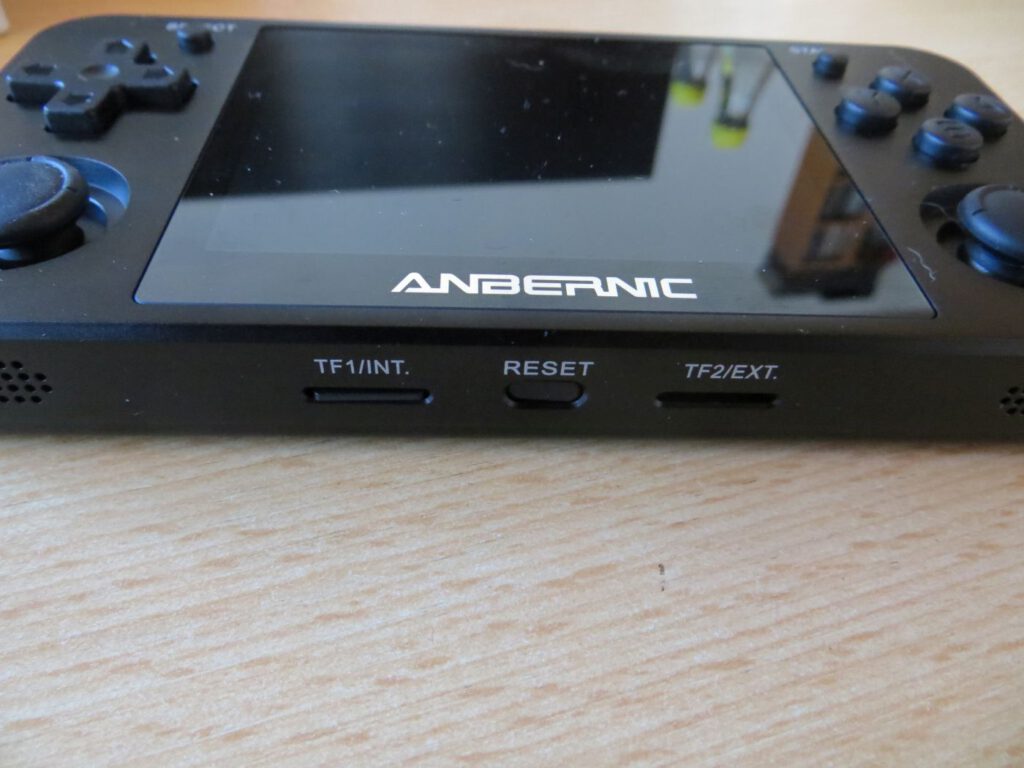
- Storage: Dual microSD slots (OS + games)
- Battery: approx. 3500 mAh (typically 6–8 hours, depending on the system)
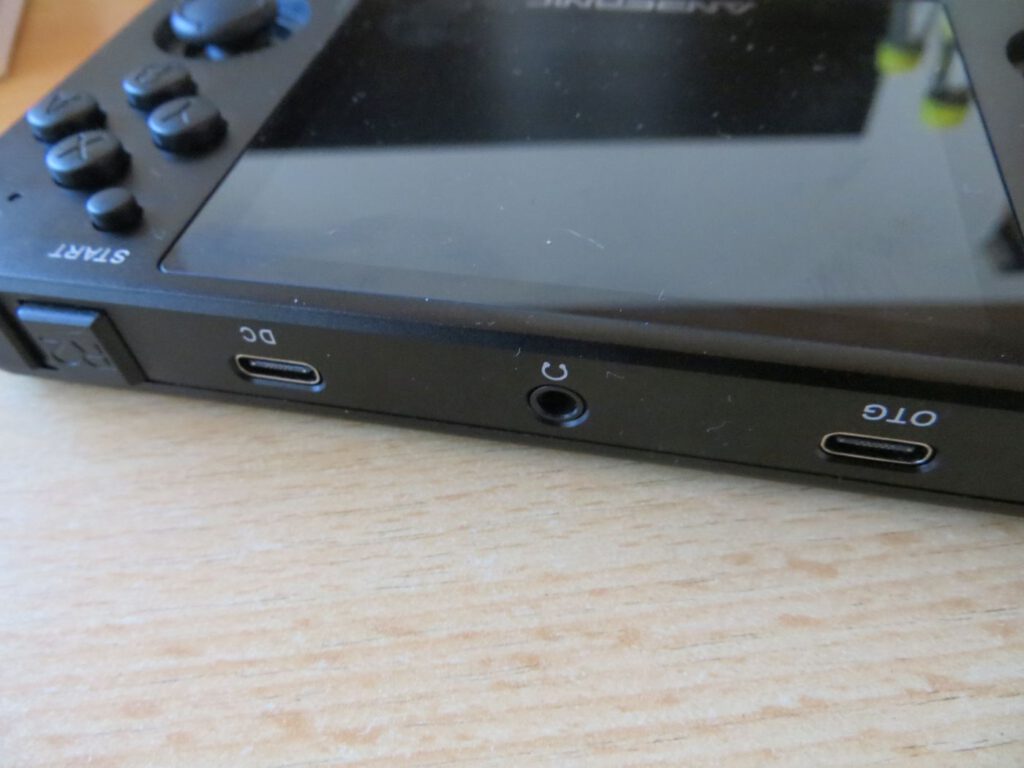
- Audio/Connections: 3.5 mm headphone jack, USB-C (OTG), stereo speakers
- Audio/Anschlüsse: 3,5 mm Kopfhörer, USB-C (OTG), Stereo-Lautsprecher
- Wi-Fi: not built-in, via a compatible USB Wi-Fi dongle
(Specifications may vary slightly depending on the retailer.)
Wi-Fi? Yes – but only via a dongle
On the RG351MP, built-in Wi-Fi has been removed; connectivity is provided via a USB Wi-Fi adapter (nano dongle via OTG). This has been officially confirmed; various firmware wikis list compatible dongles (including the TP-Link Archer T2U Nano).
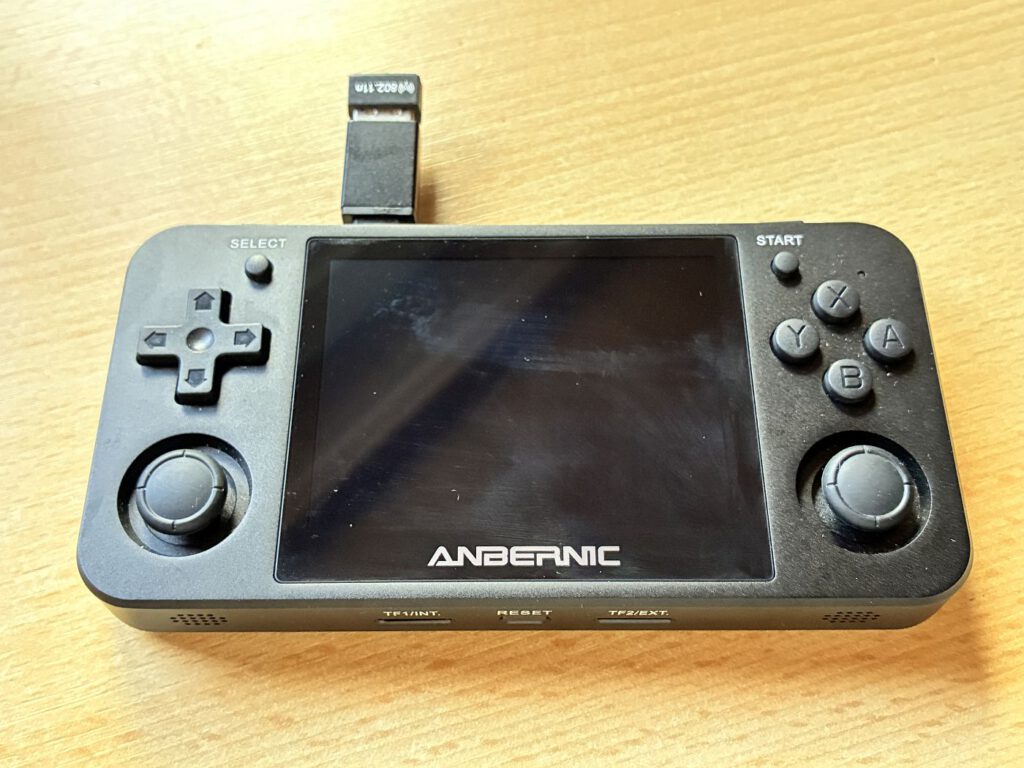
Emulation: Works flawlessly up to PlayStation 1 – N64/PSP/Saturn/Dreamcast only to a limited extent
The RK3326 handles virtually all systems up to the 5th generation (NES, SNES, Mega Drive, PC-Engine, Neo-Geo, GB/GBC/GBA, PS1, …) with excellent quality. N64, PSP, Saturn and Dreamcast are more of an ‘experiment’ on this SoC, with performance heavily dependent on the game – no benchmark for these platforms.
A practical tip on accessories
- microSD: OS card + GAMES card are separate. 128 GB is sufficient for many systems; 256–512 GB for extensive PS1 collections.
- Card reader: Ideally USB 3.0 for faster transfers.
- Case: A simple 2.5″ HDD protective case fits well.
(Based on experience; storage requirements depend on file formats such as CD, MP3, FLAC, etc.)
Software recommendation (2025)
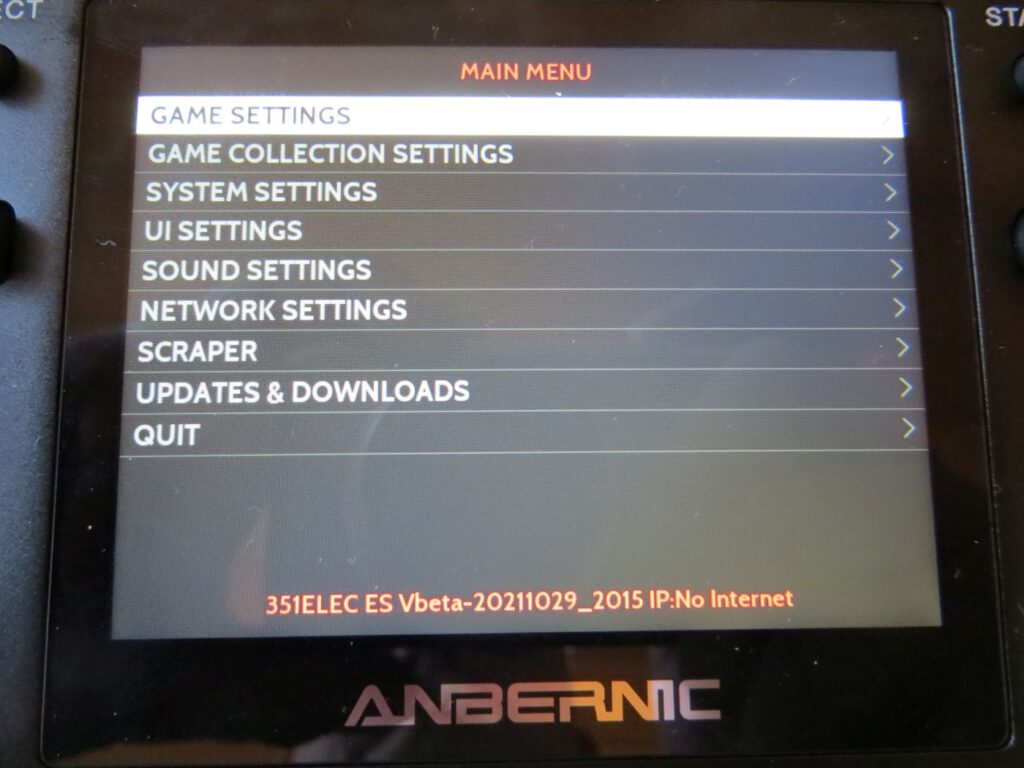
Historically, AmberELEC (formerly 351ELEC) was my first choice; the latest release version is dated 3 February 2023 (“Panda Conspiracy”). Since May 2025, a pre-release version has been available via online update. ArkOS is an alternative for the RG351MP – with updates for 2024/2025 (including emulator updates such as PPSSPP 1.19.x). There are separate changelogs/builds for the MP. (AmberELEC)
Quick guide: Setting up AmberELEC/ArkOS (my method)
- Download the image (make sure you select the correct device variant) and write it to the OS microSD card using Balena Etcher or a similar tool.
- The system creates the data structure during the first boot; for updates: simply copy the update package into the update directory.
- On the PC (AmberELEC), you can see the volumes “351ELEC” and “GAMES” – ROMs are stored in GAMES/roms/[system folder].
- Wi-Fi (dongle only): enable in ArkOS and select a network. (See the ArkOS Wiki for a list of compatible dongles.) (AmberELEC)
Supported systems (selection)
- Consoles: Atari 2600–7800, NES/Famicom, SNES, PC Engine/TurboGrafx-16 & CD, Mega Drive/Genesis & Sega Mega CD, Master System, Neo Geo, PS1
- Handhelds: Game Boy/Color/Advance, Game Gear, Neo-Geo Pocket/Color, WonderSwan/Color
- Arcade: MAME (older cores, e.g. 2003), FBNeo/CPS1/2/3
- Limited: N64, PSP, Saturn, Dreamcast (depending on the game, core and tweaks)
(Coverage varies by firmware/core version; the 5th generation is the RK3326’s comfort zone.)
Usability, feel & everyday use
The metal casing feels high-quality and has a satisfyingly solid weight to it; the buttons are responsive, and the sticks (dual analogue) are well-positioned. With a 4:3 panel, classic systems look just right. For cover scraping, RetroAchievements or network transfers, I use a Nano dongle when needed. Battery life is around 6–8 hours in real-world use (depending on system/load).
Conclusion
I’m still very happy with the RG351MP. Compared to newer, faster handhelds, it feels more substantial, the aluminium casing is top-notch, everything runs smoothly up to PS1 – and the 4:3 display is ideal for retro classics. If you want more power for N64/PSP/Saturn/Dreamcast, go for the newer RK3566/3588 devices; if you’re looking for a robust ‘PS1-and-back’ machine, the RG351MP offers a well-rounded, timeless package.
![ZX Touch – Firmware 1.12a [ZX Touch]](https://www.jungsi.de/blog/wp-content/uploads/ZX-Touch-Verpackung-Oberseite.jpg)
![ZX Touch [Elmar Electronic]](https://www.jungsi.de/blog/wp-content/uploads/ZX-Touch-Oberseite.jpg)
![Evercade Alpha Mega Man [Blaze]](https://www.jungsi.de/blog/wp-content/uploads/Evercade-Alpha-Controller.jpg)
Leave a Reply