

![Amiga CD³² [Commodore]](https://www.jungsi.de/blog/wp-content/uploads/Commodore-Amiga-CD32-seitlich.jpg)
A Commodore games console? The Commodore Amiga CD³² has found its way into my retro corner. This device wasn’t Commodore’s first attempt to break into the games console market – for example, the C64 Game System was launched in 1990 and the CDTV in 1991.
Die Basis für das CD³² lieferte der Amiga 1200, der 1992 veröffentlicht und mit dem neuen AGA-Chipsatz (Advanced Graphics Architecture) ausgestattet wurde. 1992 war ein Jahr, in dem viel falsch lief für die Firma aus USA – die Spezifikationen des A1200 wurden zu früh veröffentlicht und Commodore konnte das Gerät nicht pünktlich zum Weihnachtsgeschäft ausliefern. Währenddessen wurden noch viele Amiga 600 produziert oder waren auf Lager. Da aber am Horizont schon der neue, bessere Rechner in Sicht war, blieb Commodore auf einem riesigen Berg A600 (und A500) sitzen, womit auch viel Geld fehlte. Zudem kostete der Amiga 600 viel Geld – er sollte eigentlich eine günstige Version des A500 werden, wurde aber wegen seiner Bauweise sogar teurer als der A500. Commodore arbeitete nach dem Prinzip etwas herzustellen, zu verkaufen und mit den Erlösen die „Rohstoffe“, die sie eingesetzt hatten, zu bezahlen. Das rächte sich nun…
Diesen Hintergrund wollte ich vorher erklären, um das weitere Geschehen besser verstehen zu können. Seit 1992 arbeitete Commodore am „CD Game System“ (interner Frühcodename: Amigo, später offiziell „Spellbound“) und im Januar 1993 wurde das Design des Gatearray-Chips mit dem Namen „Akiko“ dafür fertiggestellt. Dieser konvertierte Bitplane-Grafiken hardwareseitig in das sogenannte „Chunky-Pixel“-Format und vereinfachte damit die Portierung von PC-Spielen mit bis zu 24-Bit-Grafiken auf das neue Gerät erheblich.
In February 1993, development was nearing completion. As the console urgently needed high-quality games, 15 prototypes were produced for game developers. As the casings weren’t ready yet, the circuit boards were simply screwed onto wooden panels 😉 Before being delivered to the developers, the name was finally changed to CD³². That said it all: a CD-based system with a 32-bit processor.
Im Oktober 1992 begann auch die Entwicklung des Controllers für das Game System. Das Design lehnte sich an SNES/Super-Famicom-Controller an. Aus heutiger Sicht ist die gequetschte Form eines „U“ aus ergonomischer Sicht fragwürdig. Trotzdem liegt das Joypad recht gut in der Hand. Der rote Knopf wurde etwas größer gestaltet und wird damit zum Hauptknopf. Leider ist die Verarbeitung mangelhaft und das Steuerkreuz besteht aus einer flachen Scheibe mit vier Noppen. Bei späteren Versionen wurde auf die Steuerscheibe einfach noch ein Steuerkreuz aufgeklebt.
Das Gehäuse des CD³² wurde von Don Kaminsky, der auch für das Design von A600 und A1200 verantwortlich war, entworfen. Als Ausgangspunkt diente das „Top-Loading“ CD-Laufwerk, das aussieht wie bei billigen CD-Spielern ohne Schubladen für die CDs. Immerhin war es ein Double-Speed-Laufwerk!
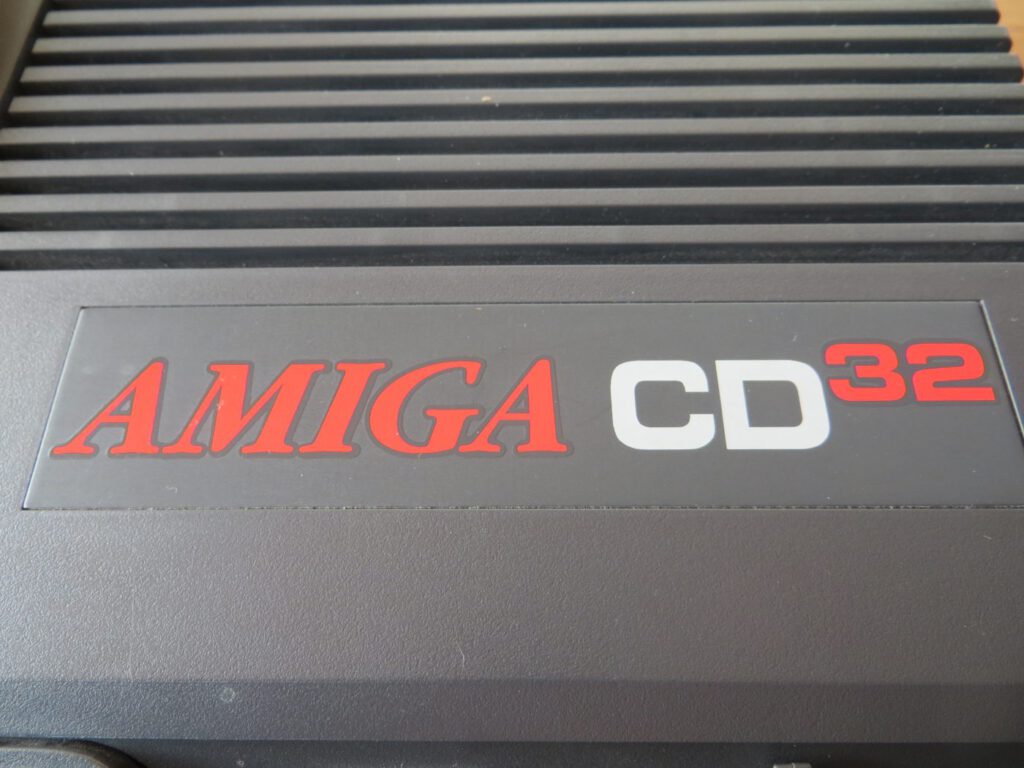
Commodore Amiga CD³² – Logo
Alongside the device itself, a separate MPEG video decoder card was developed, which enabled the CD³² to play digital videos from CD (VCD – Video CD format). It was also possible to use CD-i Video CDs.
The CD³² was due to be unveiled at the CES in Chicago in June 1993, but Commodore lacked the funds for a large stand. The only place where the Amiga was on display was at the stand of NewTek, the developer of the LightWave 3D software, which ran on Commodore computers. This software was used to create scenes for Babylon 5, seaQuest DSV and Jurassic Park. Commodore’s main rival – the 3DO – was also unveiled at CES. The device was very well received at the exhibition, and Commodore developers were successfully poached.
Production of the CD³² began in Asia in August 1993 to ensure that sufficient units would be available for the Christmas shopping season. Then the problems began to escalate, as Commodore owed too much money to too many companies, and they would only supply goods if paid in cash. Added to this were shortages of CD drives, which were not simply off-the-shelf components, but required a specific CD-ROM mechanism. There was only enough money to purchase parts to produce 100,000 units. Then Commodore was also caught up in legal proceedings with CADtrak, which had sued several computer manufacturers for infringing its XOR patent relating to the manipulation of bitmap graphics. As Commodore failed to pay the licence fees demanded (around 10 million US dollars), a US court imposed an import ban on CD³² units manufactured in Asia into the USA.
In Europe, the console was officially unveiled on 16 July 1993 at the Science Museum in London. The actual launch took place in September 1993 – making the CD³² the first standalone 32-bit CD console in Europe. Its main competitor in Europe was Sega with the Mega Drive, which, however, was only 16-bit and, with the Mega CD, could only offer an add-on to the existing console. The CD³² initially cost 299 pounds (approx. 750 DM).
As the CD³² had to be brought to market quickly, there was a lack of software capable of making full use of the device’s capabilities. Consequently, numerous titles originally developed for the Amiga 1200 had to be ported. As a result, in 1993 only 26 of the promised 70 games were available. In total, there were around 140 commercial releases by 1995.
By the end of 1993, Commodore had sold only 166,000 CD³² worldwide (25,000 in Germany), whereas 400,000 would have been needed for Commodore to survive. This was not due to low demand, but to limited production caused by a lack of financial resources.
In April 1994, Commodore International filed for bankruptcy and discontinued the CD³² after just eight months on the market.
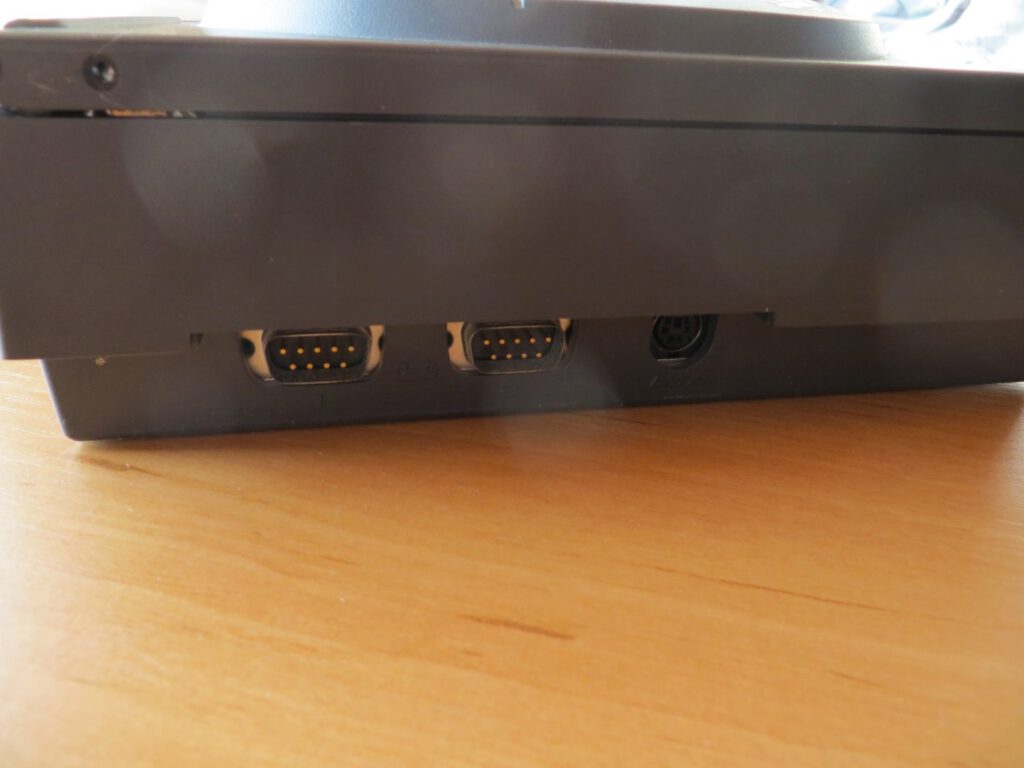
Technical Specifications
– CPU: Motorola 68EC020 @ 14.18 MHz (PAL) / 14.32 MHz (NTSC)
– RAM: 2 MB chip RAM
– Save data storage: 1 KB EEPROM
– Graphics: AGA chipset with Akiko (chunky-to-planar converter)
– CD drive: Double-speed (2×)
– Operating system: AmigaOS 3.1 / Kickstart 3.1
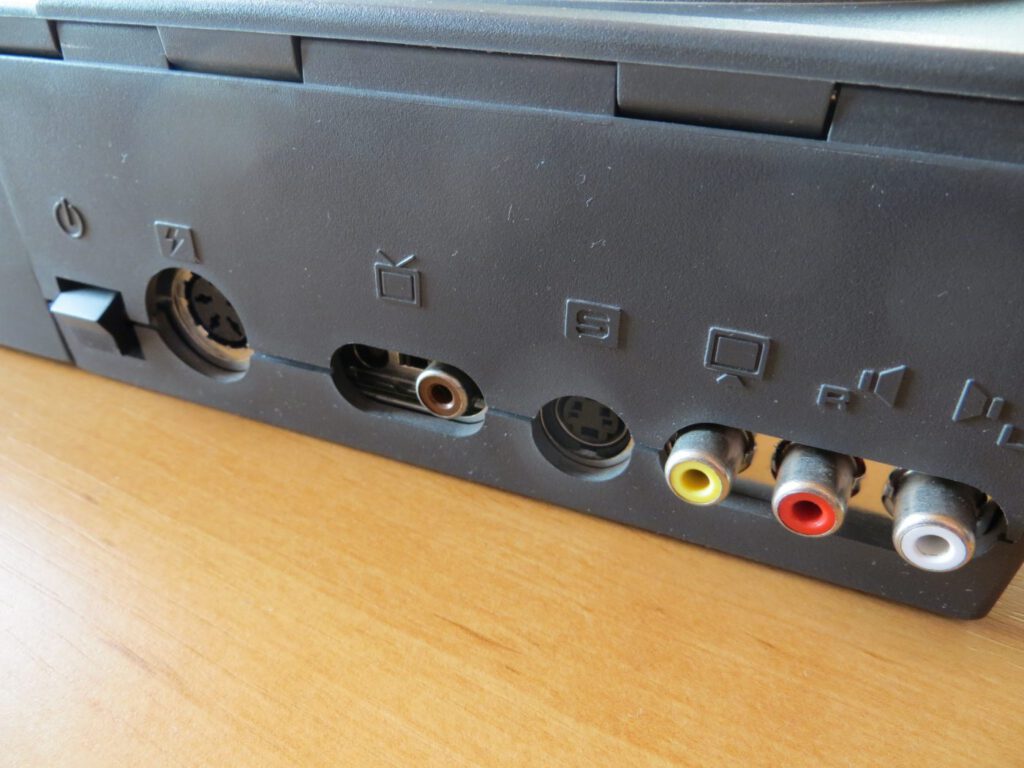
Connections
– RF output (antenna socket)
– Composite video (RCA)
– S-Video
– Stereo audio (2× RCA)
– Headphone output with volume control (front panel)
– Two 9-pin joypad sockets
– Amiga-compatible (e.g. mouse or joystick)
– Expansion port (e.g. for FMV module and expansion cards)
– Auxiliary port: for Amiga 2000/4000 keyboard
– CD control buttons on the front (Play/Stop/Skip) allow the CD³² to be used as a dedicated audio CD player
Tips
– It is very important to replace the old electrolytic capacitors with modern ceramic ones, as the former, like those in the Amiga 1200, are prone to leaking. Whilst doing so, you can also replace any capacitors that have been fitted with the polarity reversed.
– when buying, make sure the cover for the expansion slot on the back is included
– the CD drive’s hinges are delicate – but the drive still works
– Replacement parts are available for the laser unit
– To get the most out of the machine today, it’s worth fitting an expansion such as the TerribleFire 328/330 or the Wicher CD32. Both expand the memory with additional FastRAM and add an IDE port – together with a mouse and keyboard, this effectively turns it into a fully-fledged Amiga 1200 with a CD drive.
– the controller’s D-pad is very sensitive and can easily be faulty
– as an alternative to the original controller, there’s the HoneyBee or Competition Pro Pad – apart from the name, they’re both the same (see separate section below)
– Power supplies: small/large power supply – the large one can be opened and therefore repaired
– Various cases: white Commodore logo and a raised section behind the CD flap – the other one doesn’t have this – it doesn’t matter which one you choose
– Restart the CD³² and press both mouse buttons (mouse in Port 2): Early Boot Menu
– CD³² start screen → right mouse button → language menu
– CD³² start screen → left mouse button → save menu – if there is no free space, the oldest save file will be overwritten. Save files can be protected from being overwritten in the menu. Unfortunately, only 1 KB(!) was available, which was often filled up by just a single save file. – A good way to test the CD³²’s functionality is to use the ‘200’ or ‘444’ CDs, which can be found online. If the sound works on the first CD, the demos run smoothly and you can navigate through the menu without delay, the device is in good condition.
– the Mega Drive or Master System controller can also be used (though some buttons won’t work)
– the joypad can also be used on standard Amigas
– if using a mouse, it should be connected to Port 2
A special Kickstart (3.1) has been created for the CD³², which enables the system to boot automatically from the CD. If the console is started without a CD inserted, a colourful, animated welcome screen is displayed.

strong>Well-known expansions
– Paravision SX1: converts the CD32 into an Amiga 1200 – including an IDE port, floppy drive port and memory slot
– DCE SX32 MK1/Mk2: as above
– TerribleFire 328/330
– Wicher CD32
– Indivision ECS
– Competition Pro/HoneyBee
– Alternatives to the original controller
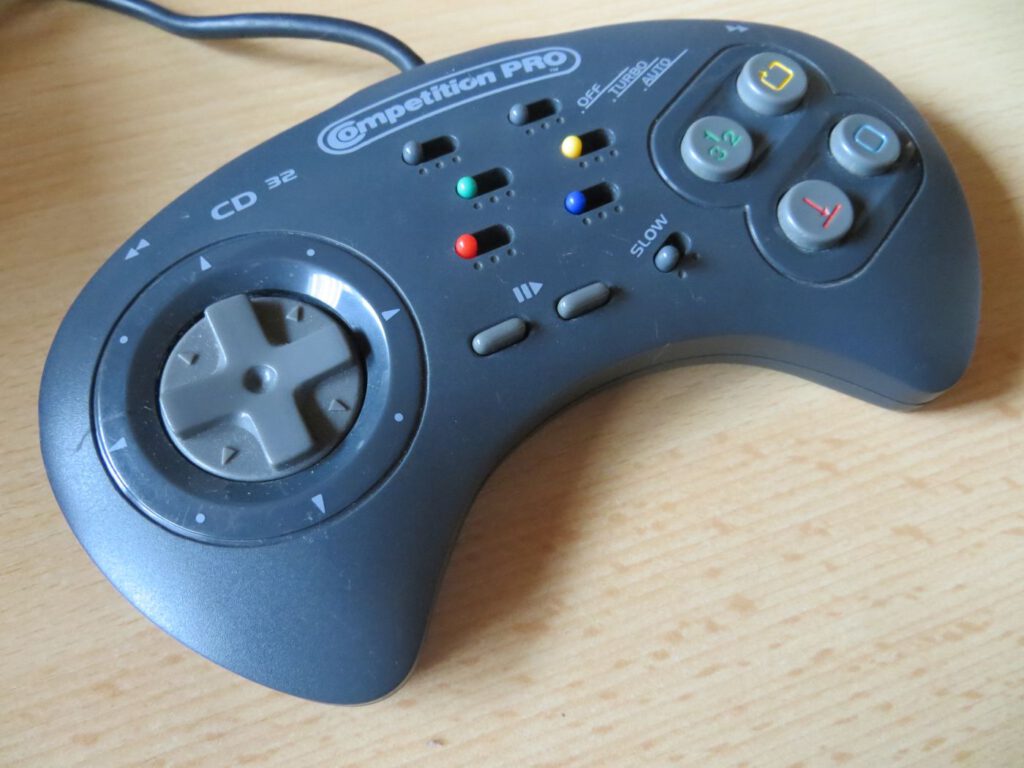
Competition Pro CD32 – the better pad
If you want to play the CD³² for any length of time, you’ll find it hard to do without an alternative to the original pad – the wobbly D-pad and the poor build quality simply spoil the fun. A very decent alternative is the Competition Pro CD32 (also available as the HoneyBee – the only difference is the logo).
The pad is clearly modelled on the Mega Drive controller: it has a classic curved shape, a decent directional pad with a distinct click, and the four coloured action buttons (red, yellow, green, blue) are arranged in the typical diamond pattern this time, rather than in a flat square. This makes it fit much better in the hand than the original CD³² model.
However, the real added value lies in the additional functions: each of the four action buttons has its own mini-slider switch, which can be used to individually enable or disable Turbo/Autofire. A central three-position switch (OFF/TURBO/AUTO) sets the global mode, and a SLOW switch allows for slower playback – formerly the typical cheat to help with difficult passages. The CD control buttons (Play/Rewind/Forward) are also included, so the pad works in audio CD mode too.
So if you spend a lot of time playing with the CD³² or want to use the pad on another Amiga (all 9-pin models from the A500 to the A4000), you shouldn’t stick with the original pad.
Type plate and serial number
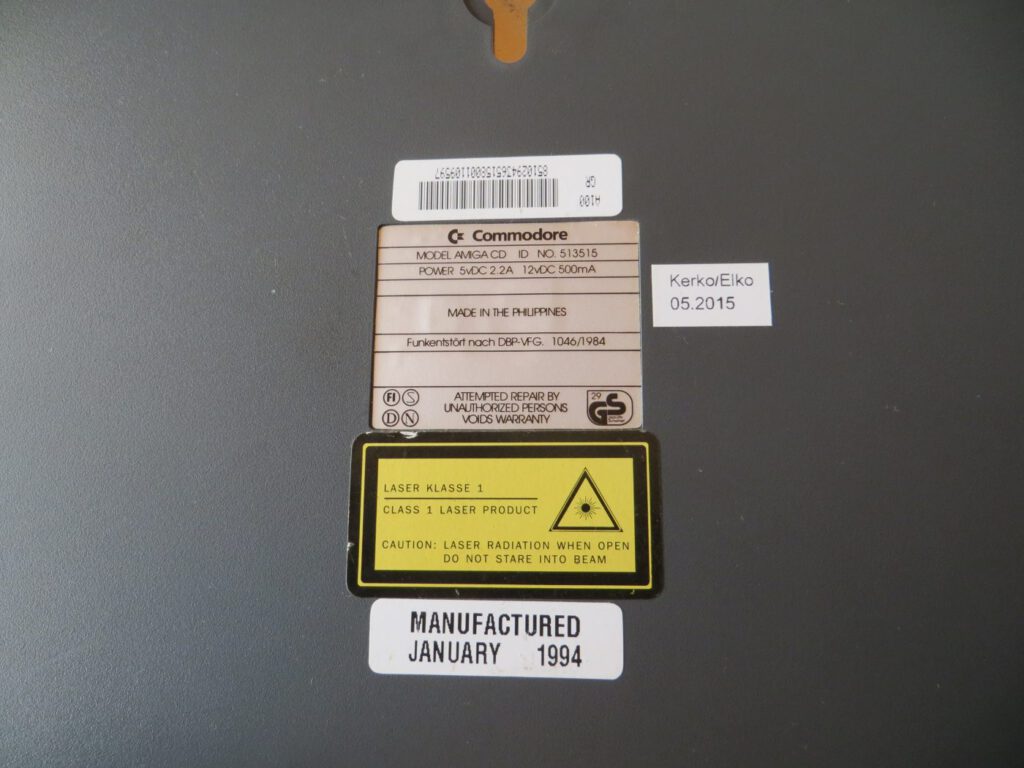
On the underside, there’s a whole collection of stickers that reveal quite a lot about the device.
Das Haupt-Typenschild trägt das Commodore-Logo und nennt die Modellbezeichnung „AMIGA CD“ sowie die ID No. 513515, die für die Modellvariante steht. Daneben die Stromversorgung (5 V DC / 2,2 A und 12 V DC / 500 mA), die Herstellungsangabe „Made in the Philippines“ und die deutsche Funkentstörungs-Kennung DBP-VFG 1046/1984. Ergänzt wird das durch das GS-Zeichen für „Geprüfte Sicherheit“ und das gelbe „Class 1 Laser Product“-Warnschild, das auf das CD-Laufwerk hinweist.
An additional label records the production details: ‘Manufactured January 1994’. This means my unit rolled off the production line just three months before Commodore International went bankrupt in April 1994 – one of the many CD³²s produced during the company’s final days.
Die Seriennummer 8510294365158001109597 lässt sich teilweise entschlüsseln: – 851 = Werkscode für die Philippinen (passt zur Beschriftung „Made in the Philippines“) – 02 = Kalenderwoche 2 – 94 = Produktionsjahr 1994 – die folgenden Ziffern bilden die fortlaufende Chargen- bzw. Seriennummer
Damit ergibt sich als Produktionszeitpunkt die zweite Januarwoche 1994 – konsistent mit dem „Manufactured“-Aufkleber.
Oberhalb des Typenschilds findet sich noch ein Barcode-Etikett mit dem Zusatzcode „AL00 GR“. Das GR dürfte die Auslieferungsversion für den deutschen Markt (Germany) kennzeichnen, was zum DBP-Funkentstör-Aufdruck passt; AL00 verweist vermutlich auf eine bestimmte Hardware- bzw. Kickstart-Konfiguration der Region.
The small white sticker ‘Kerko/Elko 05.2015’ is not a factory mark, but a label I added myself: in May 2015, I replaced the old electrolytic capacitors with ceramic capacitors – the same precautionary measure I recommend in the tips above. This way, it’s easy to trace later on exactly when the recap took place.
Games
Unfortunately, many games were lacklustre ports of the floppy-disc versions, but there were also a few titles that were given new sound and music in particular, as there was plenty of space on the CDs – for example, *Disposable Hero*, *Xenon* and *Fire & Ice*. There were also titles exclusive to the CD³², although many other official releases were Amiga 1200 games that had been expanded.
– Flink
– Pirates Gold
– Diggers
– Defender of the Crown 2
– Microcosm
– Prey: An Alien Encounter
– Litil Divil
– Amiga CD Football
– Castles II
– Final Gate
– Labyrinth of Time
– Lunar-C
– Summer Olympix
– Ultimate Body Blows
Commodore Amiga chipsets
– OCS (Original Chip Set) – used in the Amiga 1000, 500 and 2000 – HiRes 640×256 or 640×512 (PAL interlaced) with 16 out of 4096 colours; LoRes 320×256 (320×512) with 32 colours, HAM6 4096 colours; EHB mode (Enhanced Half Bright) – 64 colours – 32 freely selectable, the remainder generated from the first 32 at half brightness
– ECS (Enhanced Chip Set) – Amiga 600, 500 Plus and 3000 – SuperHiRes mode at 1280×256 (1280×512) with 5 out of 64 colours; freely programmable line frequencies and the ability to address 2 MiB of chip RAM
– AGA (Advanced Graphics Architecture) – Colour depth ranging from 12-bit (4,096 colours) to 24-bit (16.8 million colours), of which a maximum of 262,144 colours can be displayed simultaneously in HAM8 mode at all resolutions. With AGA, colour palettes can consistently comprise 256 entries. Here too, 2 MiB of chip RAM is possible. – AAA (Advanced Amiga Architecture) – a 64-bit graphics chipset that was intended to be the successor to the AGA. Unfortunately, the project never progressed beyond three prototypes, which still had many faults.
![Rogue Declan [Commodore Amiga]](https://www.jungsi.de/blog/wp-content/uploads/Rogue-Declan-Ladescreen.jpg)
![TerribleFire 328/330 – Kipper 2K Riser [Commodore Amiga CD³²]](https://www.jungsi.de/blog/wp-content/uploads/TF328_330.jpg)
![Krogharr [Commodore Amiga]](https://www.jungsi.de/blog/wp-content/uploads/Krogharr-The-Beerserker-Startscreen-480x300.webp)
Leave a Reply