

![Enterprise 128 [Enterprise Computers]](https://www.jungsi.de/blog/wp-content/uploads/Enterprise-128-Oberseite.jpg)
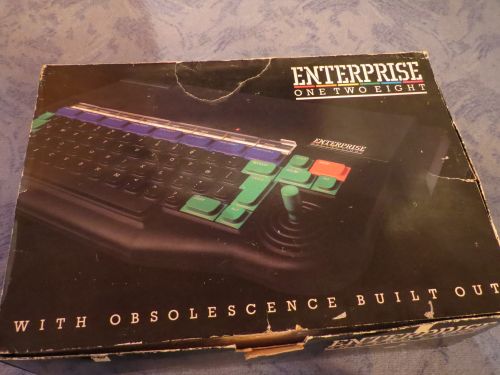
I’ve gone and done it again, adding an Enterprise 128 to my collection. As it seems only 80,000 of these computers were ever produced, this is likely to be a genuine collector’s item. My unit comes from Hungary – I shan’t mention the price – and the purchase was preceded by some fair haggling. 🙂
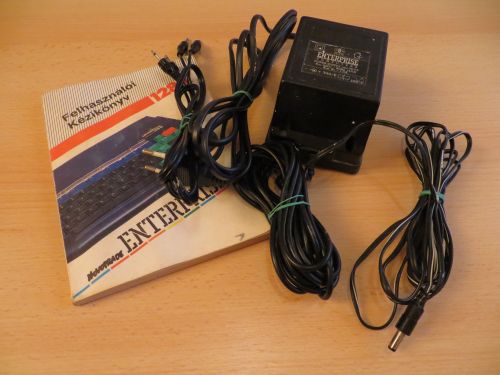
After just one week, I had the unit in my hands. It was in its original box, and the polystyrene inserts were included too. Also included were the mains adaptor, an aerial cable, a cable for connecting a cassette recorder and an original Enterprise cassette recorder. The manual is in Hungarian. 🙂
History
The English home computer market began in 1982 with the launch of the Sinclair ZX Spectrum. The trading firm Locumals, based in Hong Kong, commissioned Intelligent Software in England (led by the international chess player David Levy) to develop a home computer. During development, the computer was codenamed DPC (Damp Proof Course) to confuse potential competitors. The machine was also known by the names Samurai, Oscar, Elan and Flan before the name ‘Enterprise’ was finally chosen.
Modelled on Amstrad’s AMSOFT, Entersoft was founded to ensure a steady supply of software. The Enterprise was announced in the press in September 1983, and by the time of its planned launch in April 1984, 80,000 pre-orders had been placed. Unfortunately, the product could not be launched until 1985 – by which time the UK home computer market was already dominated by the ZX Spectrum, Commodore 64, Amstrad CPC and Acorn BBC Micro.
A successor model, the PW360, was developed in 1986 to compete with the Amstrad PCW 8256 (known in Germany as the Schneider Joyce), but by that time the company was already in financial difficulties and was closed down.
Financial failure
The Enterprise was very advanced for its time, but was not a commercial success. The Amstrad CPC 464 had a monitor and a cassette recorder, was released before the Enterprise and was sold at a lower price.
Following the first production run of 80,000 units, it is assumed that no further units were produced, meaning that the Enterprise is likely to be an exceptionally sought-after collector’s item in Europe. Before it closed down, the company shipped 20,000 units to Hungary, where a strong user community formed.
Further comments on the Enterprise
The Enterprise 128 was a latecomer to the 8-bit scene. Its ambitious developers had big plans, but were overtaken by reality. After repeated delays to the launch and a veritable odyssey of problems with the product name, the Enterprise appeared at a time when the 16-bit machines (Atari ST and Amiga) were already on the shelves.
A brilliant computer with a fabulous design. Unfortunately, it was made by the wrong company. At first, it was called ‘Elan’. Apparently, that infringed someone’s rights. So they changed it to ‘Flan’, followed by ‘Enterprise Computers’. It wasn’t until 1987 that a distribution partner was found for Germany (the chess computer manufacturer Hegener & Glaser – known for the ‘Mephisto’), and the Enterprise had to contend with very different competitors than would have been the case in 1985.
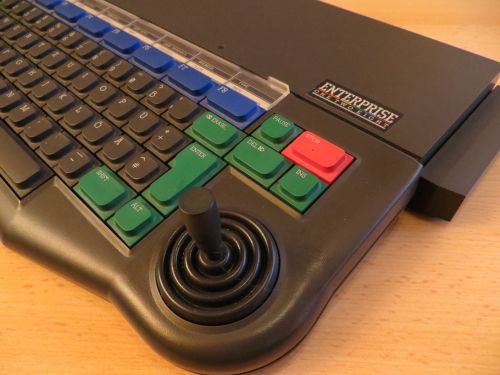
With its flat casing, colourful keys and a joystick in place of the cursor keys (which earned the computer the nickname ‘Knetgummilache’), you might mistake the Enterprise 128 for a video title generator straight off the production line. The built-in joystick replaces the cursor keys and even allows diagonal movement – this may seem a bit frivolous, but it’s actually very practical and, of course, works brilliantly for gaming too. But it wasn’t just the design that was ahead of its time: the graphics chip is almost fully programmable and can even display exotic modes. Even the built-in word processor demonstrates this with its mix of 40- and 80-character displays on a single screen page.
The word processor is fully integrated into the ROM. It is relatively user-friendly and a world away from the makeshift solution that Commodore, for example, had built into the Plus/4. The Basic programme is included as a ROM module.
For a computer from 1985, the Enterprise is very advanced. For example, it offers a graphics resolution of up to 640 x 256 pixels (in 2-colour mode) or 640 x 512 pixels in interlaced mode – although the latter is anything but easy on the eyes and not really recommended for prolonged use. At higher colour depths, the resolution decreases accordingly: a display with 256 colours is possible at a maximum resolution of 80 x 256 pixels.
The Enterprise 64’s memory capacity is fairly average for a computer of its time – the others also offer 64 KByte. However, this computer has 22 address lines, which enables it to address up to 4 MByte of memory! This is made possible by a special memory management circuit, as the Z80A CPU used has only 16 address lines itself. Under BASIC, the full 4 MB cannot be utilised, but up to 128 different programmes can be stored there, or buffer memory can be allocated for peripheral devices.
Another highlight of the Enterprise is its built-in networking capability: as standard, 32 computers can work together in a Local Area Network (LAN). The operating system handles the administration of this in the background; it therefore makes no difference which programme the user is currently running on their computer. Incidentally, the network routines take up a mere 8 KByte!
With the included 3.5-inch floppy disk drive, users also have access to CP/M programmes, which can be run under EXDOS (thanks to the Z80A). For those who prefer to write their own programmes, a comprehensive version of BASIC is also available, which, amongst other things, supports structured programming (see the section on IS-Basic below for more details).
Despite all its merits, the Enterprise was a flop. This may have been down to its high price, but above all to a lack of marketing. In Germany at least, the Enterprise was virtually unknown and was usually only briefly mentioned in the trade press as something of a curiosity.
The company Hegener & Glaser, well known for its chess computers, has released its own version of the Enterprise 64 under the name Mephisto PHC 64. Apart from the name, the computer is absolutely identical to the original, both in terms of its exterior and its internal components.
The Enterprise 128, with 128 KB of RAM, was released alongside the Enterprise 64 in 1985 as a second RAM configuration of the same machine – not as a later successor. However, it was no more successful than the smaller model.
Technology
CPU, memory and ASIC chips
The Enterprise has a 4 MHz Z80A CPU, 64 kB or 128 kB of RAM and 32 kB of internal ROM, which contains the EXOS operating system, an editor and a word processor. The BASIC programming language was supplied on a 16 kB ROM module.
Two specialised chips (application-specific integrated circuits – ASICs) took some of the workload off the CPU. They were named after their developers, ‘Nick’ and ‘Dave’ – Nick Toop, who had previously worked on the Acorn Atom, and Dave Woodfield. ‘Nick’ handled the graphics, whilst ‘Dave’ was responsible for the sound and memory paging (bank switching).
Keyboard and casing
The casing is unusual in that it incorporates a full keyboard with programmable function keys and a joystick. Its distinctive shape was the result of the developers’ desire to move away from the conventional design. The low-profile keyboard was constructed with mechanical keycaps on a rubber membrane and features a standard layout. Many users did not find the feel of the keys to be good, as the keys were not full-size and felt spongy, similar to those on the Sinclair QL or the Spectrum+. The joystick replaces the standard cursor keys and allows the cursor to be moved diagonally. The two graduates of the Royal College of Art, Geoff Hollington and Nick Oakley, were responsible for the design.
Graphics
The Enterprise has five graphics modes: 40- and 80-column text modes, low-res and high-res bitmap graphics, and attribute graphics. The bitmap graphics mode allows you to choose between a 2-, 16- or 256-colour display, with the horizontal resolution decreasing as the colour depth increases. Interlaced and deinterlaced modes are available. At 640×256 pixels (or 640×512 in interlaced mode), only a 2-colour display is possible. A 256-colour display has a maximum resolution of 80×256. The attribute graphics mode offers a resolution of 320×256 pixels, with colours selectable from a palette of 256.
Several pages can be displayed on the screen at the same time, even if their graphics modes differ. Each page has its own colour palette, which allows more colours to be displayed on the screen simultaneously. A page may be taller than the screen or the window in which it is displayed. Each page is linked to a channel of the EXOS operating system, making it possible to write to hidden pages.
Sound
The sound is processed by the second ASIC chip, ‘Dave’, and features three sound channels and one noise channel. The sound from each channel can be freely positioned within the stereo image. The available effects are distortion, low-pass and high-pass filters, and ring modulation. The chip features programmable envelope generators, which are more flexible than conventional ADSR envelope synthesisers, and up to 255 phases can be specified for each envelope. In each phase, the envelope can adjust the pitch and stereo balance of the sound.
Interfaces
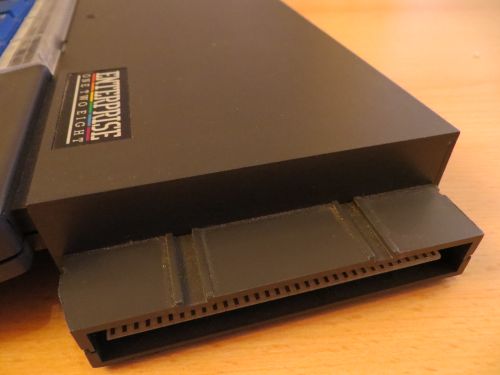
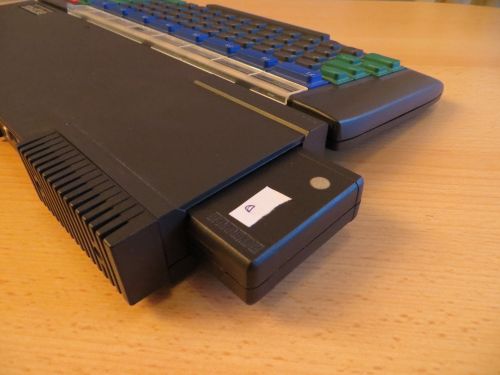
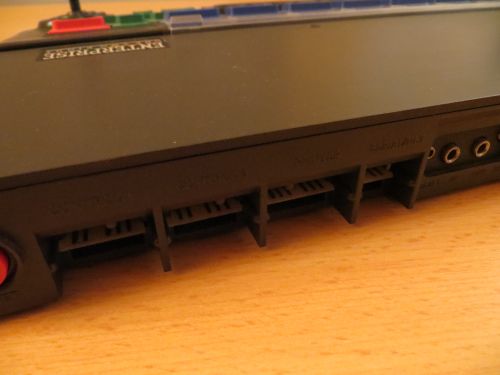
The Enterprise was equipped with a wide range of ports, offering far more than was usual for home computers at the time. It features an RGB output, an RS232/RS423 port, a Centronics printer port, two external joystick ports, two cassette interfaces, a ROM cartridge port and a simple expansion port. To keep costs down, many of the connections did not use sockets, but rather simple pin headers which provided access to the exposed circuit traces at the edge of the circuit board.
The Basic ROM can be replaced with a ROM that emulates the ZX Spectrum, which theoretically allows the Enterprise to run thousands of Spectrum games. An external floppy drive became available later, allowing access to CP/M programmes, whilst at the same time being compatible with the MS-DOS floppy disc format and file structure.
Software
System ROM
EXOS (Enterprise Expandable Operating System) is included in the System ROM and is based on channels. All peripheral devices are accessed via channels, which enables programmes to treat all input and output from the devices in the same way. The System ROM also contains a full-screen editor that can be used as a simple word processor. It can be used to edit text files and BASIC programmes, as well as programmes written in other languages. The editor uses the joystick to control the cursor.
IS-Basic
Enterprise did not have BASIC or any other programming language integrated into its internal ROM, unlike many other home computers of the time. The BASIC interpreter was sold on a 16k ROM cartridge, and the language could be easily changed by swapping the cartridge – a system similar to that of the Acorn BBC Micro.
IS-Basic complies with the ANSI BASIC standard. It is a fully structured language whose wide range of control structures allows for multi-line IF…THEN…ELSE, SELECT…CASE, DO…LOOP with WHILE and UNTIL at the start and/or end of the loop, and EXIT LOOP statements.
IS-Basic offers the unique ability to run several programmes simultaneously in memory. Each programme has a separate set of global variables and line numbers, but the CHAIN statement allows one programme to be called from another and parameters to be exchanged. Devices can be controlled directly from BASIC, so POKE and PEEK instructions are rarely needed. IS-Basic has the standard commands for drawing points, lines, circles and ellipses, and for filling areas, and supports Logo-style turtle graphics. Sound commands can be queued and executed in the background whilst the programme continues to run.
Other software
In addition to IS-Basic, a number of other languages were also available, including Forth, Lisp, Pascal and Assembler, either on ROM modules or on cassette. Basic-to-Basic converters could convert Basic programmes written for other home computers. Around 40 games, from IS and other publishers, were listed in the software catalogue. IS-DOS, the CP/M-compatible operating system, provided access to the large number of CP/M programmes that were available at the time.
Conclusion
A truly fascinating computer, which unfortunately was not as successful as it deserved to be given its capabilities. Because so few were produced, it is also difficult to get hold of one. The best way to do this is via eBay – mostly from Hungarian sellers. It is even more difficult to find peripherals for the Enterprise. I’ve never actually seen the floppy disk interface, and the Sinclair emulator is being offered on eBay at astronomical prices. Anyone with a keen interest in this computer should sign up to the Hungarian Enterprise forum – there’s even an English-language section there!
Links
http://de.wikipedia.org/wiki/Enterprise_%28Heimcomputer%29
http://www.theregister.co.uk/2013/10/24/elan_flan_enterprise_micro_is_30_years_old/
http://www.zock.com/8-Bit/D_Enterprise128.HTML
http://www.binarydinosaurs.co.uk/Museum/Enterprise/index.php
http://enterpriseforever.com/
![EXDOS Card Clone [Enterprise]](https://www.jungsi.de/blog/wp-content/uploads/exdos-floppy-conroller-klon-enterprise.jpg)
![EnterMice [Enterprise]](https://www.jungsi.de/blog/wp-content/uploads/entermice-bauteilseite.jpg)
![Enterprise Memory Upgrade [Enterprise]](https://www.jungsi.de/blog/wp-content/uploads/2015/02/Enterprise-128-RAM-Expansion-1M.jpg)
Wahnsinn…
Hab nicht mal gewusst, dass es so einen Rechner gab. Vor allem die Grafikauflösung mit 256 Farben ist hier der Hammer, quasi Amiga-Qualität auf 8-Bit Ebene…
PS: Hab dein ISA-Board noch immer bei mir. Ich denke so ab Februar hab ich wieder mehr Zeit. Den Janunar ab Morgen bin ich auswärts auf ReHa.
Gruß
Bernd
Ein sehr schöner Rechner, der mir damals schon gefiel – ich hatte aber schon einen ZX81 und einen *hust* C64 – aber bevor ich überhaupt einen Computer bekam, ging ich allein nach dem Aussehen (so ähnlich wie bei Frauen). Die Inneren Werte waren da noch egal (auch wie bei den Frauen). Heute sieht das ganz anders aus – auch bei den Frauen 🙂
Vielleicht können wir den ja in Mahlerts sehen??
Gruß
Jens
lieber jungsi, habe einen neuen entrerprise 64 und wollte nun einen monitor anschliessen. nun scheint jedoch der anschluss anders zu sein. mich würde nun interessieren wie ich einen monitor anschliesse und welcher kompatibel sein könnte. gruss, philip herdina unter philip.herdina@uibk.ac.at zu erreichen. mfg, p.herdina
Hallo, ein passendes Kabel gibt es z.B. gibt es hier: http://retrocables.es/tienda/index.php?id_product=48&controller=product&id_lang=1
erstmal schönen dank für diese beitrag und die info´s über diesen sehr hübschen homecomputer! Für 1983/1984/1985 wäre ER geil gewesen als EU/EG Schul-Computer anstatt dumme US 8 Bit Spiel Computer!
wie ich so lese muss ich da wohl feststellen,das den entwickler team wohl die zeit und die kosten davon gelaufen sind.auch dass sie sich für den uralten langsamen z80 als 8 BIT cpu entschieden haben,wie das alle „MSX“ von MSX 1-2-3 Entwickler Hersteller ja damals ja auch falsch gemacht haben,anstatt gleich hier eine moderne billige 16 bit cpu ala 8086/88 oder gleich 68000 zu nehmen.
Ich habe mir gerade über IHN Grafik Demos auf Youtube ansehen aber leider sehen viele alte Atari ST oder Amiga GRAFIK Demo´s da viel besser aus.
Denn gegen Mega DRIVE, ATARI ST (ob 130,260 oder 520) oder Amiga 500 hatte dieser Computer keinerlei Chancen okay, 256 Farben ABER ,z.b. wo sind da die SPRITES ? oder BOBs ? Oder der schnellen DMA DATA TRANSFER Modus ? ALA eines „Blitter“???