

I've finally got the first game console in my collection! I managed to rescue this Atari VCS 2600 (built sometime from 1982 onward, judging by the manufacturing date) right before it ended up at the recycling centre. Along with it came 18 cartridges, all handed to me in a plastic bag. First up was a thorough cleaning. A bit of soapy water and some silicone spray took care of that quickly enough. After checking over the crudely repaired antenna and power cables once more, I was ready to give it a try. At first I got no picture at all, since I was searching in the frequency range I was used to from my other computers (870 MHz). The VCS, however, sits on channel 2 or 3 – 68 MHz. Once tuned in correctly, it worked right away. Unfortunately, the picture coming through the RF/antenna input is barely bearable for more than five minutes on a modern flat screen. :-)
History
The Atari VCS (Video Computer System) was introduced in 1977, though it sold poorly at first. By 1979 it had become the must-have gift of the holiday season, despite being technically outdated even then (128 bytes of memory). In Germany, incidentally, the first units went on sale in 1980. That same year, the home conversion of the arcade hit Space Invaders gave sales a massive boost and turned the VCS into a true mass phenomenon. In 1982 the console was renamed Atari VCS 2600 (or Atari 2600 for short). In 1986 a visually slimmer version arrived on the market: the Atari VCS 2600 Junior, which then remained in production into the 1990s. The VCS helped cement the then-new concept of separating hardware from software once and for all. Up to that point, almost all consoles could only run various versions of Pong. With the VCS, there was now a base unit for the mass market that could play hundreds of different games. Roughly 30 million units of the VCS were sold, making it the best-selling game console of its era.
That rapid success had a flip side, though: the market became flooded with cartridges, many of them of dubious quality. In 1983 the US video game market then collapsed dramatically – now known as the "Video Game Crash of 1983". Flops like the home ports of Pac-Man and E.T. the Extra-Terrestrial are still seen as symbols of that crisis; legend has it that Atari had millions of unsold cartridges buried in a landfill in New Mexico. Trust among retailers and customers was badly shaken, and it took the next console generation – above all the NES – to bring the market back to life.
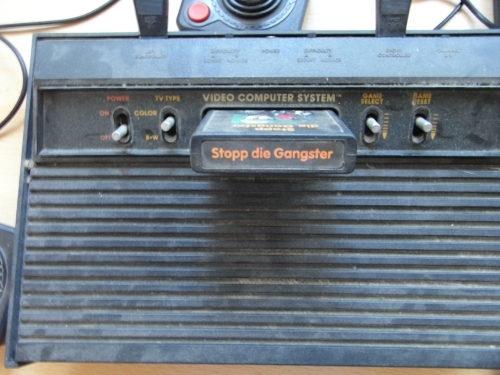
Switches on the unit:
- On/Off
- Black & White / Colour
- Left player difficulty
- Right player difficulty
- Game select
- Game start
Not every game made use of all the switches, and apart from On/Off, all of the switches could be assigned arbitrary functions by the individual game, since they were read and interpreted by whichever program was running.
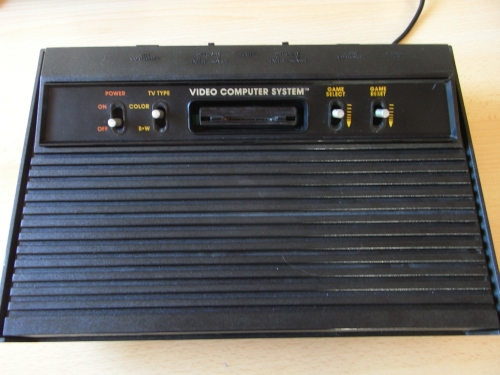
Controllers
Digital joysticks were used as controllers. There were also paddles, trackballs, light guns, and keypads.
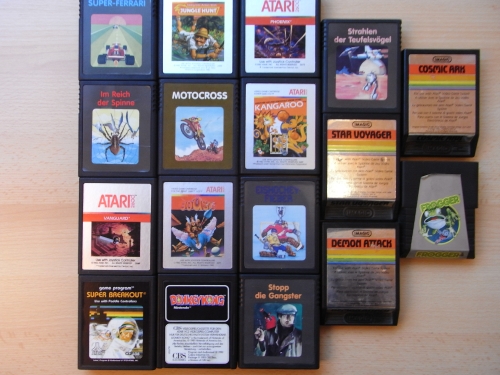
I also managed to rescue the following games before they were thrown out:
Donkey Kong - Ice Hockey - Demon Attack - Kangaroo - Joust - Phoenix - Motocross - Frogger - Jungle Hunt - Star Voyager - Super Breakout - Stopp die Gangster - Vanguard - Strahlen der Teufelsvögel - Cosmic Ark - Super Ferrari - Im Reich der Spinne
The go-to place for information on the Atari VCS is the AtariAge website.
New games on cartridge also show up there regularly – there's always something new being programmed that leaves you amazed.
Conclusion
I'm amazed how much fun some of these really simple games still are today. Many of today's programmers can hardly imagine what kind of tricks had to be pulled off back then to conjure up something entertaining on screen with such extremely limited hardware and so little memory (128 bytes of RAM and 4KB on the cartridges). These consoles are genuinely very cheap to find at flea markets these days, and the cartridges sometimes go for as little as one euro. With the two-player option, you can while away a gloomy winter's day basking in the good old days.
![AtariVox+ [Atari/Vectrex]](https://www.jungsi.de/blog/wp-content/uploads/atarivox-oberseite.jpg)
![Draconian [Atari VCS]](https://www.jungsi.de/blog/wp-content/uploads/Draconian-Cartridge.jpg)
![Harmony Cartridge [Atari VCS 2600]](https://www.jungsi.de/blog/wp-content/uploads/2013/11/Harmony.jpg)
Leave a Reply