

![Kempston Joystick Interface [Sinclair ZX Spectrum]](https://www.jungsi.de/blog/wp-content/uploads/Kempston-Joystick-Interface-2-oben.jpg)
Kempston Joystick Interface (1983) – the standard that gave the Spectrum that ‘arcade feel’
When I think back to my Spectrum days, one thing stands out above all else: the keyboard. I played an astonishing amount back then without ever using a joystick – simply because I didn’t have the right interface. It was only later that I realised just how much a small accessory can change the gaming experience. And that’s exactly what the Kempston Joystick Interface is: unassuming, robust – and, for many games, still the most obvious joystick option today.
Key facts
- Year of publication: 1983
- Manufacturer: Kempston Micro Electronics Ltd.
- System: Sinclair ZX Spectrum (über den Expansionsport / Edge-Connector)
- Connection: 9-pin D-Sub (Atari standard) for joysticks
- Special feature: Communication via a dedicated I/O port (Kempston standard); not a pure keyboard emulation
Two versions in my collection: ‘standing’ and ‘lying down’
I have two Kempston interfaces in my collection – and they differ in one respect that you notice straight away in everyday use:
Option 1: The ‘upright’ design
In this design, the interface is positioned quite high at the back of the Spectrum. This looks striking and sometimes requires less depth at the rear, but – depending on the joystick cable – can exert greater leverage on the connector.
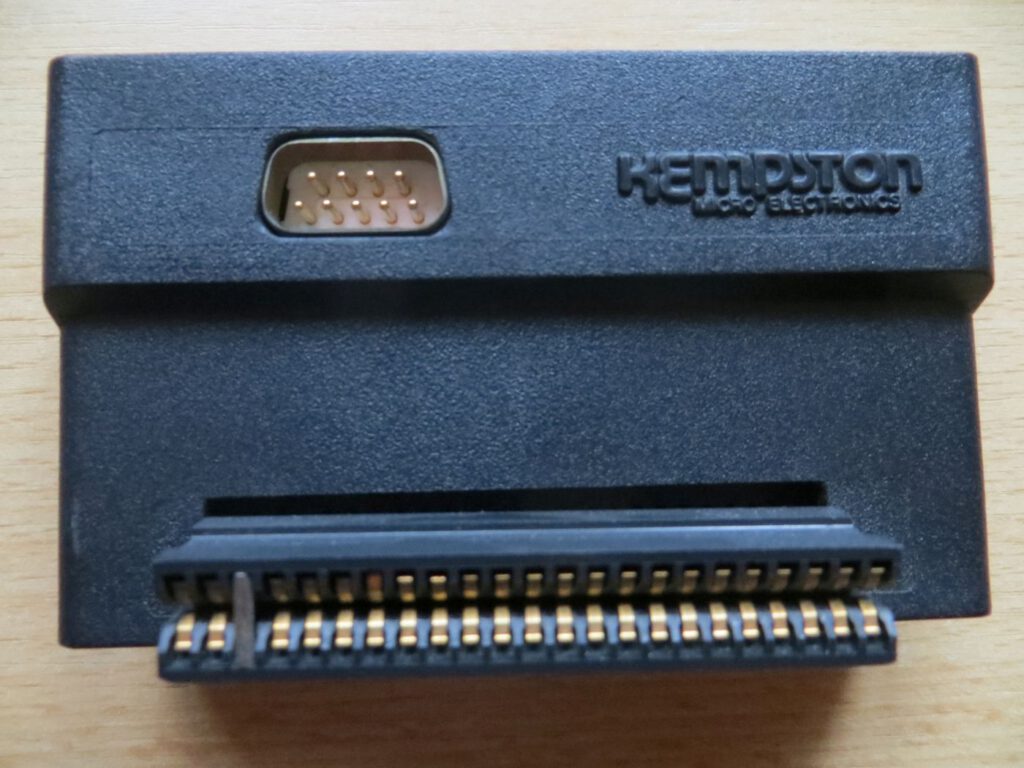
Option 2: The ‘horizontal’ design
This version sits flatter and often looks ‘neater’ on the computer because it rests on top of it. However, you may need a little more space behind the Spectrum, depending on how the computer is positioned.
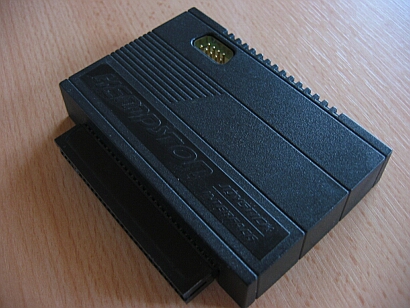
What both models have in common: no through-wired expansion port
Interesting (and important in practice): on both of my interfaces, the expansion port is not routed out as an additional socket. This means that, with these variants, the Kempston interface is usually the last device on the expansion port. Anyone wishing to operate several expansions simultaneously (e.g. printer interface, memory or disk expansion) will then need either a different solution or a separate expansion hub.
What makes the Kempston so special
There was never a single standard joystick for the Spectrum. Many joystick solutions work via keyboard mapping: the joystick internally ‘presses’ specific keys (cursor, number pad, etc.). The Kempston interface is different: it transmits the joystick status via its own hardware port. This makes the input for games and programmes very direct – and that is precisely why ‘Kempston’ became a standard over time.
In short: if a game offers ‘Kempston’ in the menu, there’s a very good chance it will be responsive and enjoyable to play.
How the query works (explained simply)
The joystick state is returned as a number. Neutral is 0. Each direction has a fixed value, and firing adds another value to this. Diagonal movements are created by adding the values together.
Typical values (Kempston standard)
- Right: 1
- Links: 2
- Down: 4
- Up: 8
- Fire: +16
- Centre: 0
- Diagonal: Sum of the directions (e.g. up + right = 8 + 1 = 9)
Mini test in BASIC
If you want to check the interface quickly, you can do so without even needing a special programme:
10 PRINT IN 31
20 GO TO 10
In neutral mode, the display should always show 0. If you press a directional button or the fire button, the values will change accordingly.
Practical tip: mechanical stress and correct attachment
The Spectrum’s expansion port is handy, but it’s not indestructible – especially after decades of use. That’s why there are a few things I bear in mind whenever I’m adding extensions to the Spectrum:
- Always apply it straight across; don’t let it tilt
- Do not press with force
- When peeling, make sure to keep the blade straight (do not tear sideways)
- Route the joystick cable so that it does not constantly pull on the interface
It is the design itself (‘upright’ vs. ‘horizontal’) that makes all the difference here: the flatter version often looks more relaxed on a shelf or on a table, whilst the taller version is sometimes more space-saving.
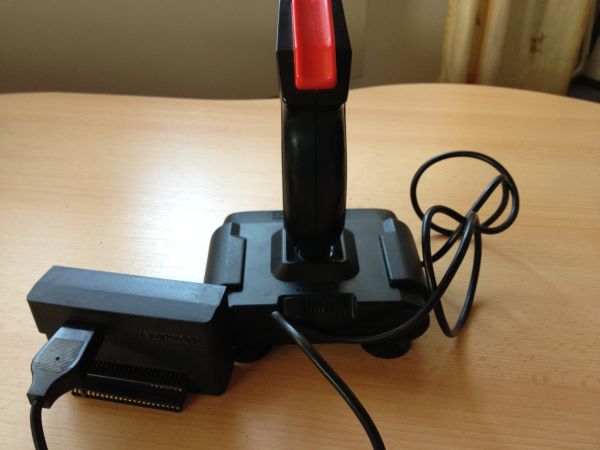
Why the Kempston is an essential accessory for me these days
I find it almost ironic: I used to play without a joystick at all. These days, for me, a Kempston interface is one of those accessories that instantly makes the Spectrum feel ‘complete’ – not because it’s technically spectacular, but because it changes the feel of the game so dramatically.
And with two different designs in the collection, it’s even better: it really brings home the point that there wasn’t just ‘the’ Kempston interface, but also variants that feel quite different in everyday use – even if, ultimately, they both deliver the same standard.
![The Legend of Traxtor [Sinclair ZX Spectrum]](https://www.jungsi.de/blog/wp-content/uploads/2015/01/The-Legend-Of-Traxtor-Ladescreen.jpg)
![Pietro Bros [Sinclair ZX Spectrum]](https://www.jungsi.de/blog/wp-content/uploads/Pietro-Bros-Ladebildschirm.jpg)
![Moritz The Striker [Sinclair ZX Spectrum]](https://www.jungsi.de/blog/wp-content/uploads/Moritz-The-Striker-Ladescreen.jpg)
Leave a Reply