

![Commodore Amiga 600 [Commodore]](https://www.jungsi.de/blog/wp-content/uploads/Amiga-600-Oberseite-schraeg.jpg)
The idea of developing a low-cost Amiga had been on the cards at Commodore since 1988. Work soon began on the A250 Game System, but this was shelved due to the excessive marketing and manufacturing costs of the cartridges. In 1989, the project was revived, this time with a keyboard, mouse and floppy disk drive. The plan was to reduce the memory to 256 KB, which would save costs – but this made little sense, as almost all games required 512 KB. Things got serious with the A300 (development name) when Jeff Porter set out the key specifications in 1991:
– Removal of the numeric keypad – Removal of the expansion port (Zorro interface) – Introduction of the PCMCIA slot – Smaller power supply – Smaller connectors – Smaller motherboard using SMT technology – ECS chipset, first used in the A3000 – 1 MB chip RAM – ATA hard disk controller
Die Umsetzung übernahm George Robbins, der ohnehin als „Vater“ der Low-End-Amigas galt – schon A500 und A500 Plus stammten aus seiner Feder. Robbins gab dem Projekt auch den passenden Codenamen: „June Bug“ – nach einem Song der B-52’s, in derselben Tradition wie zuvor „Rock Lobster“ (A500) und später „Channel Z“ (A1200).
To put this into context: in the summer of 1991, Mehdi Ali, then president of Commodore, had appointed former IBM manager Bill Sydnes as head of the development department. Sydnes scrapped the original design objectives for the A300, cancelled the A1000+ and A3000+ at the same time, and delayed the AGA chipset – decisions that were to come back to haunt the company.
As the project progressed, it became apparent that the new computer would not – as Dave Haynie had originally planned – be 50 to 60 US dollars cheaper than the A500, but would in fact be more expensive to produce. One of the main reasons for this was the new SMD technology. It seems that the developer was not particularly interested in the project either and did not make the most of the opportunities for cost reduction.
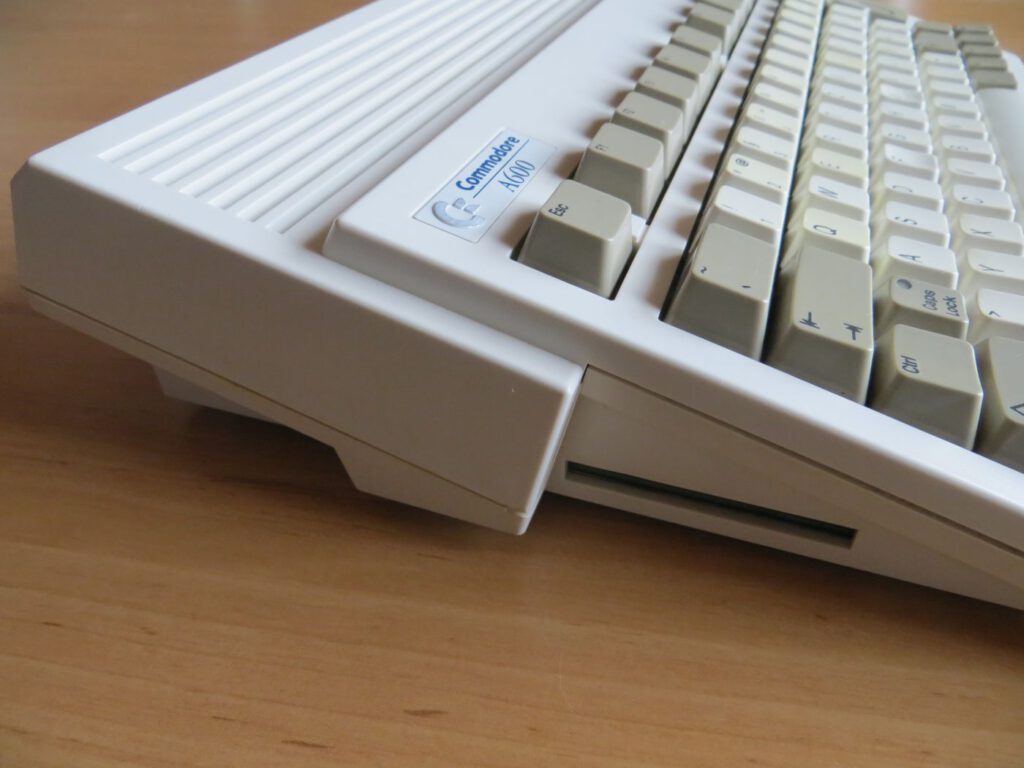
Commodore „löste“ das Problem mit den Kosten, indem aus dem A300 der A600 wurde, um bei den Käufern die Erwartung zu wecken, etwas Besseres als den A500 zu kaufen. Egal ob plötzlich kein Ziffernblock mehr vorhanden war oder die Erweiterungen des anderen Geräts nicht verwendet werden konnten – Verwirrung entstand auch bei den Kunden, die das Gerät öffneten und auf der Platine den Aufdruck „A300″ sowie den Codenamen „June Bug“ fanden.
At that time, GVP (Great Valley Products) was a thorn in the side of Commodore’s senior management, as it was making a lot of money from devices for the expansion bus, such as turbo cards. This would come to an end with the A600, as it lacks the relevant port…
Im März 1992 wurde das Gerät auf der CeBIT vorgestellt, im April 1992 startete die Massenproduktion des A600. Kurz darauf war das Gerät in den Läden und der A500 wurde „gestoppt“. Aber nicht überall: Laut Petro Tyschtschenko (in seinem Buch Meine Erinnerungen an Commodore und Amiga) sträubte sich Commodore Deutschland gegen die Einstellung des erfolgreichen A500 und ließ ihn in Braunschweig parallel weiterproduzieren. Die Engländer mussten den A600 und den A600HD (mit 20 oder 40 MB Festplatte) nehmen und verkaufen, da sie keine andere Wahl hatten. So sieht Einigkeit in einer Firma aus 😉
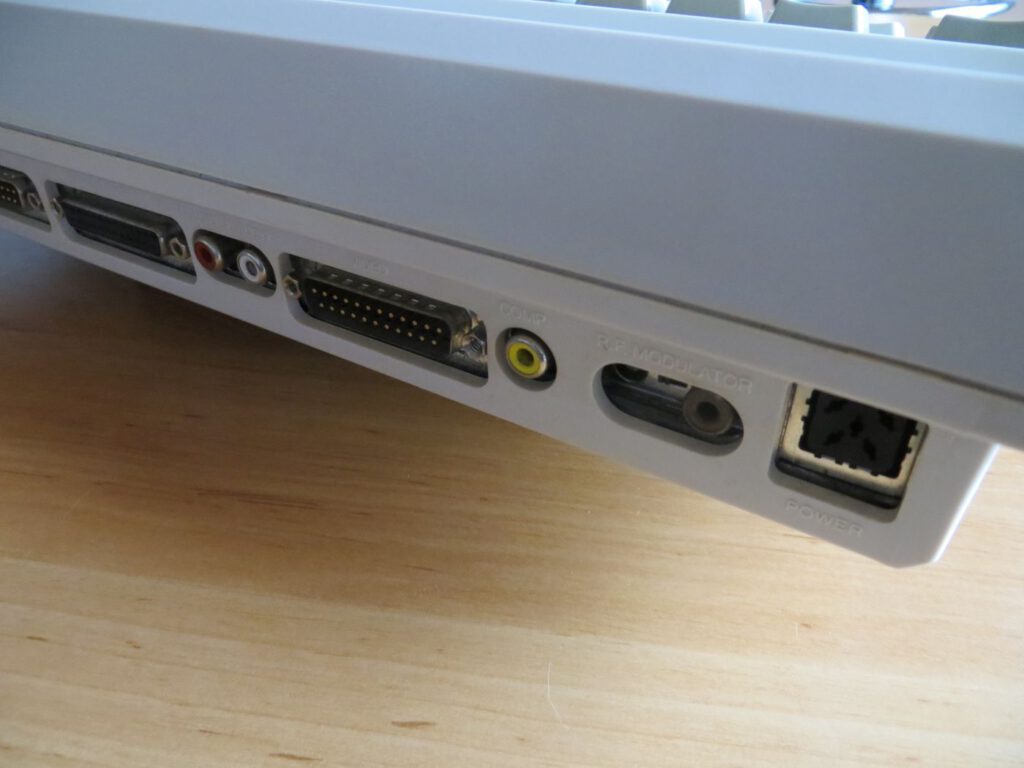
The reviews that followed were predictably critical: it wasn’t any faster, it wasn’t upgradeable, and the rest of the hardware offered no improvements in any key area – neither resolution, nor colours, nor sound. What’s more, the A600 was Commodore’s last home computer to feature a Motorola 68000 processor and an ECS chipset – just months later, the A1200, a 32-bit successor with AGA graphics, was released.
Another shortcoming only became apparent when the case was unscrewed: unlike the A500, almost all the circuit board components on the A600 are permanently soldered in place using SMD technology; only the Kickstart ROM is still socketed. As a result, many classic A500 expansion modules simply no longer fit.
Then there was the oddity with AmigaOS 2.0 and the Kickstart ROM 2.05: – Version 37.299: no support for ATA and PCMCIA ports (drivers could be loaded from a floppy disc) – Version 37.300: hardware support, but hard drives limited to 40 MB – Version 37.350: hard drives up to 4 GB
On top of that, some older, popular games did not work with Kickstart version 2.0 or later. This made the A600 unattractive to its main target audience – gamers. In Germany, only 193,000 units were sold, which was a ridiculously small number compared to the Amiga 500.
Anyone wishing to add extensions is limited to the few remaining interfaces: the trapdoor slot on the underside accommodates up to 1 MB of chip RAM (for a total of 2 MB of chip RAM), including an optional real-time clock, whilst the PCMCIA slot can hold up to 4 MB of Fast-RAM, a network card or, via an adapter, a CF card.
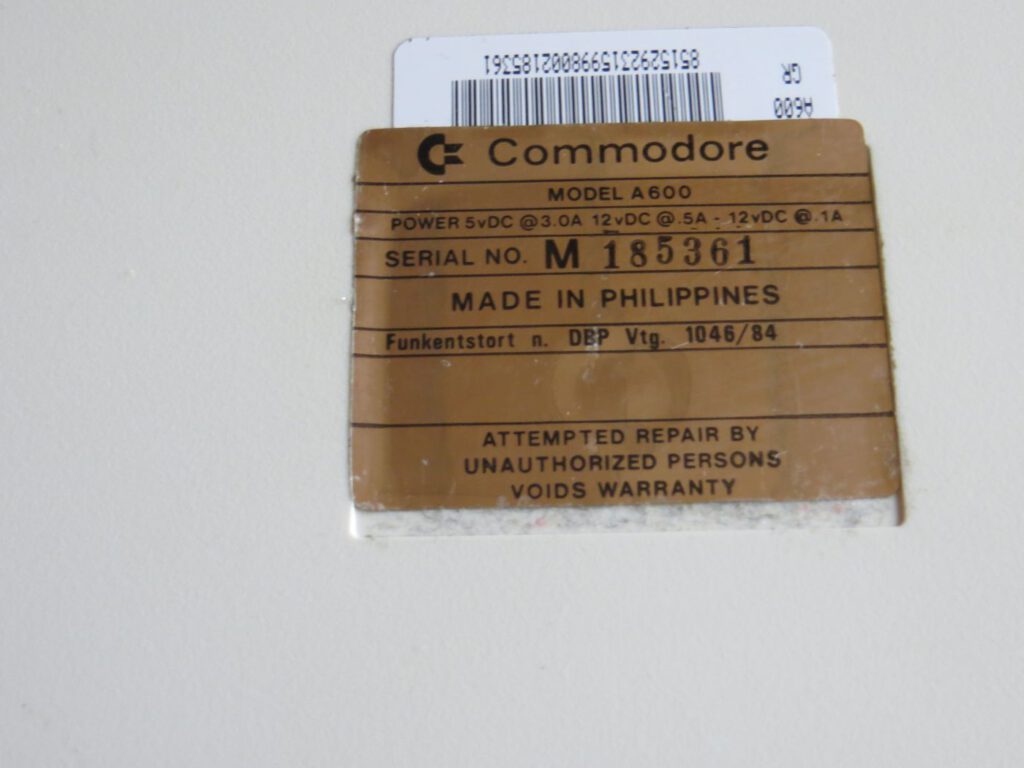
Type plate and serial number
My unit bears the serial number M 185361 and, according to the markings, was manufactured in the Philippines – one of four Commodore production sites for the A600 (alongside Irvine in Scotland, Braunschweig and Kwai Chung in Hong Kong). The marking ‘Funkentstört n. DBP Vfg. 1046/84’ refers to Decree 1046/1984 of the German Federal Post Office and indicates that the device was certified for the German market.
Anders als beim Amiga 1200, dessen Seriennummern-Schema von Petro Tyschtschenko dokumentiert wurde, existiert für den A600 keine öffentlich belastbare Aufschlüsselung – das vorangestellte „M“ ist vermutlich ein interner Werks- oder Chargencode, eine offizielle Bedeutung ist mir nicht bekannt.
A well-known weakness: SMD electrolytic capacitors
As with many Commodore devices (and those from other manufacturers), the same applies here: replace the capacitors and remove the batteries, as these are highly prone to leaking. With the A600, however, this is a particularly sensitive issue: Commodore used SMD electrolytic capacitors extensively for the first time here – a type of component that, as is well known, begins to fail in the A600, A1200, A4000 and CD32 are known to start leaking after a good two decades. The leaked electrolyte corrodes solder pads and circuit tracks, which can lead to picture distortion, sound dropouts, unstable operation or, in the worst case, an irreparable motherboard.
Unlike the A500, with its through-hole electrolytic capacitors which are more likely to dry out than to leak, you shouldn’t wait too long with an A600. The usual approach these days is to replace the SMD electrolytic capacitors with ceramic capacitors (Kerkos), which, by their very nature, cannot leak. I sent my machine to a professional who took care of this for me – this laid the groundwork for subsequently giving the A600 a few proper upgrades (GOTEK, Kickstart 3.1.4, eX601n, Indivision ECS V2, Furia EC020, AM-Sider).
My conclusion
I don’t actually think the Amiga 600 is that bad: it’s compact, has an IDE interface and, thanks to PCMCIA, offers the option of retrofitting Ethernet, for example, or using a CF card for data transfer via an adapter. There are also a number of manufacturers today who offer all sorts of upgrades: turbo cards, memory upgrades, VGA ports, etc.
![Upgrades für [Amiga 600]](https://www.jungsi.de/blog/wp-content/uploads/Amiga-600-Umbau.png)
![Krogharr [Commodore Amiga]](https://www.jungsi.de/blog/wp-content/uploads/Krogharr-The-Beerserker-Startscreen-480x300.webp)
![ASM – Das Computerspiel [Commodore Amiga]](https://www.jungsi.de/blog/wp-content/uploads/ASM-Das-Computerspiel-Vorderseite-1.jpg)
Leave a Reply