

![Commodore Amiga 1200 [Commodore]](https://www.jungsi.de/blog/wp-content/uploads/Amiga-1200-mit-Schachtel.jpg)
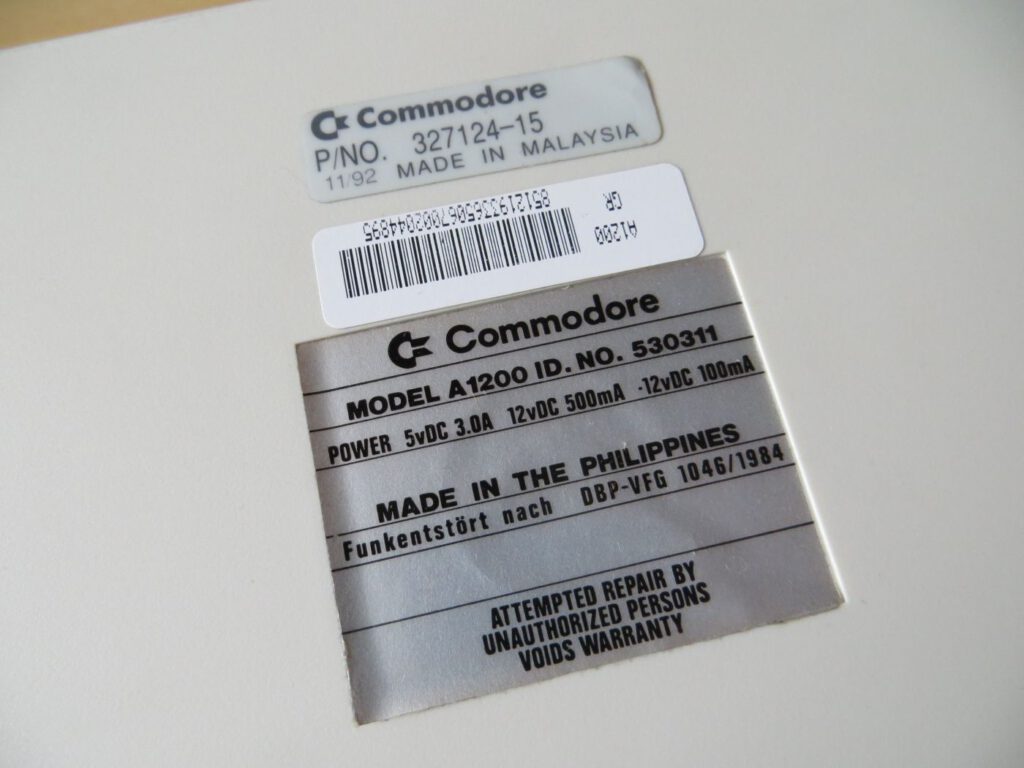
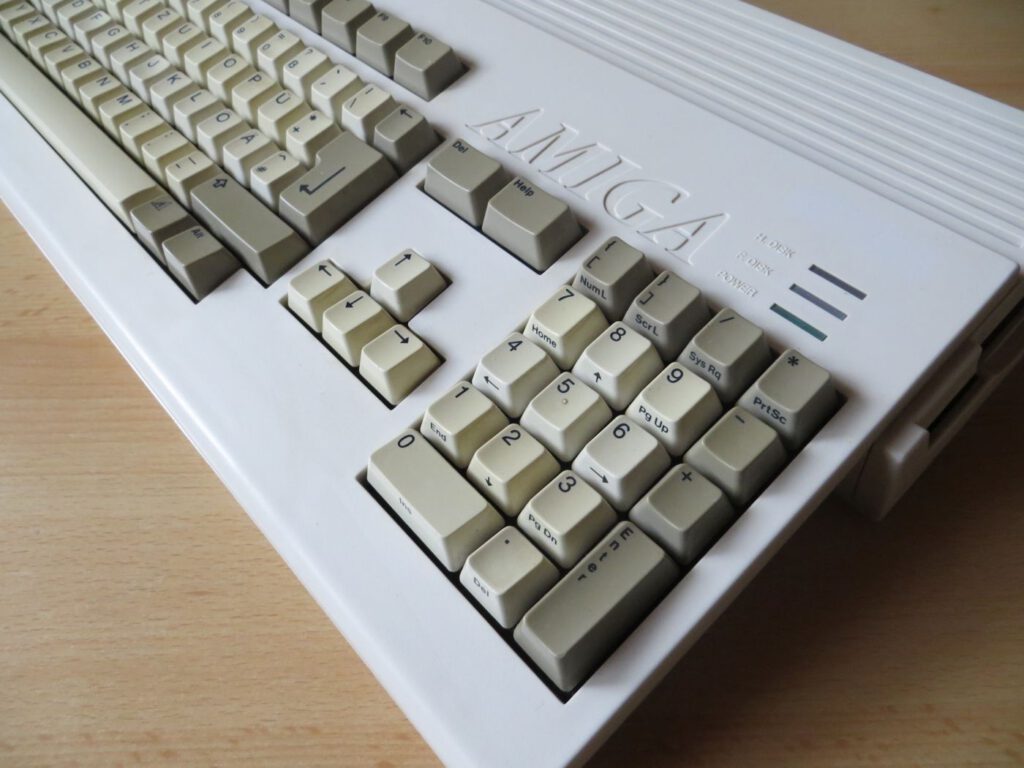
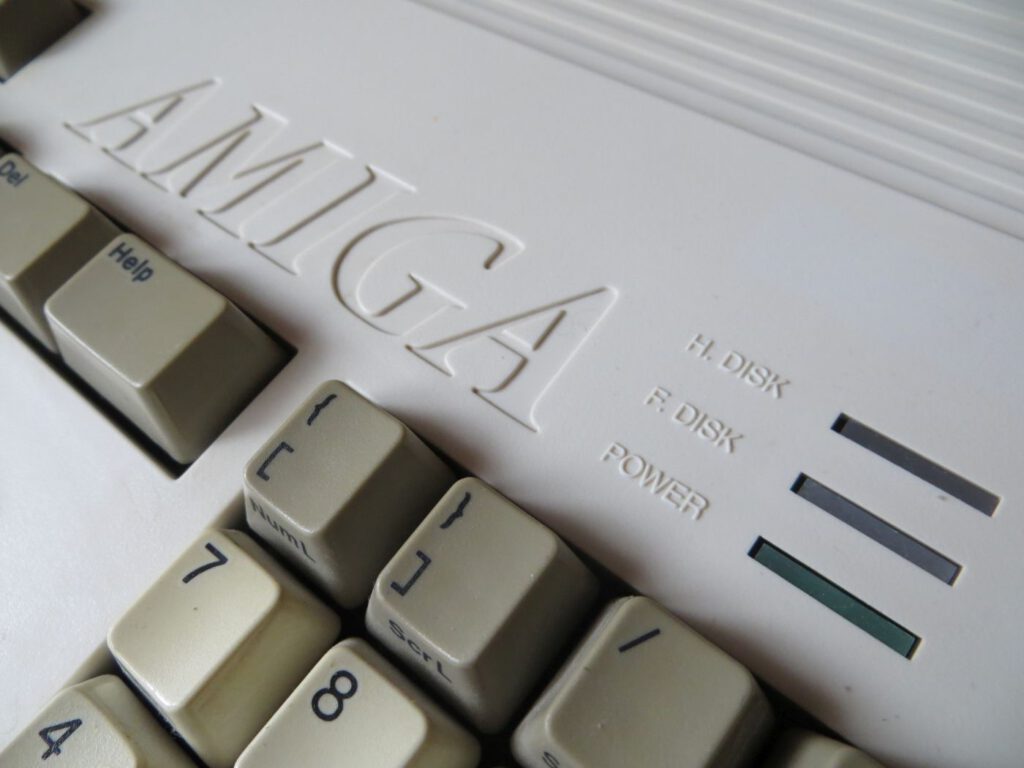
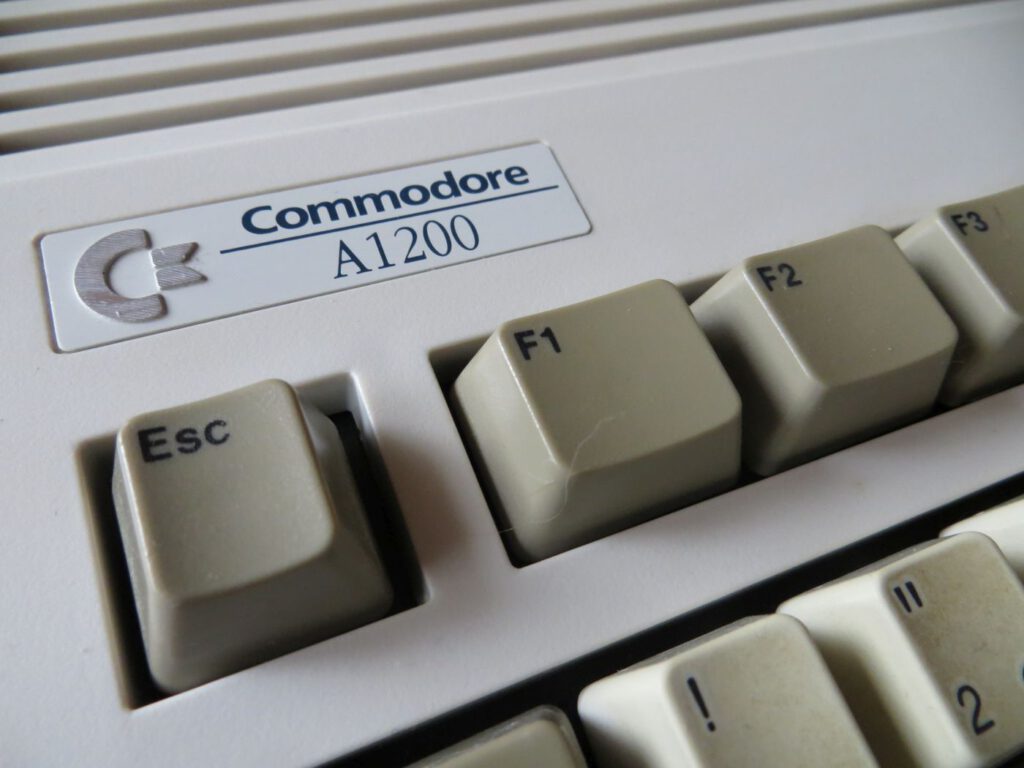
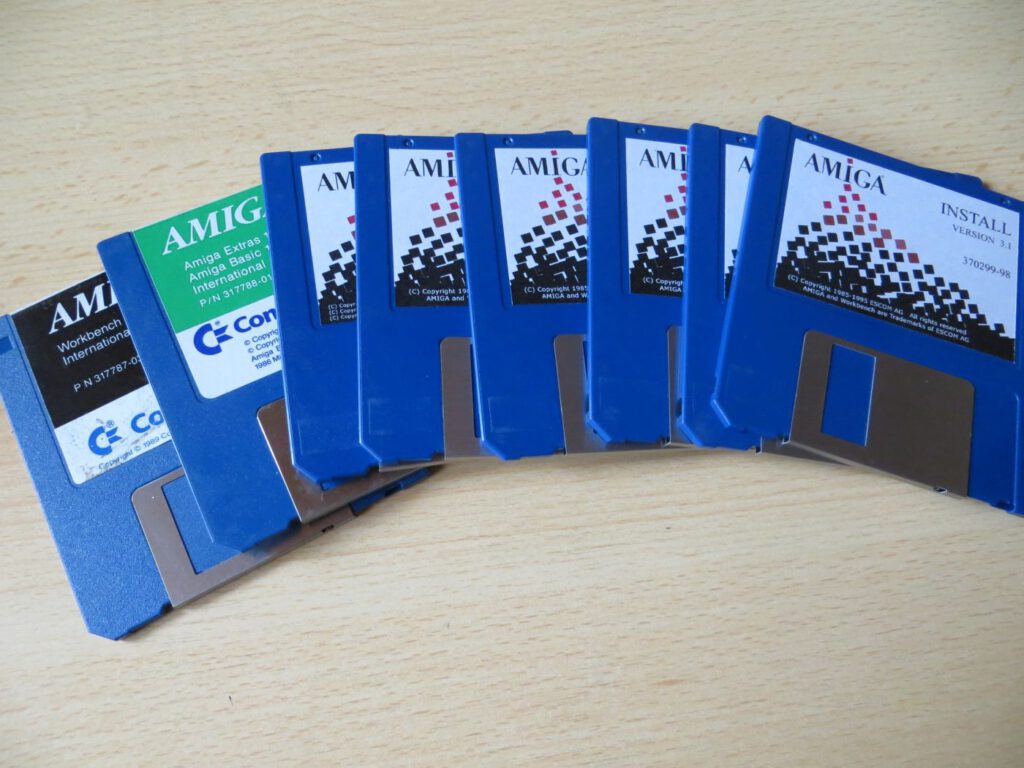
This computer had been on my wish list for quite some time, as it marked the end of the Commodore era while simultaneously representing the crowning achievement of the home computer age. I acquired it in 2018—ironically enough, at a Sinclair gathering. A glance at the nameplate reveals the details: manufactured in May 1993 in the Philippines, during week 21. The accompanying mouse is actually slightly older—November 1992, manufactured in Malaysia—making it a product of the very first production run. It was shipped without a hard drive, but included a mouse, power supply, a set of floppy disks, and the original packaging.
History
It was the spring of 1992 when the Amiga 600—the successor to the Amiga 500 and Amiga 500 Plus—turned out to be a flop. Design flaws were to blame: no numeric keypad, an unergonomic keyboard, and a lack of ports. Furthermore, it offered barely better performance specifications than the A500 Plus, as both were equipped with the ECS chipset. The A600 was released in April 1992—and was a troubled product from the very start.
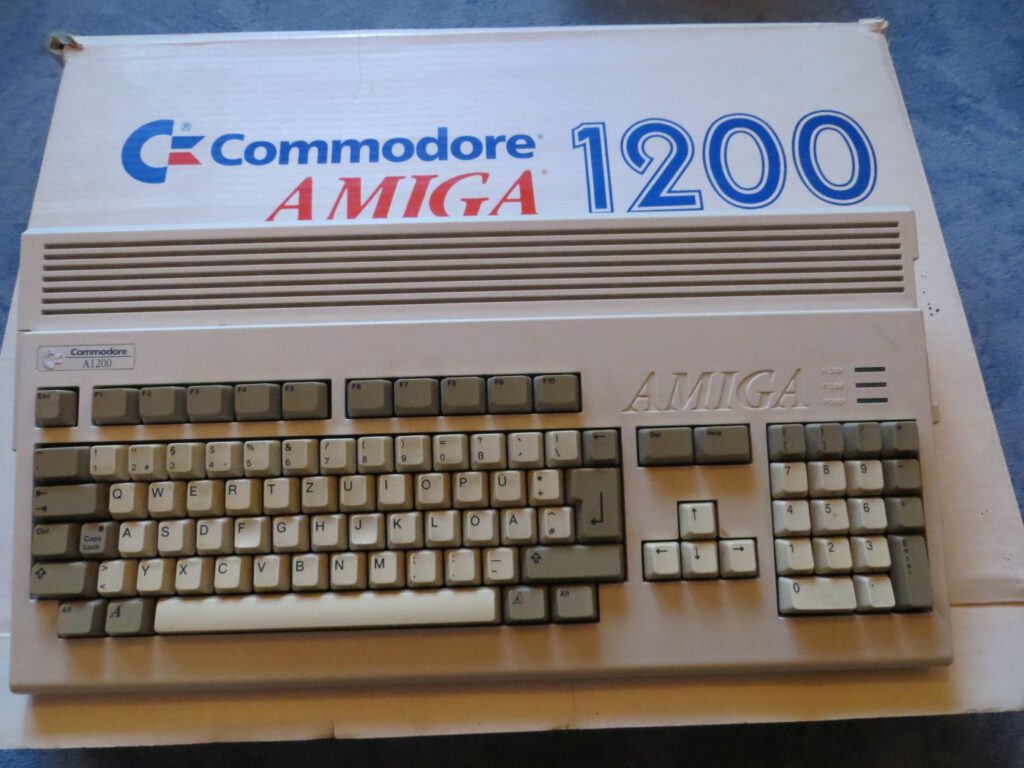
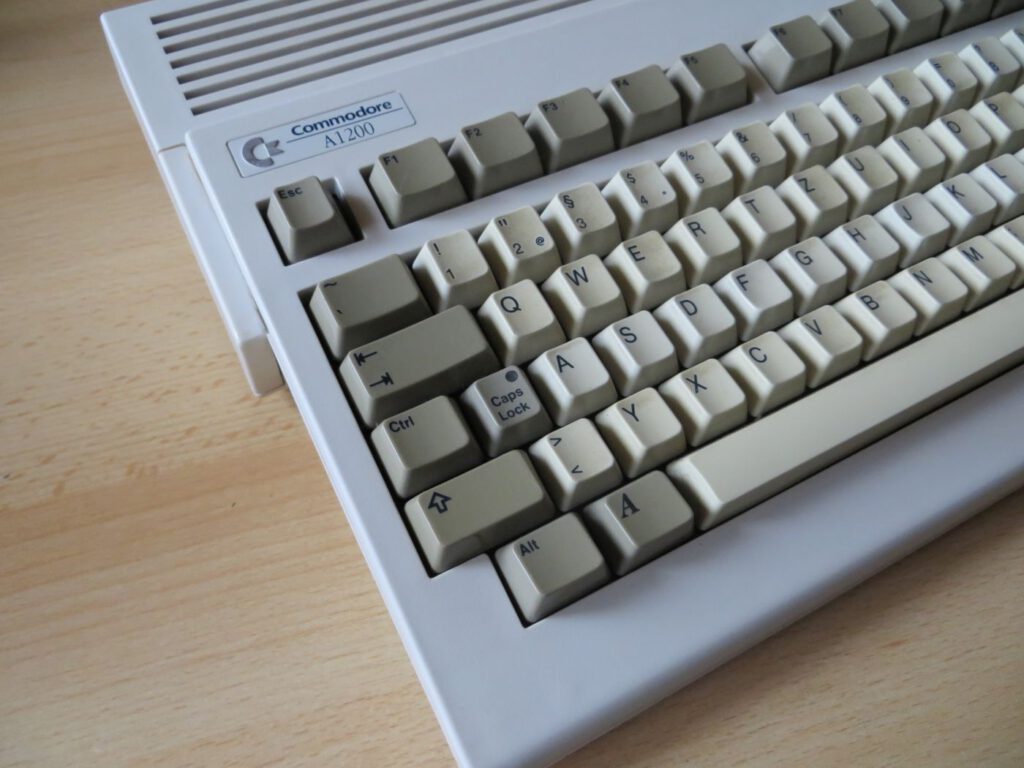
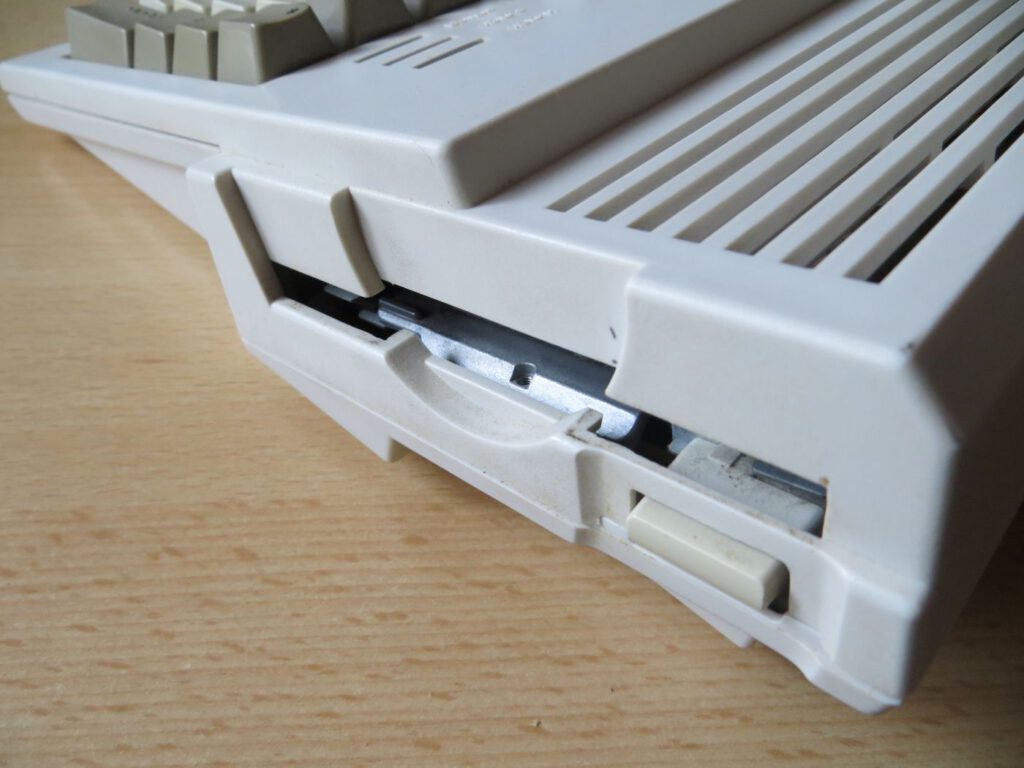
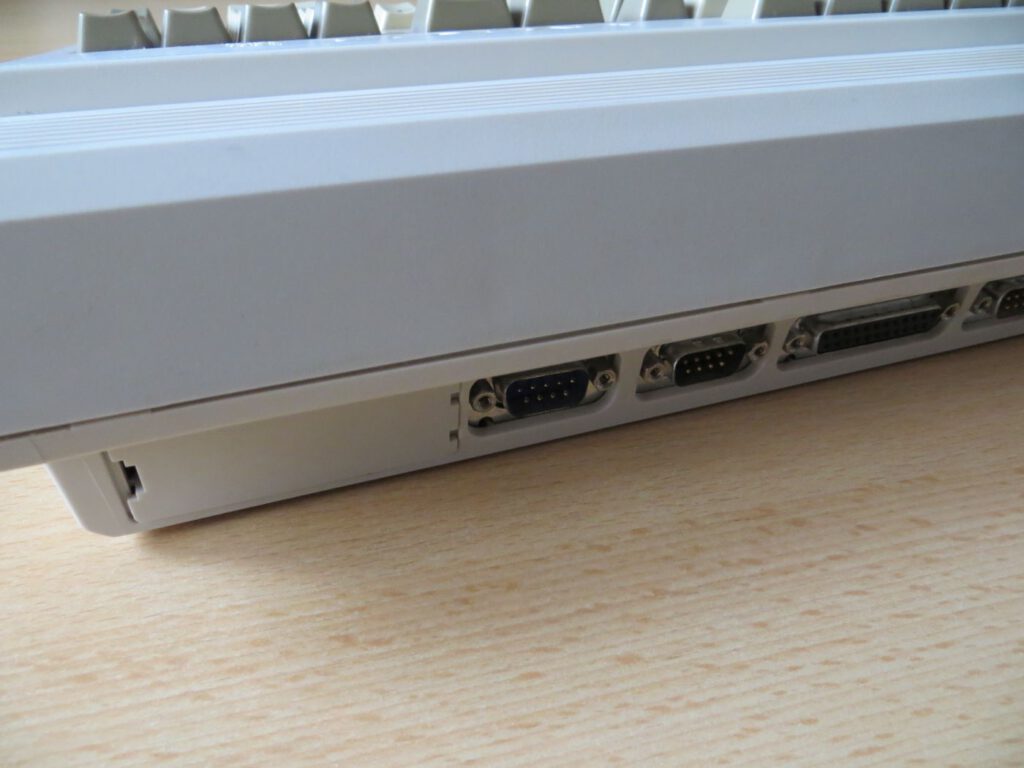
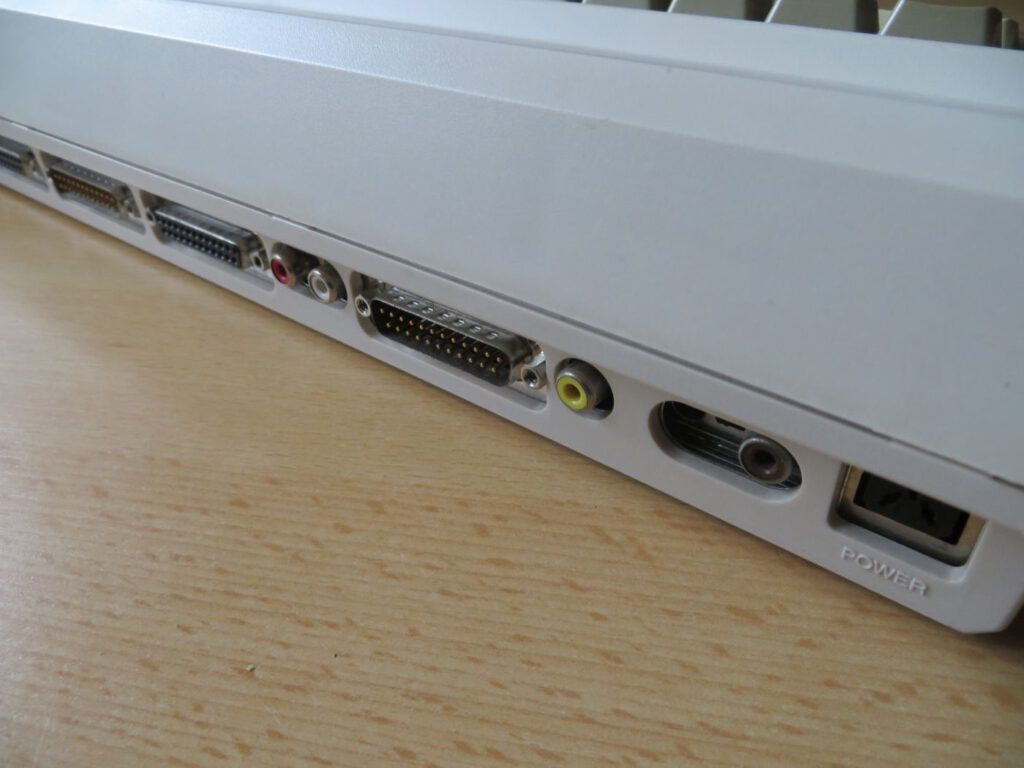
The answer arrived that very same year. In October 1992, Commodore introduced the Amiga 1200 in the UK; Continental Europe followed in November and December 1992. Simultaneously, the Amiga 4000—the new flagship for the professional market—was released. Both machines shared the same AGA chipset—the core of this relaunch. On the A1200, the case design—complete with a 3.5″ floppy disk drive—was inspired by the A500. Added to this were an external PCMCIA interface and an AT-IDE header for connecting an internal 2.5″ hard drive.
Der AGA-Chipsatz – intern von Anfang an als „AA“ (Advanced Architecture) bezeichnet – war keine Schnellentwicklung. Die Arbeit daran hatte bereits 1991 begonnen. Intern trug der A1200 zeitweise den Arbeitsnamen Channel Z.
Unfortunately, Commodore lacked sufficient liquid assets to fulfill the pre-orders (200,000 units). Consequently, only 100,000 AGA chipsets could be ordered from HP. The long delivery times frustrated customers, and the A600—produced in large quantities—became a shelf-warmer.
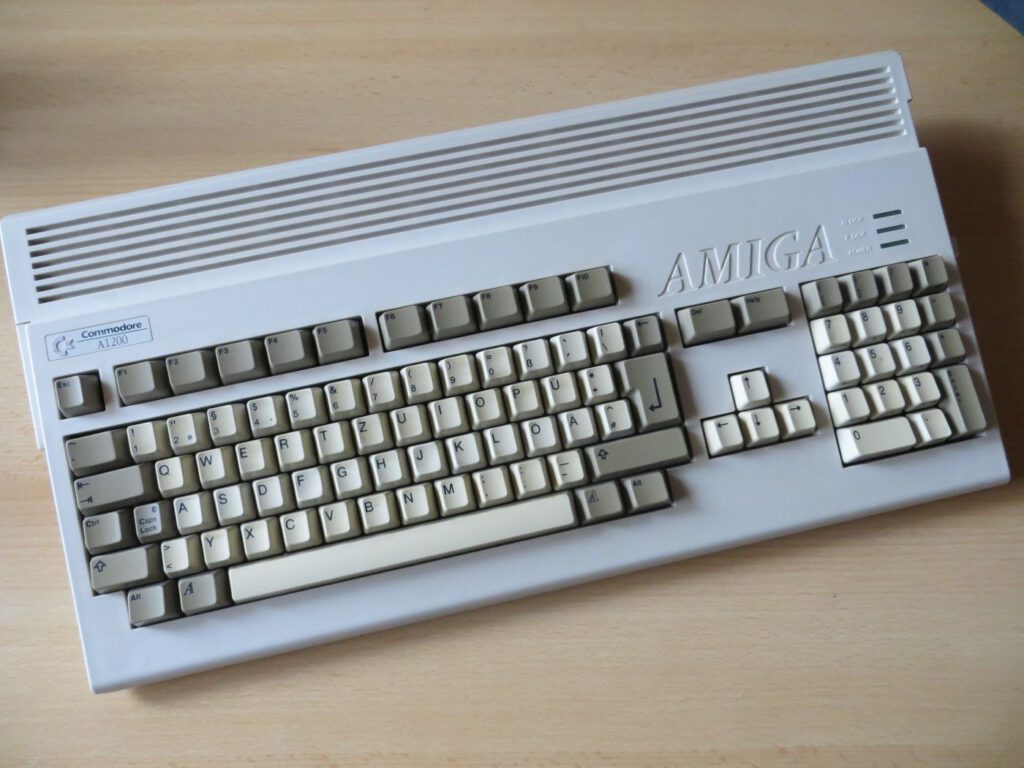
In the summer of 1993, the A1200 succeeded in surpassing the sales figures of the A500, and in Europe, Commodore ranked second in market share—behind only MS-DOS-compatible computers. An estimated 500,000 to 600,000 units were manufactured under the Commodore label—a remarkable feat, considering the pressure the company was under.
Based on the same AGA chipset architecture, the CD32 game console was released in September 1993. However, the A1200 remained the last home computer that Commodore ever brought to market. On April 29, 1994, Commodore International filed for bankruptcy.
When was my A1200 built?
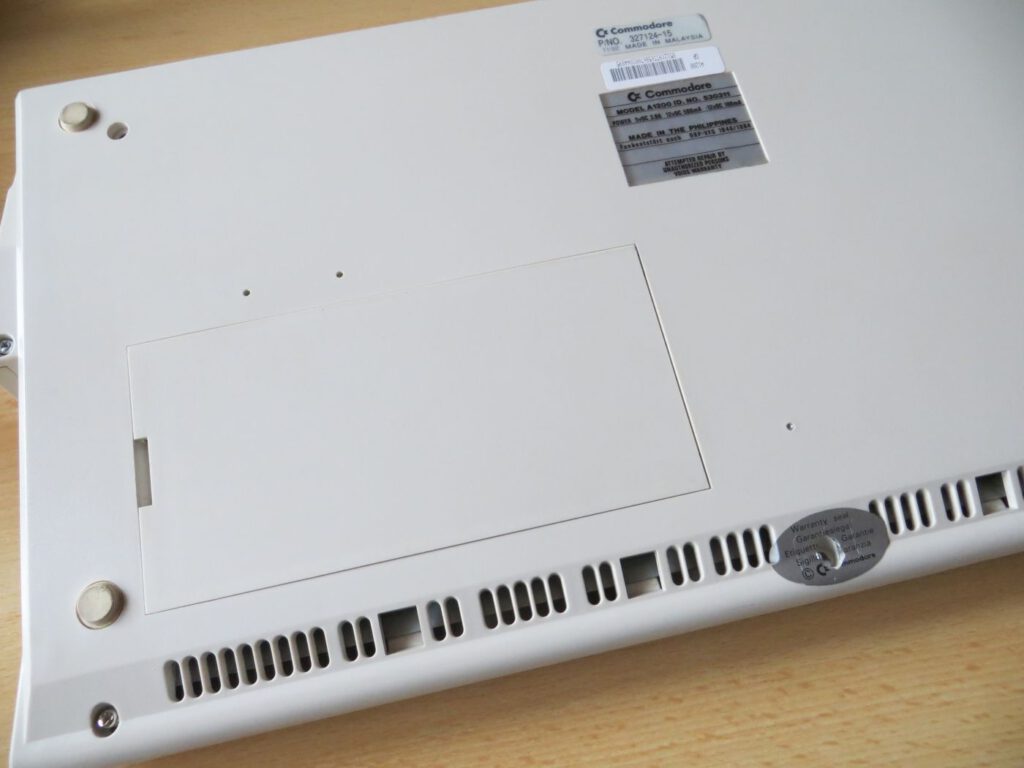
This can be determined by taking a look at the underside of the device. Located there, next to the nameplate, is a barcode label featuring a 22-digit sequence of numbers. The structure is as follows:
AAA · BB · CC · DDDDDD · EE · FF · GGGGG
- AAA – Production Site:
851= Philippines,401= United Kingdom,012= China - BB – Production Week
- CC – Year of Production
- DDDDDD – product number
- GGGGG – actual device number
My unit bears the serial number 8512193365067002044895—indicating the Philippines as the manufacturing site, week 21, and the year 1993. It was produced in late May 1993. Incidentally, the separately affixed Malaysia label (11/92) does not pertain to the computer itself, but rather to the accompanying Commodore mouse (part number 327124-15)—a fine testament to the fact that Commodore integrated components from various manufacturing sites.
Technical data
The main processor used was the Motorola 68EC020 – running at 14.18 MHz in PAL mode (14.32 MHz for NTSC), derived from the system clock of 28.375 MHz. It had 2 MB of chip RAM, expandable via the trapdoor slot. AmigaOS 3.0 was included as the operating system, based on Kickstart 3.0 in ROM. Later devices – especially those from the E
On its underside, the Amiga 1200 features an internal 150-pin processor slot for accelerator cards and other low-level hardware expansions. A unique feature is the so-called Clockportlocated on the motherboard. Originally intended for a real-time clock (hence the name), it allows for the connection of a wide variety of specialized hardware—such as a Catweasel floppy controller or a high-speed serial interface. The built-in PCMCIA Type II slot enabled the use of network cards, memory cards, and other expansions that did not require opening the case. Practical—and, for its time, a rarity.
AGA chipset
Die Abkürzung steht für Advanced Graphics Architecture. In Deutschland wurde dies auch als „AA-Chipsatz“ bezeichnet. Der Chipsatz besteht aus drei aufeinander abgestimmten Koprozessoren:
- Alice – Graphics Controller and DMA Controller (Successor: Agnus/Fat Agnus)
- Lisa – Video Chip and Graphics Output (Successor: Denise)
- Paula – Sound and I/O (unchanged from its predecessor)
What truly distinguished AGA from the ECS chipset of the A500/A600 were its color display capabilities. Instead of 64 colors drawn from a 4,096-color palette, AGA now offered 256 simultaneous colors from a 24-bit palette comprising 16.7 million colors. In HAM-8 mode (Hold-And-Modify), it was even possible to display up to 262,144 colors simultaneously. Sprite width was quadrupled, increasing from 16 to 64 pixels. For game graphics and digital images, this represented a true quantum leap—even if software developers took some time to fully exploit these capabilities.
Model Variants
Commodore Models
- Commodore Amiga 1200 – Grundversion ohne Festplatte
- Commodore Amiga 1200HD – inkl. 2,5″-Festplatte mit 20 oder 40 MB
Escom models (Amiga Technologies)
Following Commodore's bankruptcy in April 1994 and the acquisition of the Amiga assets by Escom in April 1995 for approximately 10 million US dollars, the Amiga 1200 was once again manufactured under the new label Amiga Technologies GmbH (headquartered in Bensheim, Hesse).
The models retained their original designations. Technically, there were few differences, as the computer's documentation was either missing or incomplete. The Paula sound chip had to be milled open to determine its internal workings. The casing of the Escom A1200 was made of a different type of plastic, the logo was updated, and a different floppy disk drive had to be sourced, as the original model was no longer in production. The choice fell on an outdated DD drive from Mitsumi. Unfortunately, some software programs accessed the drive's hardware directly and did not receive the expected response, which led to system crashes. Once this issue came to light, Amiga Technologies provided a free circuit modification that resolved the problem. The internal hard drive now had a capacity of 170 MB.
Escom itself also filed for bankruptcy as early as 1996—the end of a brief interlude.
Petro Tyschtschenko – The Man Who Saved the Amiga Twice
Behind the Escom takeover stands a figure who is an indispensable part of Amiga history: Petro Taras Ostap Tyschtschenko, born in Vienna in 1943. He joined Commodore Germany on October 1, 1982, as Head of Materials Management, established the European central warehouse in Rotterdam, and eventually became Director of Logistics for Europe. He was not an engineer—he was the man who ensured that the devices actually reached the dealers in the first place.
Following the bankruptcy in 1994, Tyschtschenko became the liquidator. He traveled the world, closed down branches—and, at the same time, sought out investors. He found Escom, convinced them of the Amiga’s potential, and became the Managing Director of the newly founded Amiga Technologies GmbH. When Escom, too, went bankrupt in July 1996, he repeated the feat: He secured Gateway 2000 as the next investor (with $14 million USD) and continued operations under the new name Amiga International, Inc. in Langen until 2001.
At Amiga Technologies, he also championed the Walker as the successor to the A1200—featuring a 68030 processor and a CD-ROM drive. The Walker was unveiled at CeBIT 1996 but never went into mass production. Today, only two prototypes exist, one of which is in Tyschtschenko's private possession.
The India Story: New Old Amigas
Perhaps the most curious chapter in the history of the A1200 unfolded decades after production had ceased. An Indian business associate of Tyschtschenko reached out to him, asking whether he would still be interested in a stockpile of factory-sealed Amiga 1200 Magic Packs—forgotten in a warehouse in India, left untouched for some 17 to 20 years.
In 2012, Tyschtschenko imported an initial batch—reportedly fewer than 100 units—and sold them directly to the community via Facebook as a non-profit initiative for 150 euros apiece. In this first round, only three devices were defective. A second batch followed in 2013, this time priced at 200 euros, shipping included. In 2014, there were a few additional individual sales. The total quantity across all rounds likely remained well under 200 units—making these examples highly sought-after collector's items.
How do you recognize these devices?
The units from India are, without exception, Escom/Amiga Technologies Magic Packs—not original Commodore units. The identifying features:
- Serial Number: Escom devices were manufactured in France and bear the country codes 260, 364, 464, or 564—instead of 851 (Philippines) or 401 (Great Britain), as found on the original Commodore units.
- Kickstart 3.1 instead of 3.0 (the Commodore version)
- Amiga Technologies-Logo in the Boing Ball design, replacing the Commodore wordmark.
- Mitsumi floppy disk drive instead of the original drive
- Due to decades of storage under tropical conditions, the packaging and inserts often show traces of moisture.
Sales Figures
By the end of 1993, 95,500 units of the A1200 had been sold on the German market under the Commodore brand. By December 1995, Escom had sold a further 20,000 to 40,000 units in Western Europe—figures that fell far short of their own projections. To this day, the exact worldwide total has not been officially documented. Estimates suggest a total of several hundred thousand units, with the United Kingdom serving as the strongest single market.
Current Collector's Value
The A1200 is firmly established in the retro market. For well-preserved, complete units—including original accessories and packaging—prices currently range between 300 and 600 euros, depending on the condition and completeness of the package.
Conclusion
For collectors, the A1200 represents an important piece of computing history: the final home computer from Commodore—technically well ahead of its time, yet brought to market by a company in free fall. Gamers do not necessarily need to own the device, as the A500, with its vast software library, offers greater compatibility. Games that truly push the AGA chipset to its limits do exist—though there are not many of them.
What remains is a computer that was better than its fate.
Games optimized for the A1200: https://en.wikipedia.org/wiki/Category:Amiga_1200_games
Top 10 Amiga 1200 Games: https://www.retrogamer.net/top_10/amiga-1200/
![Reshoot Proxima 3 [Commodore Amiga]](https://www.jungsi.de/blog/wp-content/uploads/Reshoot-Proxima-3-Ladescreen.png)
![Inviyya [Commodore Amiga]](https://www.jungsi.de/blog/wp-content/uploads/Inviyya.jpg)
![RTC-Modul ACA1232 [Commodore Amiga]](https://www.jungsi.de/blog/wp-content/uploads/RTC-Modul-Oberseite.jpg)
Der kommt mir irgendwie bekannt vir 😉
Da könntest Du Recht haben…. 🙂